Embedded Systems - EC25C17 - Notes PDF Download
[ 3rd Semester - Mechanical Engineering Department ]
Under Class: | 3rd Semester [Mechanical Dept Anna University 2025 Regulation] |
Engineering - Embedded Systems - EC25C17 Subject (under Anna University 3rd Semester - Mechanical Engineering Department Regulation 2025) - Study Materials, Written and lecture Notes, Important Questions, Semester Question Paper PDF Download
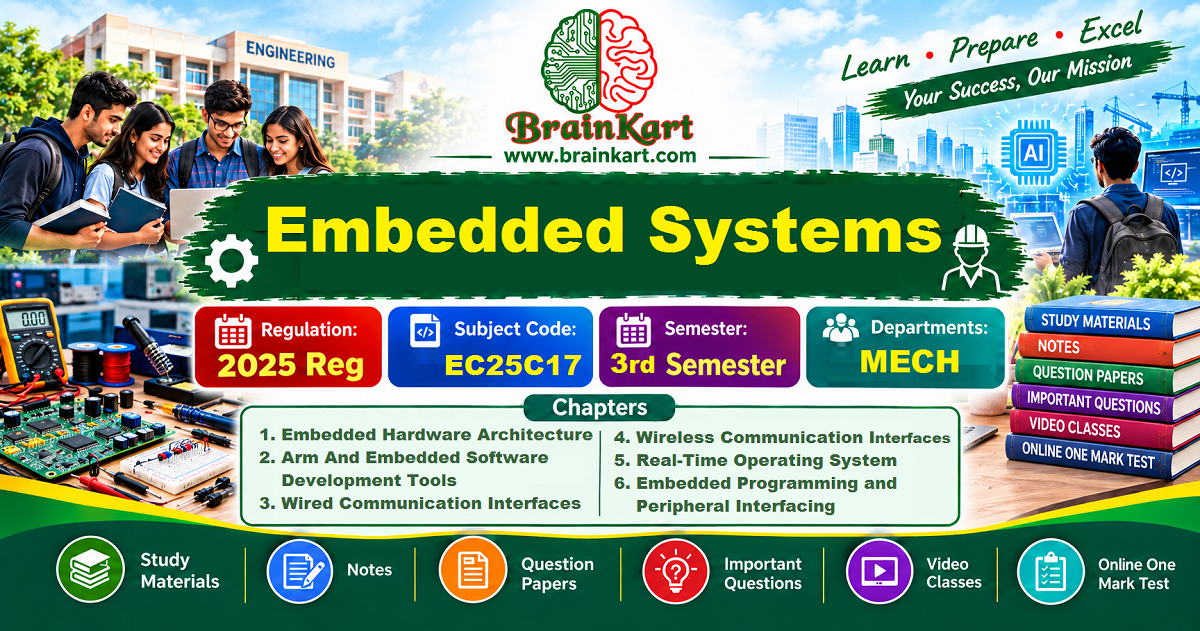
Embedded Systems
1. What is an embedded system:
• What is an embedded system?
• Inside the embedded system
2. Embedded processors:
• Embedded processors
• 8 bit accumulator processors
• Example 8 bit architectures: Z80, Z80 programming model, MC6800
• Microcontrollers: MC68HC05, MC68HC11 - Architecture
• Data processors: Complex instructions, microcode and nanocode
• INTEL 80286
• INTEL 80386DX
• INTEL 80486
• Intel Pentium
• Motorola MC68000 and its hardware
• Motorola MC68020
• Motorola MC68030
• The MC68040
• Integrated processors
• RISC processors
• The Berkeley RISC model
• Sun SPARC RISC processor
• The Stanford RISC model
• The MPC603 block diagram
• The ARM RISC architecture
• Digital signal processors
• DSP basic architecture
• Choosing a processor
3. Memory systems:
• Memory systems and Memory technologies
4. Basic peripherals:
• Parallel ports
• Timer/counters
• 8253 timer modes
• MC68230 modes
• Timer processors
• Real-time clocks
• Serial ports
• Serial peripheral interface
• I2C bus
• What is an RS232 serial port?
• Asynchronous flow control
• UART implementations
• DMA controllers
• A generic DMA controller
• DMA controller models
• Channels and control blocks
• Sharing bus bandwidth
• DMA implementations
5. Interfacing to the analogue world:
• Analogue to digital conversion techniques
• Sample rates and size: Irregular sampling errors, Nyquist�s theorem
• Codecs: Linear, A-law and Inf-law, DPCM and ADPCM
• Power control in Interfacing to the analogue
6. Interrupts and exceptions:
• What is an interrupt?
• Interrupt sources
• Recognising an interrupt
• The interrupt mechanism
• MC68000 interrupts
• RISC exceptions
• Fast interrupts
• Interrupt controllers
• Instruction restart and continuation
• Interrupt latency
• Do�s and Don�ts - Interrupts and exceptions
7. Real:
• What are operating systems?
• Operating system internals
• Multitasking operating systems
• What is a real-time operating system?
• Task swapping methods
• Scheduler algorithms
• Priority inversion
• Tasks, threads and processes
• Exceptions
• Memory model
• Memory management address translation
• Choosing an operating system
• Commercial operating systems
• Windows NT characteristics
• Resource protection
• Linux
• Disk partitioning
• The Linux disk partitioning
• Linux software structure, Physical and Memory management
• Linux limitations
• eLinux
8. Writing software for embedded systems:
• Writing software for embedded systems
• The compilation process
• Native versus cross-compilers
• Run-time libraries
• Writing a library
• Using alternative libraries
• Using a standard library
• Porting kernels
• C extensions for embedded systems
• Downloading- Writing software for embedded systems
9. Emulation and debugging techniques:
• Debugging techniques
• High level language simulation
• Low level simulation
• Onboard debugger
• Task level debugging
• Symbolic debug
• Emulation
• Optimisation problems in Emulation techniques
• Xray - Emulation technique
• The role of the development system: Floating point and memory management functions
• Emulation techniques: BDM, OnCE, JTAG
10. Buffering and other data structures:
• What is a buffer?
• Linear buffers
• Directional buffers
• Double buffering
• Buffer exchange
• Linked lists - Buffering
• FIFOs and Circular buffers
• Buffer underrun and overrun
• Allocating buffer memory
• Memory leakage in Buffering
11. Memory and performance trade:
• The effect of memory wait states
• Single cycle processor with large external memory
• Reducing the cost of memory access
12. Software examples:
• Benchmark example - Embedded Systems
• Creating software state machines
13 Design examples:
• Burglar alarm system
• Burglar alarm system
14. Real time without a RTOS:
• Choosing the software environment
• Deriving real-time performance from a non-real-time system
• Scheduling the data sampling
• Sampling the data- Real-time without a RTOS
• Controlling from an external switch
• Problems- Real-time without a RTOS
• Program listing- Real-time without a RTOS
EMBEDDED SYSTEM APPLICATION DEVELOPMENT:
• Embedded System : An Introduction
• Elements of Embedded Systems
• Core of The Embedded System
• Characteristics & Quality Attributes of Embedded Systems
• Program for Embedded Systems and Build Process
• Debugging on Embedded Systems
• Embedded Hardware from Software Programmers Perspective
• Embedded Systems: Memory
• Embedded Systems: Memory Testing
• Embedded Systems: Peripherals
• Embedded Operating System
• Embedded Systems: Integrated Development Environment
• Embedded Development Life Cycle
• EDLC Models
• Trends in Embedded Systems
• Case Study of an Embedded System for Smart Card
EMBEDDED SYSTEMS and REAL TIME OPERATING SYSTEMS:
• Introduction to Embedded Systems
• Devices and Buses for Devices Network
• Bus communication Protocols: 12C, USB, CAN, PCI
• Embedded Programming Concepts
• Concepts and Embedded Programming in C, C++
• Real Time Operating Systems
• Real Time Operating System Programming
EMBEDDED COMPUTING:
• Embedded Computing - Introduction
• Challenges in Embedded Computing System Design
• The Embedded System Design Process
• 8051 Microcontroller
• ARM processor
• Important Short Questions and Answers: Embedded Computing
MEMORY AND INPUT OUTPUT MANAGEMENT:
• Programming Input and Output in Embedded Systems
• Memory System Mechanisms
• Memory Devices in Embedded Systems
• I/O Devices
• Component Interfacing: Memory and Device Interfacing
• Interrupts in Embedded Systems
• Important Short Questions and Answers: Embedded Systems - Memory and Input/Output Management
PROCESSES AND OPERATING SYSTEMS:
• Multiple Tasks and Multiple Processes
• Context Switching
• Scheduling Policies
• Interprocess Communication Mechanisms
• Evaluating Operating System Performance
• Telephone Answering Machine
• Important Short Questions and Answers: Processes and Operating Systems
EMBEDDED SOFTWARE:
• Programming Embedded Systems in Assembly And C
• Embedded Software Development Tools
• Embedded System Development Tools
• Important Short Questions and Answers: Embedded Software
EMBEDDED SYSTEM DEVELOPMENT:
• Embedded System Development
• Intruder Alarm System
• Important Short Questions and Answers: Embedded System Development
Embedded and Real Time Systems
INTRODUCTION TO EMBEDDED COMPUTING AND ARM PROCESSORS:
• Complex Systems and Microprocessors
• Design Example: Model Train Controller
• Embedded System Design Process
• Formalisms for System Design
• Instruction Sets Prelimineris
• ARM Procssor
• CPU: Programming input and output
• Supervisor Mode, Exceptions, and Traps
• Co-Processors
• Memory System Mechanisms
• CPU Performance
• CPU Power Consumption
• Important Questions and Answers: Embedded Computing
• CPU Buses
EMBEDDED COMPUTING PLATFORM DESIGN:
• Memory Devices
• I/O Devices
• Component Interfacing
• Design With Microprocessors
• Development and Debugging
• Program Design
• Models of Programs
• Assembly and Linking
• Basic Compilation Techniques
• Analysis and Optimization of Excution Time, Power, Nrgy , Program Size
• Program Validation and Testing
• Important questions and answers: Computing Platform and Design Analysis
PROCESSES AND OPERATING SYSTEMS:
• Multiple Tasks and Multiple Processes
• Processes and Context Switching
• Operating Systems
• Schduling Policies
• Multiprocessor
• Interprocess Communication Mechanisms
• Evaluating Operating System Performance
• Power Optimization Strategies for Processes
• Important Questions and Answers: Process and Operating Systems
SYSTEM DESIGN TECHNIQUES AND NETWORKS:
• CPU Accelerators
• Accelerated System Design
• Distributed Embedded Architectures
• Networks for Embedded Systems
• Network-Based Design
• Internet-Enabled Systems
• Important Questions and Answers: Hardware Accelerates & Networks
CASE STUDY:
• Hardware and Software Co-Design- Embedded and Real Time Systems
• Data Compressor- Embedded and Real Time Systems
• Software Modem
• Personal Digital Assistants
• Set�Top�Box
• System-On-Silicon
• FOSS Tools For Embedded System Development
• Important Short Questions and Answers: Case Study- Embedded and Real Time Systems
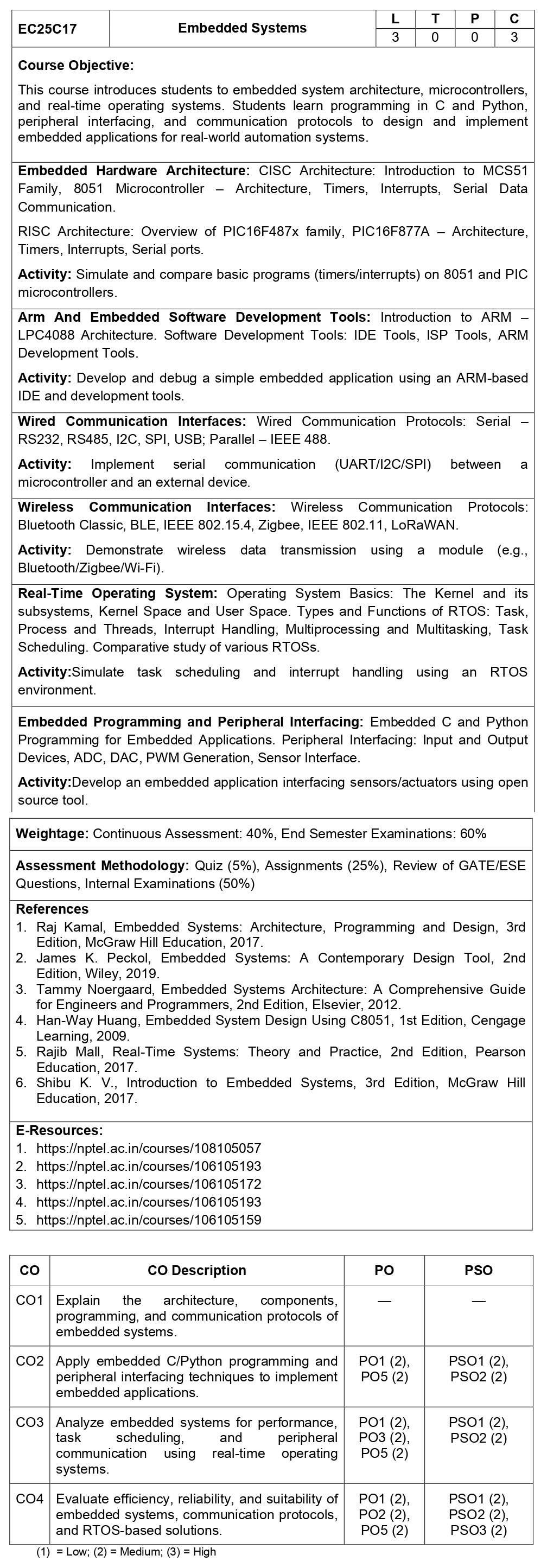
EC25C17
Embedded
Systems
Course
Objective:
This
course introduces students to embedded system architecture, microcontrollers,
and real-time operating systems. Students learn programming in C and Python,
peripheral interfacing, and communication protocols to design and implement
embedded applications for real-world automation systems.
Embedded
Hardware Architecture: CISC Architecture: Introduction
to MCS51 Family, 8051 Microcontroller – Architecture, Timers, Interrupts,
Serial Data Communication.
RISC
Architecture: Overview of PIC16F487x family, PIC16F877A – Architecture, Timers,
Interrupts, Serial ports.
Activity:
Simulate and compare basic programs (timers/interrupts) on 8051 and PIC
microcontrollers.
Arm And
Embedded Software Development Tools: Introduction to ARM –
LPC4088 Architecture. Software Development Tools: IDE Tools, ISP Tools, ARM
Development Tools.
Activity:
Develop and debug a simple embedded application using an ARM-based IDE and
development tools.
Wired
Communication Interfaces: Wired Communication
Protocols: Serial – RS232, RS485, I2C, SPI, USB; Parallel – IEEE 488.
Activity:
Implement serial communication (UART/I2C/SPI) between a microcontroller and an
external device.
Wireless
Communication Interfaces: Wireless Communication
Protocols: Bluetooth Classic, BLE, IEEE 802.15.4, Zigbee, IEEE 802.11, LoRaWAN.
Activity:
Demonstrate wireless data transmission using a module(e.g.,
Bluetooth/Zigbee/Wi-Fi).
Real-Time
Operating System: Operating System Basics: The Kernel and
its subsystems, Kernel Space and User Space. Types and Functions of RTOS: Task,
Process and Threads, Interrupt Handling, Multiprocessing and Multitasking, Task
Scheduling. Comparative study of various RTOSs.
Activity:Simulate
task scheduling and interrupt handling using an RTOS environment.
Embedded
Programming and Peripheral Interfacing: Embedded C and
Python Programming for Embedded Applications. Peripheral Interfacing: Input and
Output Devices, ADC, DAC, PWM Generation, Sensor Interface.
Activity:
Develop an embedded application interfacing sensors/actuators using open source
tool.
Weightage:
Continuous Assessment: 40%, End Semester Examinations: 60%
Assessment Methodology:
Quiz (5%), Assignments (25%), Review of GATE/ESE Questions, Internal
Examinations (50%)
References
1.
Raj Kamal, Embedded Systems: Architecture, Programming and Design, 3rd Edition,
McGraw Hill Education, 2017.
2.
James K. Peckol, Embedded Systems: A Contemporary Design Tool, 2nd Edition,
Wiley, 2019.
3.
Tammy Noergaard, Embedded Systems Architecture: A Comprehensive Guide for
Engineers and Programmers, 2nd Edition, Elsevier, 2012.
4.
Han-Way Huang, Embedded System Design Using C8051, 1st Edition, Cengage
Learning, 2009.
5.
Rajib Mall, Real-Time Systems: Theory and Practice, 2nd Edition, Pearson
Education, 2017.
6.
Shibu K. V., Introduction to Embedded Systems, 3rd Edition, McGraw Hill
Education, 2017.