Embedded Systems - EC25C17
[ 3rd Semester - Mechanical Engineering Department ]
Under Class: | 3rd Semester [Mechanical Dept Anna University 2025 Regulation] |
Embedded Systems - EC25C17 - Study Materials, Notes, Important Questions, Anna University Semester Question Paper PDF Download
Engineering - Embedded Systems - EC25C17 Subject (under Anna University 3rd Semester - Mechanical Engineering Department Regulation 2025) - Study Materials, Written and lecture Notes, Important Questions, Semester Question Paper PDF Download
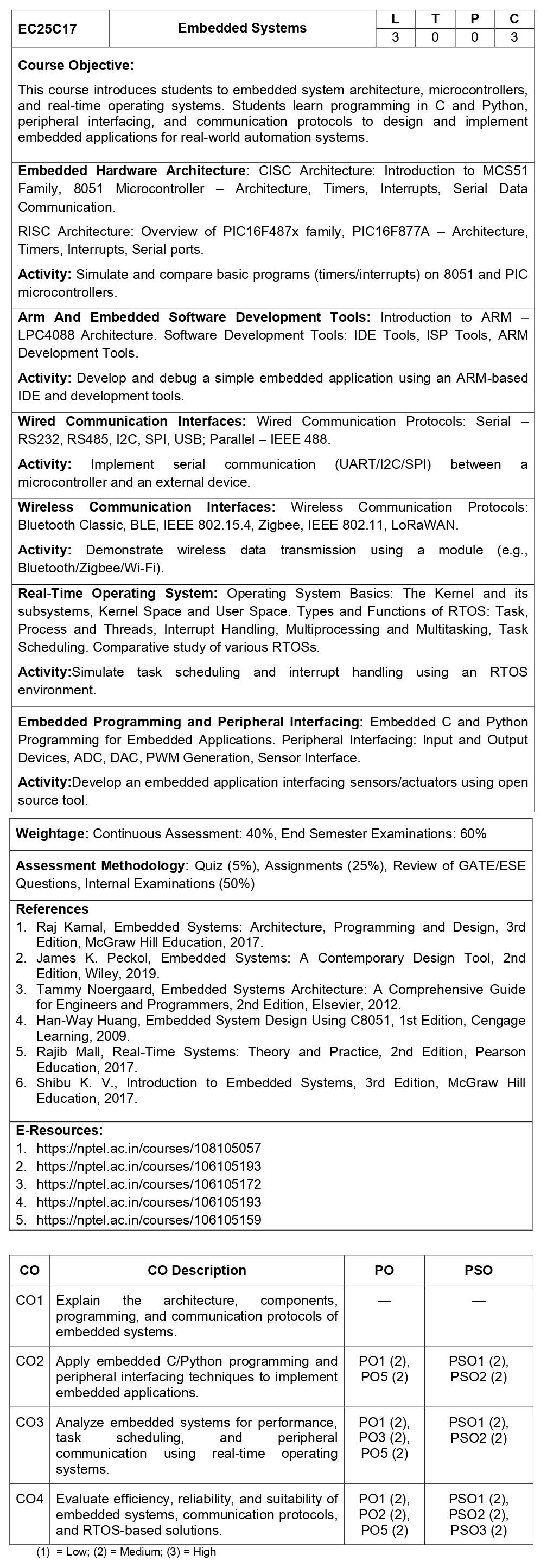
EC25C17
Embedded
Systems
Course
Objective:
This
course introduces students to embedded system architecture, microcontrollers,
and real-time operating systems. Students learn programming in C and Python,
peripheral interfacing, and communication protocols to design and implement
embedded applications for real-world automation systems.
Embedded
Hardware Architecture: CISC Architecture: Introduction
to MCS51 Family, 8051 Microcontroller – Architecture, Timers, Interrupts,
Serial Data Communication.
RISC
Architecture: Overview of PIC16F487x family, PIC16F877A – Architecture, Timers,
Interrupts, Serial ports.
Activity:
Simulate and compare basic programs (timers/interrupts) on 8051 and PIC
microcontrollers.
Arm And
Embedded Software Development Tools: Introduction to ARM –
LPC4088 Architecture. Software Development Tools: IDE Tools, ISP Tools, ARM
Development Tools.
Activity:
Develop and debug a simple embedded application using an ARM-based IDE and
development tools.
Wired
Communication Interfaces: Wired Communication
Protocols: Serial – RS232, RS485, I2C, SPI, USB; Parallel – IEEE 488.
Activity:
Implement serial communication (UART/I2C/SPI) between a microcontroller and an
external device.
Wireless
Communication Interfaces: Wireless Communication
Protocols: Bluetooth Classic, BLE, IEEE 802.15.4, Zigbee, IEEE 802.11, LoRaWAN.
Activity:
Demonstrate wireless data transmission using a module(e.g.,
Bluetooth/Zigbee/Wi-Fi).
Real-Time
Operating System: Operating System Basics: The Kernel and
its subsystems, Kernel Space and User Space. Types and Functions of RTOS: Task,
Process and Threads, Interrupt Handling, Multiprocessing and Multitasking, Task
Scheduling. Comparative study of various RTOSs.
Activity:Simulate
task scheduling and interrupt handling using an RTOS environment.
Embedded
Programming and Peripheral Interfacing: Embedded C and
Python Programming for Embedded Applications. Peripheral Interfacing: Input and
Output Devices, ADC, DAC, PWM Generation, Sensor Interface.
Activity:
Develop an embedded application interfacing sensors/actuators using open source
tool.
Weightage:
Continuous Assessment: 40%, End Semester Examinations: 60%
Assessment Methodology:
Quiz (5%), Assignments (25%), Review of GATE/ESE Questions, Internal
Examinations (50%)
References
1.
Raj Kamal, Embedded Systems: Architecture, Programming and Design, 3rd Edition,
McGraw Hill Education, 2017.
2.
James K. Peckol, Embedded Systems: A Contemporary Design Tool, 2nd Edition,
Wiley, 2019.
3.
Tammy Noergaard, Embedded Systems Architecture: A Comprehensive Guide for
Engineers and Programmers, 2nd Edition, Elsevier, 2012.
4.
Han-Way Huang, Embedded System Design Using C8051, 1st Edition, Cengage
Learning, 2009.
5.
Rajib Mall, Real-Time Systems: Theory and Practice, 2nd Edition, Pearson
Education, 2017.
6.
Shibu K. V., Introduction to Embedded Systems, 3rd Edition, McGraw Hill
Education, 2017.