Database Management Systems - CS25C13 - Notes PDF Download
[ 4th Semester - CSE, CSE(CY), AIDS, IT Engineering Departments ]
Under Class: | 4th Semester [CSE Dept Anna University 2025 Regulation] | | 4th Semester [CSE(CY) Dept Anna University 2025 Regulation] | | 4th Semester [AIDS Dept Anna University 2025 Regulation] | | 4th Semester [IT Dept Anna University 2025 Regulation] |
Engineering - Database Management Systems - CS25C13 Subject (under Anna University 4th Semester - CSE, CSE(CY), AIDS, IT Engineering Departments Regulation 2025) - Study Materials, Written and lecture Notes, Important Questions, Semester Question Paper PDF Download
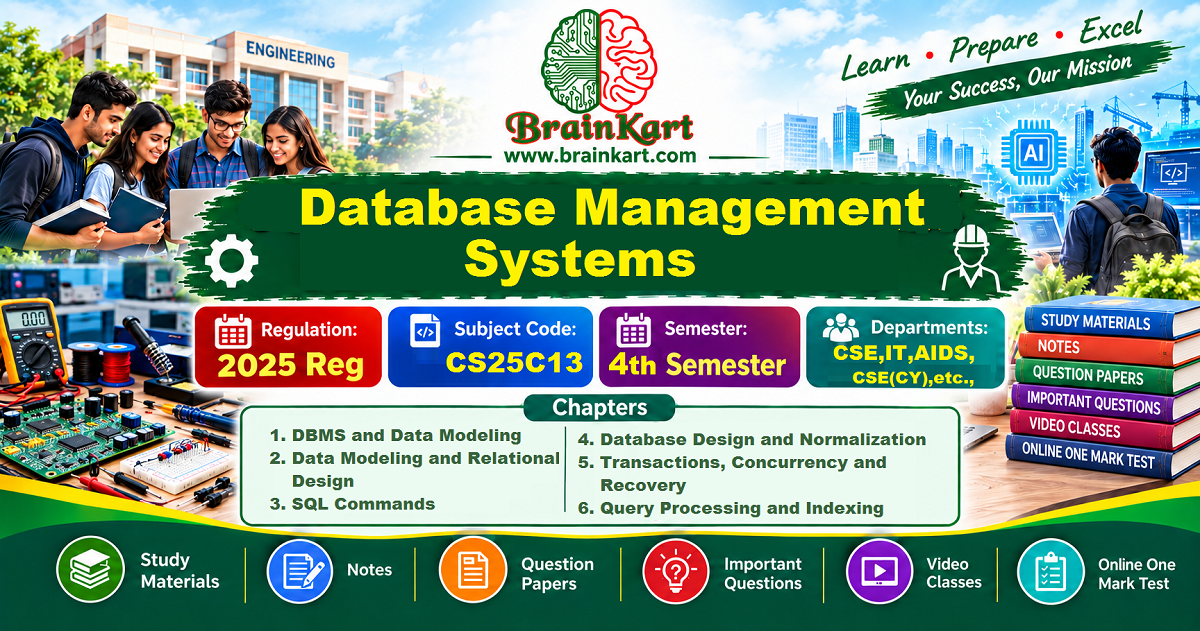
Database Management Systems
INTRODUCTION TO DBMS:
• Trust Management in Virtualized Data Centers
• Introduction to DBMS(Database Management Systems)
• Purpose of Database Systems
• File systems vs Database systems
• Database System Terminologies
• Data Models
• Components of DBMS
• Relational Algebra
• ER Model
• Functional Dependencies Definition
• Database Normalization
• Data Anomalies
SQL and QUERY OPTIMIZATION:
• SQL Overview
• Data Types in SQL
• object-oriented database management system
• Data Definition Language or Data Description Language(DDL)
• Data Manipulation Language (DML)
• Data Control Language(DCL)
• Transaction Control Language (TCL)
• Embedded SQL
• Query Processing and Optimization (QPO)
TRANSACTION PROCESSING AND CONCURRENCY CONTROL:
• Transaction Processing
• Introduction to Concurrency
• Lock
• Two-Phase Locking Techniques: The algorithm
TRENDS IN DATABASE TECHNOLOGY:
• Physical Storage Media
• RAID: Redundant Arrays of Independent Disks
• File Operations
• Hashing
• Indexing
• B+-Tree Index Files
• Data Warehouse
• Data Mining
• Mobile Databases
• Spatial Database Types of Spatial Data
• Multi-dimensional Indexes
Database Management Systems
PART 1 Introduction to Databases:
chapter 1 Databases and Database Users:
• Databases and Database Users
• An Example - Databases and Database Users
• Characteristics of the Database Approach
• Actors on the Scene - Databases and Database Users
• Workers behind the Scene - Databases and Database Users
• Advantages of Using the DBMS Approach
• A Brief History of Database Applications
• When Not to Use a DBMS
chapter 2 Database System Concepts and Architecture:
• Database System Concepts and Architecture
• Data Models, Schemas, and Instances
• Three-Schema Architecture and Data Independence
• Database Languages and Interfaces
• The Database System Environment
• Centralized and Client/Server Architectures for DBMSs
• Classification of Database Management Systems
PART 2 The Relational Data Model and SQL:
chapter 3 The Relational Data Model and Relational Database Constraints:
• The Relational Data Model and Relational Database Constraints
• Relational Model Concepts
• Relational Model Constraints and Relational Database Schemas
• Update Operations, Transactions, and Dealing with Constraint Violations
chapter 4 Basic SQL:
• Basic SQL
• SQL Data Definition and Data Types
• Specifying Constraints in SQL
• Basic Retrieval Queries in SQL
• INSERT, DELETE, and UPDATE Statements in SQL
• Additional Features of SQL
chapter 5 More SQL Complex Queries Triggers Views and Schema Modification:
• More SQL: Complex Queries, Triggers, Views, and Schema Modification
• More Complex SQL Retrieval Queries
• Specifying Constraints as Assertions and Actions as Triggers
• Views (Virtual Tables) in SQL
• Schema Change Statements in SQL
chapter 6 The Relational Algebra and Relational Calculus:
• The Relational Algebra and Relational Calculus
• Unary Relational Operations: SELECT and PROJECT
• Relational Algebra Operations from Set Theory
• Binary Relational Operations: JOIN and DIVISION
• Additional Relational Operations
• Examples of Queries in Relational Algebra
• The Tuple Relational Calculus
• The Domain Relational Calculus
PART 3 Conceptual Modeling and Database Design:
chapter 7 Data Modeling Using the Entity Relationship ER Model:
• Data Modeling Using the Entity-Relationship (ER) Model
• Using High-Level Conceptual Data Models for Database Design
• A Sample Database Application
• Entity Types, Entity Sets, Attributes, and Keys
• Relationship Types, Relationship Sets, Roles, and Structural Constraints
• Weak Entity Types
• Refining the ER Design for the COMPANY Database
• ER Diagrams, Naming Conventions, and Design Issues
• Example of Other Notation: UML Class Diagrams
• Relationship Types of Degree Higher than Two
chapter 8 The Enhanced Entity Relationship EER MODEL:
• The Enhanced Entity-Relationship (EER) Model
• Subclasses, Superclasses, and Inheritance
• Specialization and Generalization
• Constraints and Characteristics of Specialization and Generalization Hierarchies
• Modeling of UNION Types Using Categories
• A Sample UNIVERSITY EER Schema, Design Choices, and Formal Definitions
• Example of Other Notation: Representing Specialization and Generalization in UML Class Diagrams
• Data Abstraction, Knowledge Representation, and Ontology Concepts
chapter 9 Relational Database Design by ER and EER to Relational Mapping:
• Relational Database Design by ER- and EER-to-Relational Mapping
• Relational Database Design Using ER-to-Relational Mapping
• Mapping EER Model Constructs to Relations
chapter 10 Practical Database Design Methodology and Use of UML Diagrams:
• Practical Database Design Methodology and Use of UML Diagrams
• The Role of Information Systems in Organizations
• The Database Design and Implementation Process
• The Database Design and Implementation Process: Phase 1: Requirements Collection and Analysis
• The Database Design and Implementation Process: Phase 2: Conceptual Database Design
• The Database Design and Implementation Process: Phase 3: Choice of a DBMS
• Database Design and Implementation Process: Phase 4: Data Model Mapping (Logical Database Design)
• Database Design and Implementation Process: Phase 5: Physical Database Design
• Database Design and Implementation Process: Phase 6: Database System Implementation and Tuning
• Use of UML Diagrams as an Aid to Database Design Specification
• Rational Rose: A UML-Based Design Tool
• Automated Database Design Tools
PART 4 Object Object Relational and XML Concepts Models Languages and Standards:
chapter 11 Object and Object Relational Databases:
• Object and Object-Relational Databases
• Overview of Object Database Concepts
• Introduction to Object-Oriented Concepts and Features
• Object Identity, and Objects versus Literals
• Complex Type Structures for Objects and Literals
• Encapsulation of Operations and Persistence of Objects
• Type Hierarchies and Inheritance
• Object-Relational Features: Object Database Extensions to SQL
• The ODMG Object Model and the Object Definition Language ODL
• Object Database Conceptual Design
• The Object Query Language OQL
• Overview of the C++ Language Binding in the ODMG Standard
chapter 12 XML Extensible Markup Language:
• XML: Extensible Markup Language
• Structured, Semistructured, and Unstructured Data
• XML Hierarchical (Tree) Data Model
• XML Documents, DTD, and XML Schema
• Storing and Extracting XML Documents from Databases
• XML Languages
• Extracting XML Documents from Relational Databases
PART 5 Database Programming Techniques:
chapter 13 Introduction to SQL Programming TECHNIQUES:
• Introduction to SQL Programming Techniques
• Database Programming: Techniques and Issues
• Embedded SQL, Dynamic SQL, and SQLJ
• Retrieving Single Tuples with Embedded SQL
• Retrieving Multiple Tuples with Embedded SQL Using Cursors
• Specifying Queries at Runtime Using Dynamic SQL
• SQLJ: Embedding SQL Commands in Java
• Retrieving Multiple Tuples in SQLJ Using Iterators
• Database Programming with Function Calls: SQL/CLI and JDBC
• Database Stored Procedures and SQL/PSM
• Comparing the Three Approaches
chapter 14 Web Database Programming Using PHP:
• Web Database Programming Using PHP
• A Simple PHP Example
• Overview of Basic Features of PHP
• Overview of PHP Database Programming
PART 6 Database Design Theory and Normalization:
chapter 15 Basics of Functional Dependencies and Normalization or Relational Databases:
• Basics of Functional Dependencies and Normalization for Relational Databases
• Informal Design Guidelines for Relation Schemas
• Functional Dependencies
• Normal Forms Based on Primary Keys
• General Definitions of Second and Third Normal Forms
• Boyce-Codd Normal Form
• Multivalued Dependency and Fourth Normal Form
• Join Dependencies and Fifth Normal Form
chapter 16 Relational Database Design Algorithms and Further Dependencies:
• Relational Database Design Algorithms and Further Dependencies
• Further Topics in Functional Dependencies: Inference Rules, Equivalence, and Minimal Cover
• Properties of Relational Decompositions
• Algorithms for Relational Database Schema Design
• About Nulls, Dangling Tuples, and Alternative Relational Designs
• Further Discussion of Multivalued Dependencies and 4NF
• Other Dependencies and Normal Forms
PART 7 File Structures Indexing and Hashing:
chapter 17 Disk Storage Basic File Structures and Hashing:
• Disk Storage, Basic File Structures, and Hashing
• Secondary Storage Devices
• Buffering of Blocks
• Placing File Records on Disk
• Operations on Files
• Files of Unordered Records (Heap Files)
• Files of Ordered Records (Sorted Files)
• Hashing Techniques
• Internal Hashing
• External Hashing for Disk Files
• Hashing Techniques That Allow Dynamic File Expansion
• Other Primary File Organizations
• Parallelizing Disk Access Using RAID Technology
• New Storage Systems
chapter 18 Indexing Structures for Files:
• Indexing Structures for Files
• Types of Single-Level Ordered Indexes
• Multilevel Indexes
• Dynamic Multilevel Indexes Using B-Trees and B+-Trees
• Search Trees and B-Trees
• B+-Trees
• Indexes on Multiple Keys
• Other Types of Indexes
• Some General Issues Concerning Indexing
PART 8 Query Processing and Optimization and Database Tuning:
chapter 19 Algorithms for Query Processing and Optimization:
• Algorithms for Query Processing and Optimization
• Translating SQL Queries into Relational Algebra
• Algorithms for External Sorting
• Implementing the SELECT Operation and Algorithms
• Implementing the JOIN Operation and Algorithms
• Algorithms for PROJECT and Set Operations
• Implementing Aggregate Operations and OUTER JOINs
• Combining Operations Using Pipelining
• Using Heuristics in Query Optimization
• Using Selectivity and Cost Estimates in Query Optimization
• Cost Components for Query Execution
• Catalog Information Used in Cost Functions
• Examples of Cost Functions for SELECT
• Examples of Cost Functions for JOIN
• Multiple Relation Queries and JOIN Ordering
• Example to Illustrate Cost-Based Query Optimization
• Overview of Query Optimization in Oracle
• Semantic Query Optimization
chapter 20 Physical Database Design and Tuning:
• Physical Database Design and Tuning
• Physical Database Design in Relational Databases
• Factors That Influence Physical Database Design
• Physical Database Design Decisions
• An Overview of Database Tuning in Relational Systems
PART 9 Transaction Processing Concurrency Control and Recovery:
chapter 21 Introduction to Transaction Processing Concepts and Theory:
• Introduction to Transaction Processing Concepts and Theory
• Introduction to Transaction Processing
• Transaction and System Concepts
• Desirable Properties of Transactions
• Characterizing Schedules Based on Recoverability
• Characterizing Schedules Based on Serializability
• Transaction Support in SQL
chapter 22 Concurrency Control Techniques:
• Concurrency Control Techniques
• Two-Phase Locking Techniques for Concurrency Control
• Concurrency Control Based on Timestamp Ordering
• Multiversion Concurrency Control Techniques
• Validation (Optimistic) Concurrency Control Techniques
• Granularity of Data Items and Multiple Granularity Locking
• Using Locks for Concurrency Control in Indexes
• Other Concurrency Control Issues
chapter 23 Database Recovery Techniques:
• Database Recovery Techniques
• Recovery Concepts
• NO-UNDO/REDO Recovery Based on Deferred Update
• Recovery Techniques Based on Immediate Update
• Shadow Paging
• The ARIES Recovery Algorithm
• Recovery in Multidatabase Systems
• Database Backup and Recovery from Catastrophic Failures
PART 10 Additional Database Topics Security and Distribution:
chapter 24 Database Security:
• Database Security
• Introduction to Database Security Issues
• Discretionary Access Control Based on Granting and Revoking Privileges
• Mandatory Access Control and Role-Based Access Control for Multilevel Security
• SQL Injection
• Introduction to Statistical Database Security
• Introduction to Flow Control
• Encryption and Public Key Infrastructures
• Privacy Issues and Preservation
• Challenges of Database Security
• Oracle Label-Based Security
chapter 25 Distributed Databases:
• Distributed Databases
• Distributed Database Concepts
• Types of Distributed Database Systems
• Distributed Database Architectures
• Data Fragmentation, Replication, and Allocation Techniques for Distributed Database Design
• Query Processing and Optimization in Distributed Databases
• Overview of Transaction Management in Distributed Databases
• Overview of Concurrency Control and Recovery in Distributed Databases
• Distributed Catalog Management
• Current Trends in Distributed Databases
• Distributed Databases in Oracle
PART 11 Advanced Database Models Systems and Applications:
chapter 26 Enhanced Data Models for Advanced Applications:
• Enhanced Data Models for Advanced Applications
• Active Database Concepts and Triggers
• Temporal Database Concepts
• Spatial Database Concepts
• Multimedia Database Concepts
• Introduction to Deductive Databases
chapter 27 Introduction to Information Retrieval and Web Search:
• Introduction to Information Retrieval and Web Search
• Information Retrieval (IR) Concepts
• Retrieval Models
• Types of Queries in IR Systems
• Text Preprocessing
• Inverted Indexing
• Evaluation Measures of Search Relevance
• Web Search and Analysis
• Trends in Information Retrieval
chapter 28 Data Mining Concepts:
• Data Mining Concepts
• Overview of Data Mining Technology
• Association Rules
• Classification - Data Mining
• Clustering
• Approaches to Other Data Mining Problems
• Applications of Data Mining
• Commercial Data Mining Tools
chapter 29 Overview of Data Warehousing and OLAP:
• Overview of Data Warehousing and OLAP
• Introduction, Definitions, and Terminology - Data warehouses
• Characteristics of Data Warehouses
• Data Modeling for Data Warehouses
• Building a Data Warehouse
• Typical Functionality of a Data Warehouse
• Data Warehouse versus Views
• Difficulties of Implementing Data Warehouses
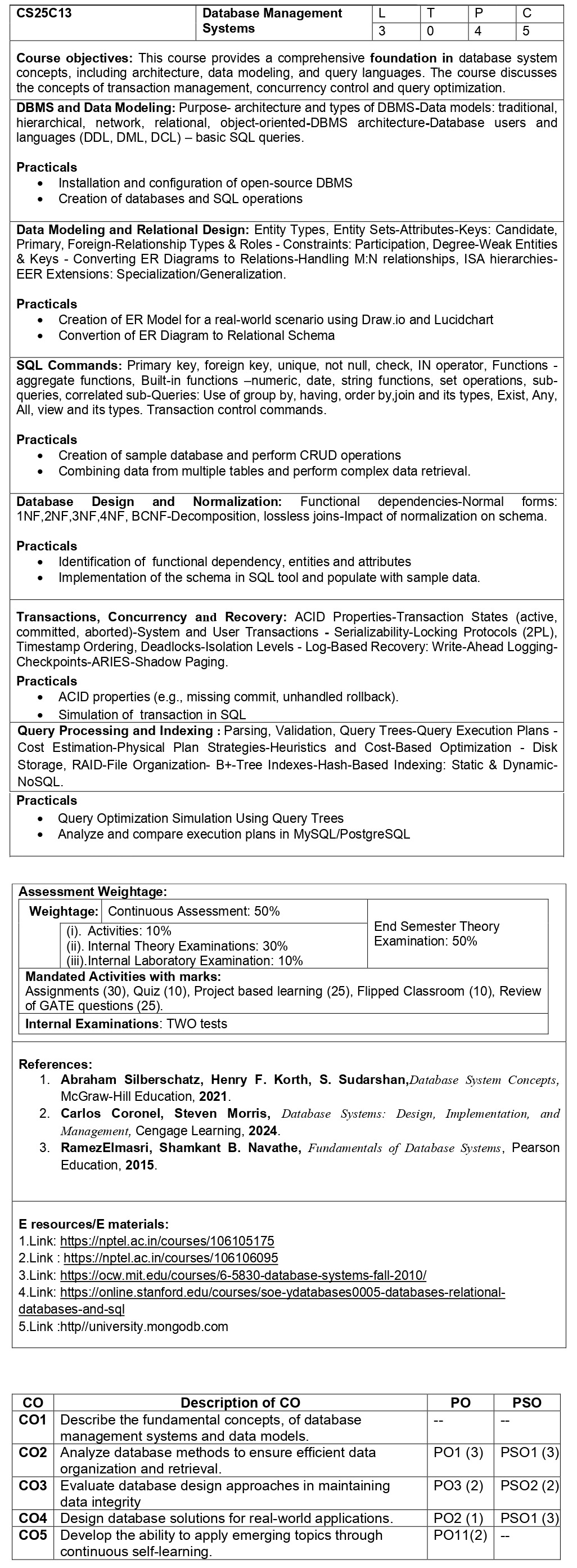
CS25C13:
Database
Management Systems
Course
objectives: This course provides a comprehensive foundation in database system
concepts, including architecture, data modeling, and query languages. The
course discusses the concepts of transaction management, concurrency control
and query optimization.
DBMS and
Data Modeling: Purpose- architecture and types of
DBMS-Data models: traditional, hierarchical, network, relational,
object-oriented-DBMS architecture-Database users and languages (DDL, DML, DCL)
– basic SQL queries
Practicals
•
Installation and configuration of open-source DBMS
•
Creation of databases and SQL operations
Data
Modeling and Relational Design: Entity Types, Entity
Sets-Attributes-Keys: Candidate, Primary, Foreign-Relationship Types &
Roles - Constraints: Participation, Degree-Weak Entities & Keys -
Converting ER Diagrams to Relations-Handling M:N relationships, ISA
hierarchies-EER Extensions: Specialization/Generalization
Practicals
•
Creation of ER Model for a real world scenario using Draw.io and Lucidchart
•
Convertion of ER Diagram to Relational Schema
SQL
Commands : Primary key, foreign key, unique, not
null, check, IN operator, Functions - aggregate functions, Built-in functions
–numeric, date, string functions, set operations, sub-queries, correlated
sub-Queries: Use of group by, having, order by,join and its types, Exist, Any,
All, view and its types. Transaction control commands
Practicals
•
Creation of sample database and perform CRUD operations
•
Combining data from multiple tables and perform complex data retrieval.
Database
Design and Normalization : Functional
dependencies-Normal forms: 1NF,2NF,3NF,4NF, BCNF-Decomposition, lossless
joins-Impact of normalization on schema.
Practicals
•
Identification of functional dependency, entities and attributes
•
Implementation of the schema in SQL tool and populate with sample data.
Transactions,
Concurrency and Recovery : ACID Properties-Transaction
States (active, committed, aborted)-System and User Transactions -
Serializability-Locking Protocols (2PL), Timestamp Ordering,
Deadlocks-Isolation Levels - Log-Based Recovery: Write-Ahead
Logging-Checkpoints-ARIES-Shadow Paging.
Practicals
•
ACID properties (e.g., missing commit, unhandled rollback).
•
Simulation of transaction in SQL
Query
Processing and Indexing : Parsing, Validation,
Query Trees-Query Execution Plans - Cost Estimation-Physical Plan
Strategies-Heuristics and Cost-Based Optimization - Disk Storage, RAID-File
Organization- B+-Tree Indexes-Hash-Based Indexing: Static & Dynamic-NoSQL
Practicals
•
Query Optimization Simulation Using Query Trees
•
Analyze and compare execution plans in MySQL/PostgreSQL
Assessment
Weightage:
Weightage:
Continuous
Assessment: 50%
(i) . Activities: 10%
(ii)
. Internal Theory Examinations: 30%
(iii)
.Internal Laboratory Examination: 10%
EndSemesterTheory
Examination: 50%
Mandated Activities
with marks:
Assignments
(30), Quiz (10), Project based learning (25), Flipped Classroom (10), Review of
GATE questions (25).
Internal Examinations:
TWO tests
References:
1. Abraham
Silberschatz, Henry F. Korth, S. Sudarshan, Database System
Concepts, McGraw-Hill Education, 2021.
2. Carlos Coronel,
Steven Morris, Database Systems: Design,
Implementation, and Management, Cengage Learning, 2024.
3. RamezElmasri, Shamkant B. Navathe, Fundamentals of Database Systems, Pearson Education, 2015.