Compiler Design - CS25C18
[ 4th Semester - CSE(CY) - Computer Science and Engineering (Cyber Security) Department ]
Under Class: | 4th Semester [CSE(CY) Dept Anna University 2025 Regulation] |
Compiler Design - CS25C18 - Study Materials, Notes, Important Questions, Anna University Semester Question Paper PDF Download
Engineering - Compiler Design - CS25C18 Subject (under Anna University 4th Semester - CSE(CY) - Computer Science and Engineering (Cyber Security) Department Regulation 2025) - Study Materials, Written and lecture Notes, Important Questions, Semester Question Paper PDF Download
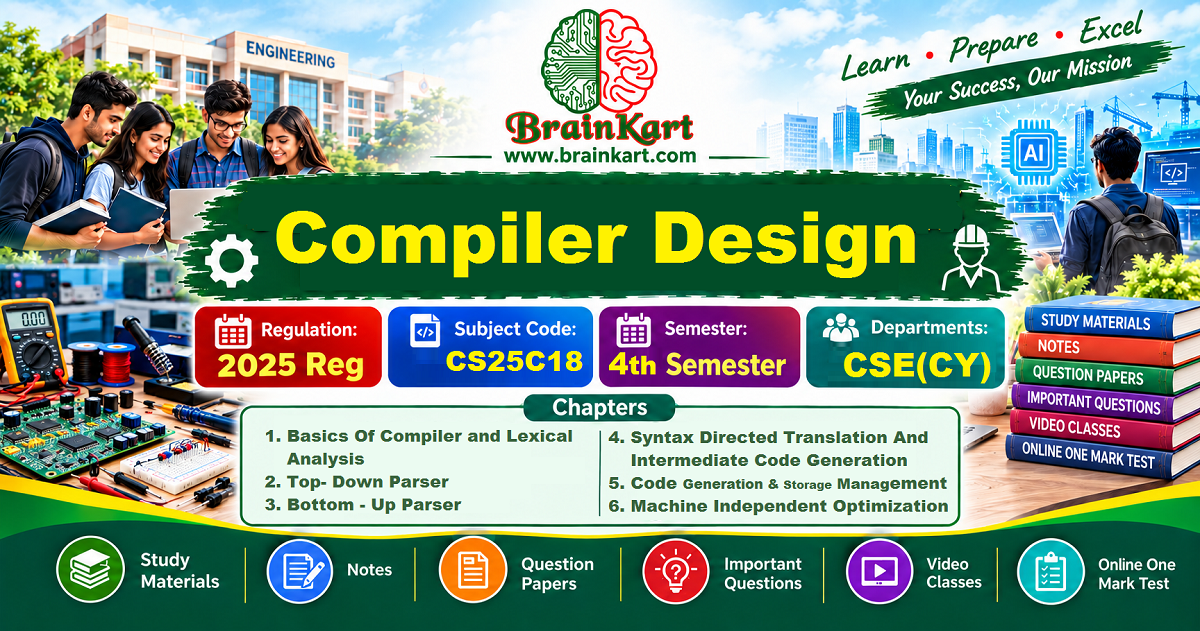
Compiler Design
LEXICAL ANALYSIS:
• Algorithms for Solving Nonlinear Equations
• Introduction to Compiling Compilers
• Analysis of the source program
• The Phases of a Compiler
• Cousins of Compiler
• Grouping of the Phases
• Compiler Construction Tools
• Lexical Analysis
• Input Buffering
• Specification of Tokens
• Recognition of Tokens
• A Language For Specifying Lexical Analyzer
• Important Short Questions and Answers : Principles of Compiler Design - Lexical Analysis
SYNTAX ANALYSIS and RUN TIME ENVIRONMENTS:
• Syntax Analysis
• The Role of Parser
• Context-Free Grammars
• Writing a Grammar
• Top down parsing and Bottom up Parsing
• Constructing SLR(1) Parsing Table
• Type Checking
• Specification of a Simple Type Checker
• Run-Time Environments - Source Language Issues
• Storage Organization
• Storage Allocation Strategies
• Important Short Questions and Answers: Syntax Analysis and Run-Time Environments
INTERMEDIATE CODE GENERATION:
• Intermediate Languages
• Declarations
• Assignment Statements
• Boolean Expressions
• Case Statements
• Backpatching
• Procedure Calls
• Important Short Questions and Answers: Principles of Compiler Design - Intermediate Code Generation
CODE GENERATION:
• Issues in the design of a code generator
• Target Machine
• Run-Time Storage Management
• Basic Blocks and Flow Graphs of Code Generation
• A Simple Code Generator
• Register Allocation and Assignment
• The Dag Representation For Basic Blocks
• Generating Code From DAGs
• Important Short Questions and Answers: Compiler Design - Code Generation
CODE OPTIMIZATION:
• Code Optimization
• Principal Sources of Optimisation
• Peephole Optimization
• Optimization of Basic Blocks
• Loops in Flow Graph
• Introduction to Global Dataflow Analysis
• Code Improvig Transformations
• Glossary - Principles of Compiler Design
• Tutorial problems and worked out examples - Principles of Compiler Design
• Important Short Questions and Answers: Code optimization
Compiler Design
Chapter 1 : Introduction:
• Compilers - Principles, Techniques, & Tools
• Language Processors
• The Structure of a Compiler
• The Evolution of Programming Languages
• The Science of Building a Compiler
• Applications of Compiler Technology
• Programming Language Basics
Chapter 2 : Simple Syntax Directed Translator:
• A Simple Syntax-Directed Translator
• Syntax Definition
• Syntax-Directed Translation
• Parsing
• A Translator for Simple Expressions
• Lexical Analysis
• Symbol Table Per Scope and Use of Symbol Tables
• Intermediate Code Generation
Chapter 3 : Lexical Analysis:
• Lexical Analysis
• The Role of the Lexical Analyzer
• Input Buffering: Buffer Pairs, Sentinels
• Specification of Tokens
• Recognition of Tokens
• The Lexical-Analyzer Generator Lex
• Finite Automata
• From Regular Expressions to Automata
• Design of a Lexical-Analyzer Generator
• Optimization of DFA-Based Pattern Matchers
Chapter 4 : Syntax Analysis:
• Syntax Analysis
• Context-Free Grammars
• Writing a Grammar
• Top-Down Parsing
• Bottom-Up Parsing
• Introduction to LR Parsing: Simple LR
• More Powerful LR Parsers
• Using Ambiguous Grammars
• Parser Generators
Chapter 5 : Syntax Directed Translation:
• Syntax-Directed Translation
• Syntax-Directed Definitions
• Evaluation Orders for SDD's
• Applications of Syntax-Directed Translation
• Syntax-Directed Translation Schemes
• Implementing L-Attributed SDD's
Chapter 6 : Intermediate Code Generation:
• Intermediate-Code Generation
• Variants of Syntax Trees
• Three-Address Code
• Types and Declarations
• Translation of Expressions
• Type Checking
• Control Flow
• Backpatching
• Switch-Statements
• Intermediate Code for Procedures
Chapter 7 : Run Time Environments:
• Run-Time Environments
• Storage Organization
• Stack Allocation of Space
• Access to Nonlocal Data on the Stack
• Heap Management
• Introduction to Garbage Collection
• Introduction to Trace-Based Collection
• Short-Pause Garbage Collection
• Advanced Topics in Garbage Collection
Chapter 8 : Code Generation:
• Code Generation
• Issues in the Design of a Code Generator
• The Target Language
• Addresses in the Target Code
• Basic Blocks and Flow Graphs
• Optimization of Basic Blocks
• A Simple Code Generator
• Peephole Optimization
• Register Allocation and Assignment
• Instruction Selection by Tree Rewriting
• Optimal Code Generation for Expressions
• Dynamic Programming Code-Generation
Chapter 9 : Machine Independent Optimizations:
• Machine-Independent Optimizations
• The Principal Sources of Optimization
• Introduction to Data-Flow Analysis
• Foundations of Data-Flow Analysis
• Constant Propagation
• Partial-Redundancy Elimination
• Loops in Flow Graphs
• Region-Based Analysis
• Symbolic Analysis
Chapter 10 : Instruction Level Parallelism:
• Instruction-Level Parallelism
• Processor Architectures
• Code-Scheduling Constraints
• Basic-Block Scheduling
• Global Code Scheduling
• Software Pipelining Algorithm
• Scheduling Acyclic Data-Dependence and Cyclic Dependence Graphs
• Improvements to the Pipelining Algorithms
Chapter 11 : Optimizing for Parallelism and Locality:
• Optimizing for Parallelism and Locality
• Basic Concepts of Optimizing for Parallelism and Locality
• Matrix Multiply: An In-Depth Example
• Iteration Spaces
• Affine Array Indexes
• Data Reuse
• Array Data-Dependence Analysis
• Finding Synchronization-Free Parallelism
• Synchronization Between Parallel Loops
• Pipelining
• Locality Optimizations
• Other Uses of Affine Transforms
Chapter 12 : Interprocedural Analysis:
• Interprocedural Analysis
• Basic Concepts of Interprocedural Analysis
• Why Interprocedural Analysis?
• A Logical Representation of Data Flow
• A Simple Pointer-Analysis Algorithm
• Context-Insensitive Interprocedural Analysis
• Context-Sensitive Pointer Analysis
• Datalog Implementation by BDD's
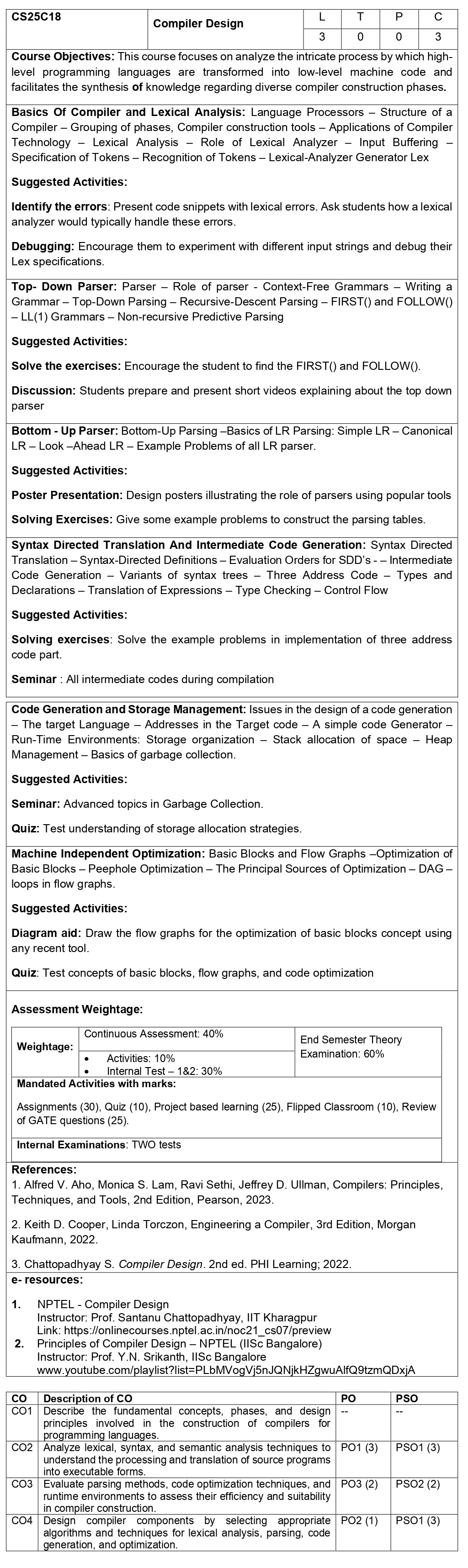
CS25C18:
Compiler
Design
Course
Objectives: This course focuses on analyze the
intricate process by which high-level programming languages are transformed
into low-level machine code and facilitates the synthesis of knowledge
regarding diverse compiler construction phases.
Basics Of
Compiler and Lexical Analysis: Language Processors –
Structure of a Compiler – Grouping of phases, Compiler construction tools –
Applications of Compiler Technology – Lexical Analysis – Role of Lexical
Analyzer – Input Buffering – Specification of Tokens – Recognition of Tokens –
Lexical-Analyzer Generator Lex
Suggested
Activities:
Identify the errors:
Present code snippets with lexical errors. Ask students how a lexical analyzer
would typically handle these errors.
Debugging:
Encourage them to experiment with different input strings and debug their Lex
specifications.
Top- Down
Parser: Parser – Role of parser - Context-Free
Grammars – Writing a Grammar – Top-Down Parsing – Recursive-Descent Parsing –
FIRST() and FOLLOW() – LL(1) Grammars – Non-recursive Predictive Parsing
Suggested
Activities:
Solve the exercises:
Encourage the student to find the FIRST() and FOLLOW().
Discussion:
Students prepare and present short videos explaining about the top down parser
Bottom -
Up Parser: Bottom-Up Parsing –Basics of LR
Parsing: Simple LR – Canonical LR – Look –Ahead LR – Example Problems of all LR
parser.
Suggested
Activities:
Poster Presentation:
Design posters illustrating the role of parsers using popular tools
Solving Exercises:
Give some example problems to construct the parsing tables.
Syntax Directed
Translation And Intermediate Code Generation:
Syntax Directed Translation – Syntax-Directed Definitions – Evaluation Orders
for SDD’s - – Intermediate Code Generation – Variants of syntax trees – Three
Address Code – Types and Declarations – Translation of Expressions – Type
Checking – Control Flow
Suggested
Activities:
Solving exercises:
Solve the example problems in implementation of three address code part.
Seminar :
All intermediate codes during compilation
Code
Generation and Storage Management: Issues in the design
of a code generation – The target Language – Addresses in the Target code – A
simple code Generator – Run-Time Environments: Storage organization – Stack
allocation of space – Heap Management – Basics of garbage collection.
Suggested
Activities:
Seminar:
Advanced topics in Garbage Collection.
Quiz:
Test understanding of storage allocation strategies.
Machine
Independent Optimization: Basic Blocks and Flow
Graphs –Optimization of Basic Blocks – Peephole Optimization – The Principal Sources
of Optimization – DAG – loops in flow graphs.
Suggested
Activities:
Diagram aid:
Draw the flow graphs for the optimization of basic blocks concept using any
recent tool.
Quiz:
Test concepts of basic blocks, flow graphs, and code optimization
Assessment
Weightage:
Weightage:Continuous
Assessment: 40%
•
Activities: 10%
•
Internal Test – 1&2: 30%
End
Semester Theory Examination: 60%
Mandated Activities
with marks:
Assignments
(30), Quiz (10), Project based learning (25), Flipped Classroom (10), Review of
GATE questions (25).
Internal Examinations:
TWO tests
References:
1.
Alfred V. Aho, Monica S. Lam, Ravi Sethi, Jeffrey D. Ullman, Compilers:
Principles, Techniques, and Tools, 2nd Edition, Pearson, 2023.
2.
Keith D. Cooper, Linda Torczon, Engineering a Compiler, 3rd Edition, Morgan
Kaufmann, 2022.
3.
Chattopadhyay S. Compiler Design. 2nd ed. PHI Learning; 2022.