Algorithms - CS25C12 - Notes PDF Download
[ 4th Semester - CSE, CSE(CY), AIDS Engineering Departments ]
Under Class: | 4th Semester [CSE Dept Anna University 2025 Regulation] | | 4th Semester [CSE(CY) Dept Anna University 2025 Regulation] | | 4th Semester [AIDS Dept Anna University 2025 Regulation] |
Engineering - Algorithms - CS25C12 Subject (under Anna University 4th Semester - CSE, CSE(CY), AIDS Engineering Departments Regulation 2025) - Study Materials, Written and lecture Notes, Important Questions, Semester Question Paper PDF Download
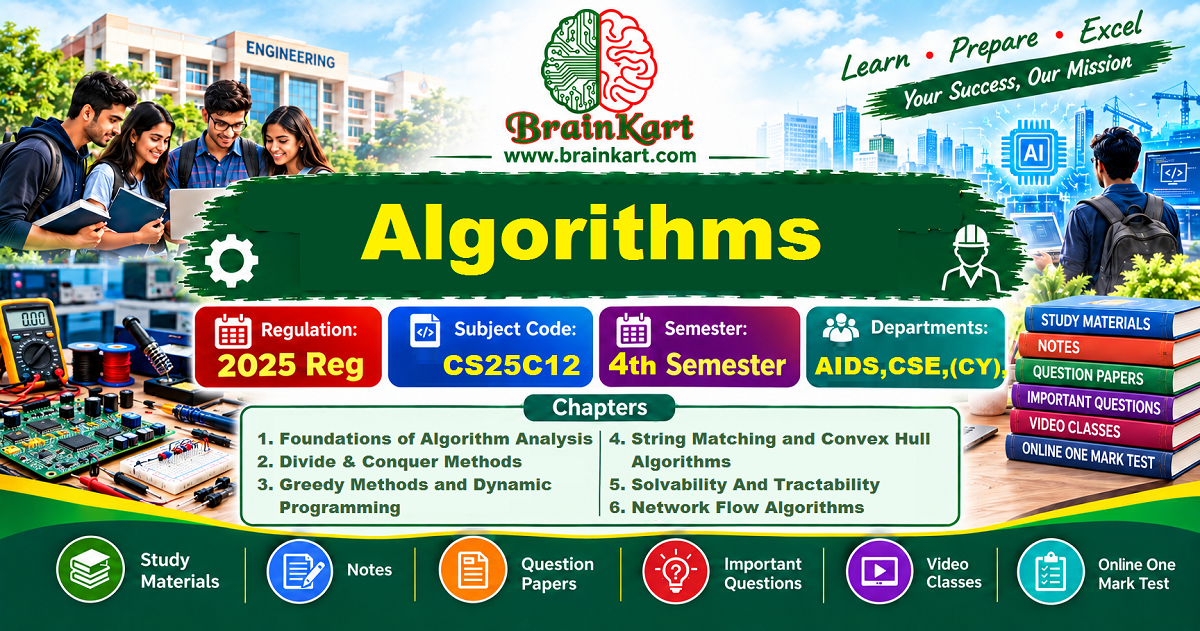
Algorithms
Chapter 1 : Introduction:
• Introduction to the Design and Analysis of Algorithms
• What Is an Algorithm?
• Fundamentals of Algorithmic Problem Solving
• Ascertaining the Capabilities of the Computational Device
• Algorithm Design Techniques
• Designing an Algorithm and Data Structures
• Methods of Specifying an Algorithm
• Proving an Algorithm�s Correctness
• Analyzing an Algorithm
• Coding an Algorithm
• Important Problem Types in Algorithms Analysis
• Fundamental Data Structures
Chapter 2 : Fundamentals of the Analysis of Algorithm Eficiency:
• The Analysis Framework
• Asymptotic Notations and Basic Efficiency Classes
• Mathematical Analysis of Non recursive Algorithms
• Mathematical Analysis of Recursive Algorithms
• Example: Computing the nth Fibonacci Number
• Empirical Analysis of Algorithms
• Algorithm Visualization
Chapter 3 : Brute Force and Exhaustive Search:
• Brute Force and Exhaustive Search
• Selection Sort and Bubble Sort
• Sequential Search and Brute-Force String Matching
• Closest-Pair and Convex-Hull Problems by Brute Force
• Exhaustive Search
• Depth-First Search and Breadth-First Search
Chapter 4 : Decrease and Conquer:
• Decrease and Conquer
• Insertion Sort
• Topological Sorting
• Algorithms for Generating Combinatorial Objects
• Decrease by a Constant Factor Algorithms
• Variable Size Decrease Algorithms
Chapter 5 : Divide and Conquer:
• Divide and Conquer
• Mergesort
• Quicksort
• Binary Tree Traversals and Related Properties
• Multiplication of Large Integers
• Strassen�s Matrix Multiplication
• The Closest Pair Problem by Divide and Conquer
• Convex Hull Problems by Divide and Conquer
Chapter 6 : Transform and Conquer:
• Transform and Conquer
• Presorting
• Gaussian Elimination
• Balanced Search Trees: AVL Trees and 2-3 Trees
• Heaps and Heapsort
• Horner�s Rule and Binary Exponentiation
• Problem Reduction
Chapter 7 : Space and Time Trade Offs:
• Space and Time Trade-Offs
• Sorting by Counting
• Input Enhancement in String Matching: Horspool�s and Boyer-Moore Algorithm
• Open and Closed Hashing
• B-Trees Algorithms
Chapter 8 : Dynamic Programming:
• Dynamic Programming
• Dynamic Programming: Three Basic Examples
• The Knapsack Problem and Memory Functions
• Optimal Binary Search Trees
• Warshall�s and Floyd�s Algorithms
Chapter 9 : Greedy Technique:
• Greedy Technique
• Prim�s Algorithm
• Kruskal�s Algorithm
• Dijkstra�s Algorithm
• Huffman Trees and Codes
Chapter 10 : Iterative Improvement:
• Iterative Improvement
• The Simplex Method
• The Iterative Maximum-Flow Problem
• Maximum Matching in Bipartite Graphs
• The Stable Marriage Problem
Chapter 11 : Limitations of Algorithm Power:
• Limitations of Algorithm Power
• Lower-Bound Arguments
• Decision Trees algorithms
• P , NP , and NP-Complete Problems
• Challenges of Numerical Algorithms
Chapter 12 : Coping with the Limitations of Algorithm Power:
• Coping with the Limitations of Algorithm Power
• Backtracking
• Branch-and-Bound
• Approximation Algorithms for NP -Hard Problems
• Approximation Algorithms for the Traveling Salesman Problem
• Approximation Algorithms for the Knapsack Problem
• Algorithms for Solving Nonlinear Equations
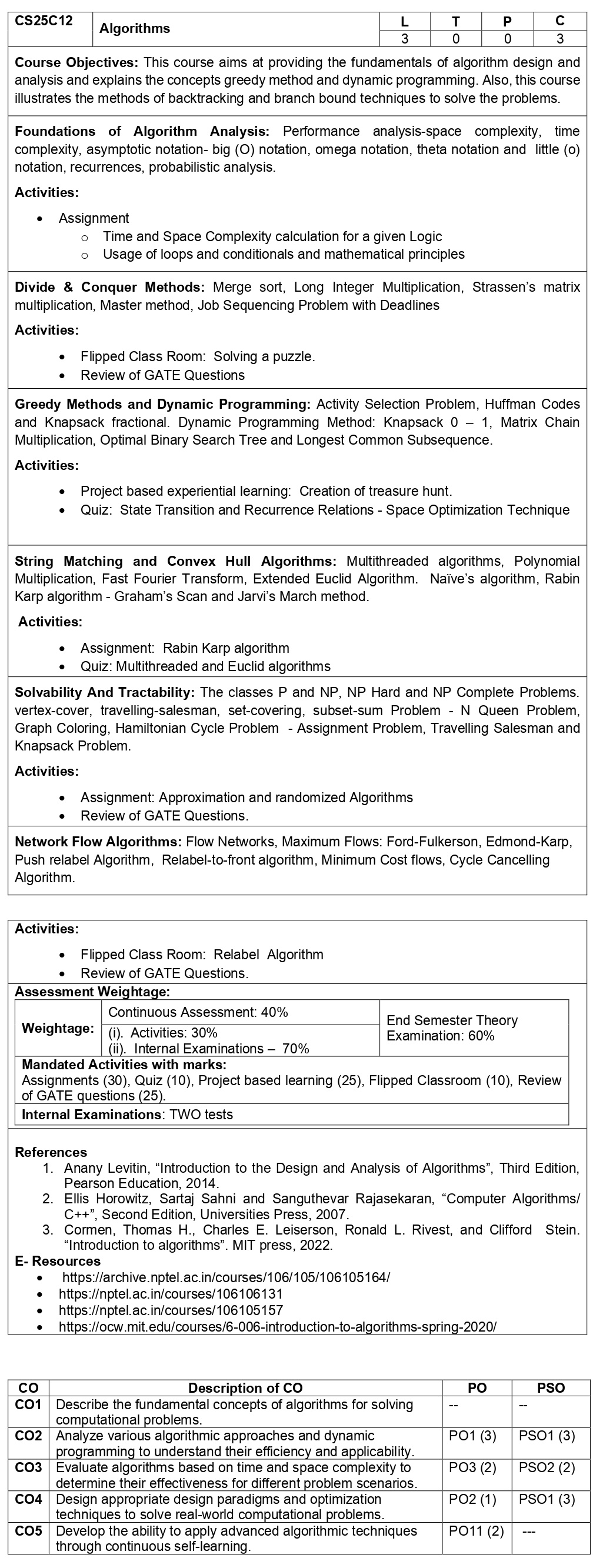
CS25C12:
Algorithms
Course
Objectives: This course aims at providing the
fundamentals of algorithm design and analysis and explains the concepts greedy
method and dynamic programming. Also, this course illustrates the methods of
backtracking and branch bound techniques to solve the problems.
Foundations
of Algorithm Analysis: Performance analysis-space
complexity, time complexity, asymptotic notation- big (O) notation, omega
notation, theta notation and little (o) notation, recurrences, probabilistic
analysis.
Activities:
•
Assignment
o
Time and Space Complexity calculation for a given Logic
o
Usage of loops and conditionals and mathematical principles
Divide
& Conquer Methods: Merge sort, Long Integer
Multiplication, Strassen’s matrix multiplication, Master method, Job Sequencing
Problem with Deadlines
Activities:
•
Flipped Class Room: Solving a puzzle.
•
Review of GATE Questions
Greedy
Methods and Dynamic Programming: Activity Selection
Problem, Huffman Codes and Knapsack fractional. Dynamic Programming Method:
Knapsack 0 – 1, Matrix Chain Multiplication, Optimal Binary Search Tree and
Longest Common Subsequence.
Activities:
•
Project based experiential learning: Creation of treasure hunt.
•
Quiz: State Transition and Recurrence Relations - Space Optimization Technique
String
Matching and Convex Hull Algorithms: Multithreaded
algorithms, Polynomial Multiplication, Fast Fourier Transform, Extended Euclid
Algorithm. Naive’s algorithm, Rabin Karp algorithm - Graham’s Scan and Jarvi’s
March method.
Activities:
•
Assignment: Rabin Karp algorithm
•
Quiz: Multithreaded and Euclid algorithms
Solvability
And Tractability: The classes P and NP, NP Hard and NP
Complete Problems. vertex-cover, travelling-salesman, set-covering, subset-sum
Problem - N Queen Problem, Graph Coloring, Hamiltonian Cycle Problem -
Assignment Problem, Travelling Salesman and Knapsack Problem.
Activities:
•
Assignment: Approximation and randomized Algorithms
•
Review of GATE Questions.
Network
Flow Algorithms: Flow Networks, Maximum Flows:
Ford-Fulkerson, Edmond-Karp, Push relabel Algorithm, Relabel-to-front
algorithm, Minimum Cost flows, Cycle Cancelling Algorithm.
Activities:
•
Flipped Class Room: Relabel Algorithm
•
Review of GATE Questions.
Assessment
Weightage:
Weightage:
Continuous
Assessment: 40%
(i)
.Activities: 30%
(ii)
.Internal Examinations – 70%
End
Semester Theory Examination: 60%
Mandated Activities
with marks:
Assignments
(30), Quiz (10), Project based learning (25), Flipped Classroom (10), Review of
GATE questions (25).
Internal Examinations: TWO tests
References
1.
Anany Levitin, “Introduction to the Design and Analysis of Algorithms”, Third
Edition, Pearson Education, 2014.
2.
Ellis Horowitz, Sartaj Sahni and Sanguthevar Rajasekaran, “Computer Algorithms/
C++”, Second Edition, Universities Press, 2007.
3.
Cormen, Thomas H., Charles E. Leiserson, Ronald L. Rivest, and CliffordStein.
“Introduction to algorithms”. MIT press, 2022.