Electronic Devices and Circuits - EE25C05 - Notes PDF Download
[ 3rd Semester - EEE - Electrical and Electronics Engineering Department ]
Under Class: | 3rd Semester [EEE Dept Anna University 2025 Regulation] |
Engineering - Electronic Devices and Circuits - EE25C05 Subject (under Anna University 3rd Semester - EEE - Electrical and Electronics Engineering Department Regulation 2025) - Study Materials, Written and lecture Notes, Important Questions, Semester Question Paper PDF Download
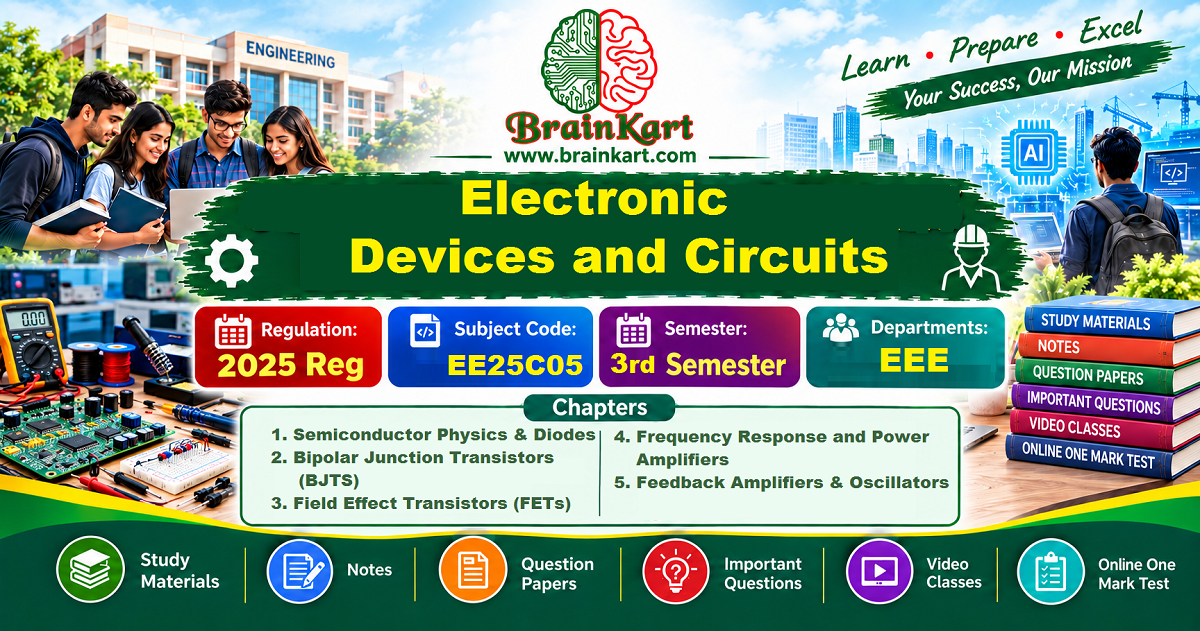
Electronic Devices and Circuits
PN JUNCTION DEVICES:
• Semiconductor: Diode
• Review of Intrinsic and Extrinsic Semiconductors
• PN Junction Diode:Operation, V-I characteristics of Forward and Reverse Bias Condition
• Transition capacitances
• Diffusion capacitance
• Half Wave Rectifier: Characteristics and Working
• Full wave rectifier: Center Tapped Full Wave and Full Wave Bridge Rectifier
• Light Emitting Diode (LED)
• Laser diode and its L/I characteristic
• A Zener Diode and its characteristics, Regulator
• Important Short Questions and Answers: PN Junction Devices
TRANSISTORS:
• Transistors: Types, Construction, Currents
• Operation of an NPN and PNP Transistor
• Configuration of Transistor Circuit: CB, CE, CC configuration Input and Output Characteristics
• Common base(CB) configuration of Transistor
• Common emitter (CE) configuration of Transistor
• Common collector (CC) configuration of Transistor
• Field Effect Transistor(FET) and its Operation
• MOSFET (Metal Oxide Semiconductor Field Effect Transistor) - Depletion and Enhancement mode: Construction, Operation, Symbol, Characteristics
• Biasing: Fixed Bias or Base Bias and Stability of Operating Point
• Uni Junction Transistor (UJT): Construction, Operation, Characteristics, Applications
• Silicon Controlled Rectifier (SCR): Construction, Working Principle
• V-I Characteristics of SCR
• DIAC (Diode A.C. Switch): Circuit symbol, Construction, Operation, V- I characteristics, Applications
• TRIAC: symbol, basics, Operation, Characteristics, Advantages and disadvantages
• Insulated Gate Bipolar Transistor(IGBT) and its Characteristics
• Important Short Questions and Answers: Transistors
AMPLIFIERS:
• CE, CB and CC Amplifiers Circuits
• Small Signal Low Frequency h-parameter Model
• General shape of frequency response of amplifiers
• Low frequency analysis of amplifier to obtain lower cut-off frequency
• MOSFET small signal model Amplifiers
• High frequency analysis of MOSFET
• Frequency Response of Common Source Amplifier
• Important Short Questions and Answers: Amplifier Circuits
MULTISTAGE AMPLIFIERS AND DIFFERENTIAL AMPLIFIER:
• Multistage Amplifiers
• Advantages of Representation of Gain in Decibels
• Basics of Differential Amplifier
• Transistorised Differential Amplifier
• Differential Mode Operation - Differential Amplifier
• Common Mode operation and Configurations - Differential Amplifier
• D.C. Analysis of Differential Amplifier
• Tuned amplifier
• General shape of frequency response of amplifiers
• Neutralization Methods
• Power Amplifiers
• Important Short Questions and Answers: Multistage Amplifiers and Differential Amplifier
FEEDBACK AMPLIFIERS AND OSCILLATORS:
• Feed Back Amplifiers and Oscillators
• Feedback: Positive and Negative feedback
• Principles of Negative Voltage Feedback In Amplifiers
• Gain of Negative Voltage Feedback Amplifier
• Advantages of Negative Voltage Feedback
• Effects of Negative Current Feedback
• Oscillators
• The Hartley Oscillator
• The Colpitts Oscillator
• Wien Bridge Oscillator
• Quartz Crystal Oscillators
• Important Short Questions and Answers: Feed Back Amplifiers and Oscillators
Electronic Circuits
BIASING OF DISCRETE BJT JFET AND MOSFET:
• Biasing of Discrete BJT and MOSFET
• Need for biasing
• Load line and Variation of quiescent point
• Biasing Methods
• Fixed Bias (Base Resistor Bias)
• Requirements of a biasing circuit
• Method of stabilizing the Q point
• Stability Factors
• Collector to Base Bias
• Modified collector to base bias circuit
• Voltage divider bias circuit
• Diode and Thermistor Compensation technique
• FET Biasing
• Biasing of MOSFET
• Important Short Questions and Answers: Biasing of Discrete BJT and MOSFET
BJT AMPLIFIERS:
• BJT Amplifiers Introduction
• Common Emitter Amplifier Circuit
• Common Collector Amplifier Circuit
• Common Base Amplifier Circuit
• Small Signal Low Frequency h-parameter Model
• h-Parameters for all three configurations
• Midband analysis of BJT Single Stage Amplifiers
• Introduction of Differential Amplifier
• Transistorised Differential Amplifier
• Configurations of Differential Amplifier
• D.C. Analysis of Differential Amplifier
• A.C. Analysis of Differential Amplifier using h-Parameters
• Common Mode rejection Ratio (CMRR)
• Techniques of Improving Input Impedance
• Important Short Questions and Answers: Electronic Circuits - BJT Amplifiers
SINGLE STAGE FET MOSFET AMPLIFIERS:
• JFET Amplifiers
• Common Source Amplifier With Fixed Bias
• Common source amplifier with self bias (Bypassed Rs)
• Common source amplifier with self bias (unbypassed Rs)
• Common source amplifier with Voltage divider bias (Bypassed Rs)
• Common source amplifier with Voltage divider bias (unbypassed Rs)
• Common Drain Amplifier
• Common Gate Amplifier
• Multistage Amplifiers
• Small signal Analysis of MOSFET
• Cascaded Amplifiers
• Important Short Questions and Answers: JFET and MOSFET Amplifiers
FREQUENCY RESPONSE OF AMPLIFIERS:
• General shape of frequency response of amplifiers
• Definition of cut-off frequencies and bandwidth
• Low frequency analysis of amplifier to obtain lower cut-off frequency
• Effect of various capacitors on frequency response
• Miller Theorem
• Low frequency analysis of BJT
• Low frequency analysis of FET amplifier
• Hybrid - ? equivalent circuits of BJTs
• High frequency analysis of FET
• Frequency Response of Multistage Amplifiers
• Rise time and its Relation to Upper Cut-off Frequency
• Relation between Bandwidth and Rise time
• Sag and its Relation to Lower Cut-off Frequency
• Important Short Questions and Answers: Frequency Analysis of BJT and MOSFET Amplifiers
FEEDBACK AMPLIFIERS AND STABILITY:
• Feed Back Amplifiers - Introduction
• Feedback
• Principles of Negative Voltage Feedback In Amplifiers
• Gain of Negative Voltage Feedback Amplifier
• Advantages of Negative Voltage Feedback
• Feedback Circuit
• Principles of Negative Current Feedback
• Current Gain with Negative Current Feedback
• Effects of Negative Current Feedback
• Emitter Follower
• D.C. Analysis of Emitter Follower
• Voltage Gain of Emitter Follower
• Input Impedance of Emitter Follower
• Output Impedance of Emitter Follower
• Applications of Emitter Follower
• Nyquist Criterion
• Important Short Questions and Answers: Feed Back Amplifiers
OSCILLATORS:
• Introduction about Oscillators
• Mechanism of start of oscillation
• Basic Oscillator Feedback Circuit
• Basic LC Oscillator Tank Circuit
• Basic Transistor LC Oscillator Circuit
• The Hartley Oscillator
• Armstrong oscillator
• The Colpitts Oscillator
• Colpitts Oscillator Circuit
• RC Phase-Shift Oscillator
• Wien Bridge Oscillator
• Quartz Crystal Oscillators
• Pierce Oscillator
• Important Short Questions and Answers: Oscillators
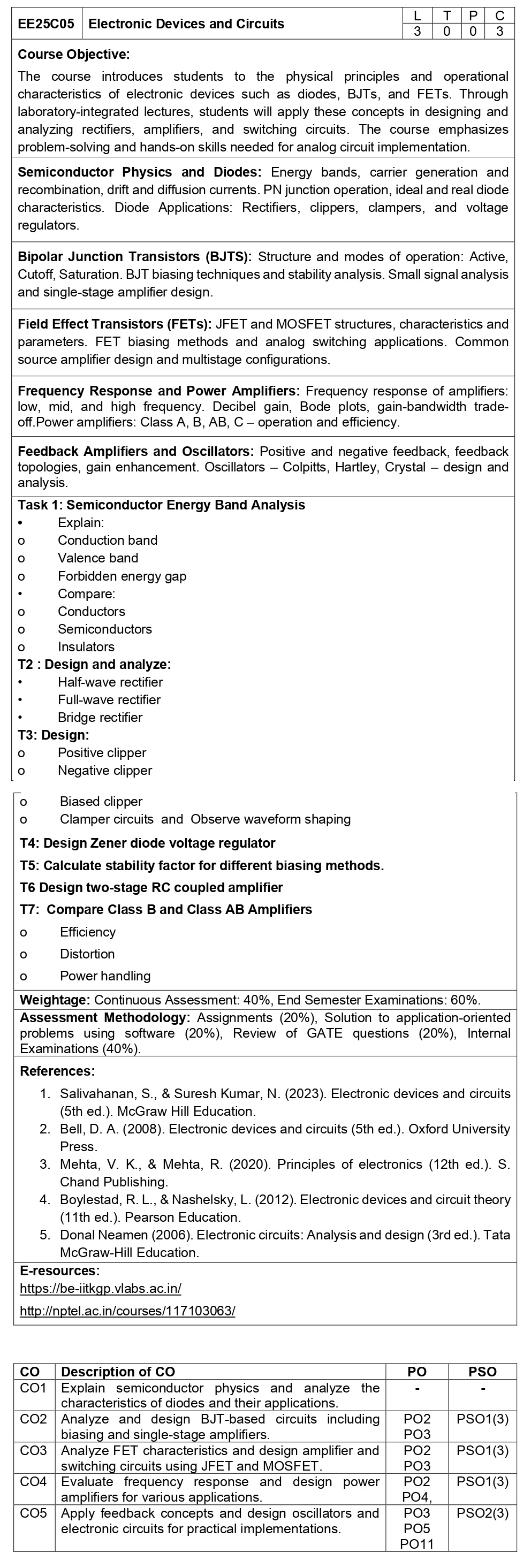
EE25C05:
Electronic Devices and Circuits
Course Objective:
The
course introduces students to the physical principles and operational
characteristics of electronic devices such as diodes, BJTs, and FETs. Through
laboratory-integrated lectures, students will apply these concepts in designing
and analyzing rectifiers, amplifiers, and switching circuits. The course
emphasizes problem-solving and hands-on skills needed for analog circuit
implementation.
Semiconductor
Physics and Diodes: Energy bands, carrier generation
and recombination, drift and diffusion currents. PN junction operation, ideal
and real diode characteristics. Diode Applications: Rectifiers, clippers,
clampers, and voltage regulators.
Bipolar
Junction Transistors (BJTS): Structure and modes of
operation: Active, Cutoff, Saturation. BJT biasing techniques and stability
analysis. Small signal analysis and single-stage amplifier design.
Field
Effect Transistors (FETs): JFET and MOSFET
structures, characteristics and parameters. FET biasing methods and analog
switching applications. Common source amplifier design and multistage
configurations.
Frequency
Response and Power Amplifiers: Frequency response of
amplifiers: low, mid, and high frequency. Decibel gain, Bode plots,
gain-bandwidth trade-off.Power amplifiers: Class A, B, AB, C – operation and
efficiency.
Feedback
Amplifiers and Oscillators: Positive and negative
feedback, feedback topologies, gain enhancement. Oscillators – Colpitts,
Hartley, Crystal – design and analysis.
Task 1: Semiconductor
Energy Band Analysis
•
Explain:
o
Conduction band
o
Valence band
o
Forbidden energy gap
•
Compare:
o
Conductors
o
Semiconductors
o
Insulators
T2 : Design and
analyze:
•
Half-wave rectifier
•
Full-wave rectifier
•
Bridge rectifier
T3: Design:
o
Positive clipper
o
Negative clipper
o
Biased clipper
o
Clamper circuits and Observe waveform shaping
T4: Design Zener diode
voltage regulator
T5: Calculate stability
factor for different biasing methods.
T6 :Design two-stage RC
coupled amplifier
T7: Compare Class B and
Class AB Amplifiers
o
Efficiency
o
Distortion
o
Power handling
Weightage:
Continuous Assessment: 40%, End Semester Examinations: 60%.
Assessment Methodology:
Assignments (20%), Solution to application-oriented problems using software
(20%), Review of GATE questions (20%), Internal Examinations (40%).
References:
1.
Salivahanan, S., & Suresh Kumar, N. (2023). Electronic devices and circuits
(5th ed.). McGraw Hill Education.
2.
Bell, D. A. (2008). Electronic devices and circuits (5th ed.). Oxford
University Press.
3.
Mehta, V. K., & Mehta, R. (2020). Principles of electronics (12th ed.). S.
Chand Publishing.
4.
Boylestad, R. L., & Nashelsky, L. (2012). Electronic devices and circuit
theory (11th ed.). Pearson Education.
5.
Donal Neamen (2006). Electronic circuits: Analysis and design (3rd ed.). Tata
McGraw-Hill
Education.