Electronic Devices and Circuits - EE25C05
[ 3rd Semester - EEE - Electrical and Electronics Engineering Department ]
Under Class: | 3rd Semester [EEE Dept Anna University 2025 Regulation] |
Electronic Devices and Circuits - EE25C05 - Study Materials, Notes, Important Questions, Anna University Semester Question Paper PDF Download
Engineering - Electronic Devices and Circuits - EE25C05 Subject (under Anna University 3rd Semester - EEE - Electrical and Electronics Engineering Department Regulation 2025) - Study Materials, Written and lecture Notes, Important Questions, Semester Question Paper PDF Download
EE25C05:
Electronic Devices and Circuits
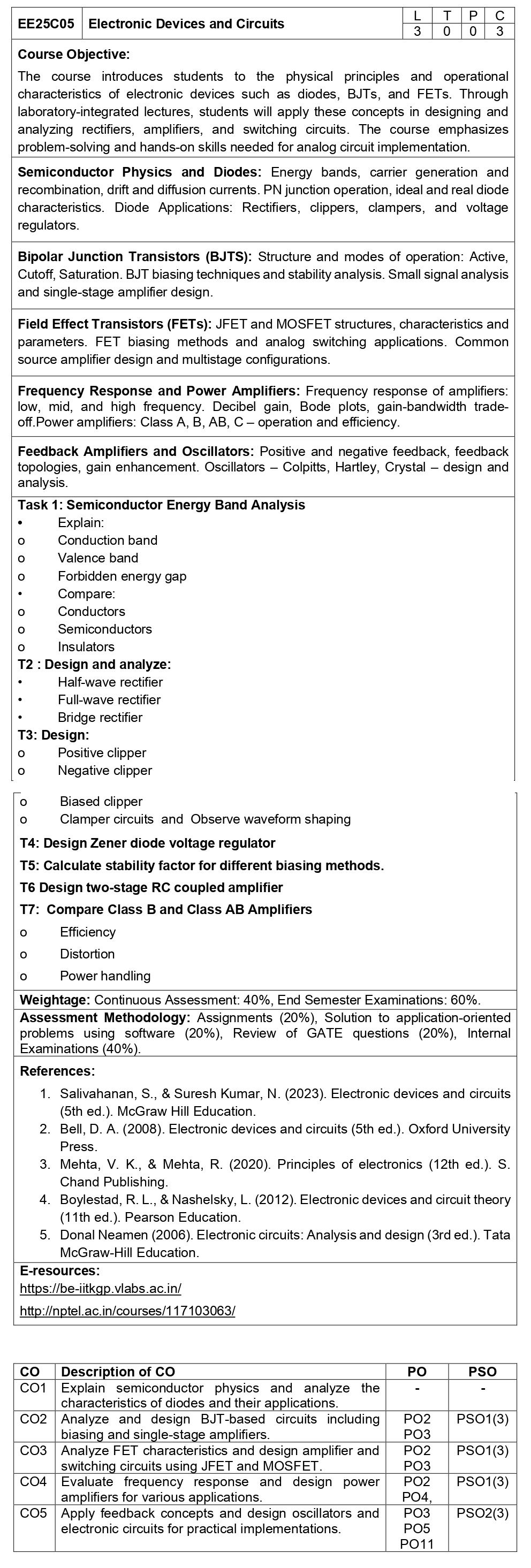
Course Objective:
The
course introduces students to the physical principles and operational
characteristics of electronic devices such as diodes, BJTs, and FETs. Through
laboratory-integrated lectures, students will apply these concepts in designing
and analyzing rectifiers, amplifiers, and switching circuits. The course
emphasizes problem-solving and hands-on skills needed for analog circuit
implementation.
Semiconductor
Physics and Diodes: Energy bands, carrier generation
and recombination, drift and diffusion currents. PN junction operation, ideal
and real diode characteristics. Diode Applications: Rectifiers, clippers,
clampers, and voltage regulators.
Bipolar
Junction Transistors (BJTS): Structure and modes of
operation: Active, Cutoff, Saturation. BJT biasing techniques and stability
analysis. Small signal analysis and single-stage amplifier design.
Field
Effect Transistors (FETs): JFET and MOSFET
structures, characteristics and parameters. FET biasing methods and analog
switching applications. Common source amplifier design and multistage
configurations.
Frequency
Response and Power Amplifiers: Frequency response of
amplifiers: low, mid, and high frequency. Decibel gain, Bode plots,
gain-bandwidth trade-off.Power amplifiers: Class A, B, AB, C – operation and
efficiency.
Feedback
Amplifiers and Oscillators: Positive and negative
feedback, feedback topologies, gain enhancement. Oscillators – Colpitts,
Hartley, Crystal – design and analysis.
Task 1: Semiconductor
Energy Band Analysis
•
Explain:
o
Conduction band
o
Valence band
o
Forbidden energy gap
•
Compare:
o
Conductors
o
Semiconductors
o
Insulators
T2 : Design and
analyze:
•
Half-wave rectifier
•
Full-wave rectifier
•
Bridge rectifier
T3: Design:
o
Positive clipper
o
Negative clipper
o
Biased clipper
o
Clamper circuits and Observe waveform shaping
T4: Design Zener diode
voltage regulator
T5: Calculate stability
factor for different biasing methods.
T6 :Design two-stage RC
coupled amplifier
T7: Compare Class B and
Class AB Amplifiers
o
Efficiency
o
Distortion
o
Power handling
Weightage:
Continuous Assessment: 40%, End Semester Examinations: 60%.
Assessment Methodology:
Assignments (20%), Solution to application-oriented problems using software
(20%), Review of GATE questions (20%), Internal Examinations (40%).
References:
1.
Salivahanan, S., & Suresh Kumar, N. (2023). Electronic devices and circuits
(5th ed.). McGraw Hill Education.
2.
Bell, D. A. (2008). Electronic devices and circuits (5th ed.). Oxford
University Press.
3.
Mehta, V. K., & Mehta, R. (2020). Principles of electronics (12th ed.). S.
Chand Publishing.
4.
Boylestad, R. L., & Nashelsky, L. (2012). Electronic devices and circuit
theory (11th ed.). Pearson Education.
5.
Donal Neamen (2006). Electronic circuits: Analysis and design (3rd ed.). Tata
McGraw-Hill
Education.