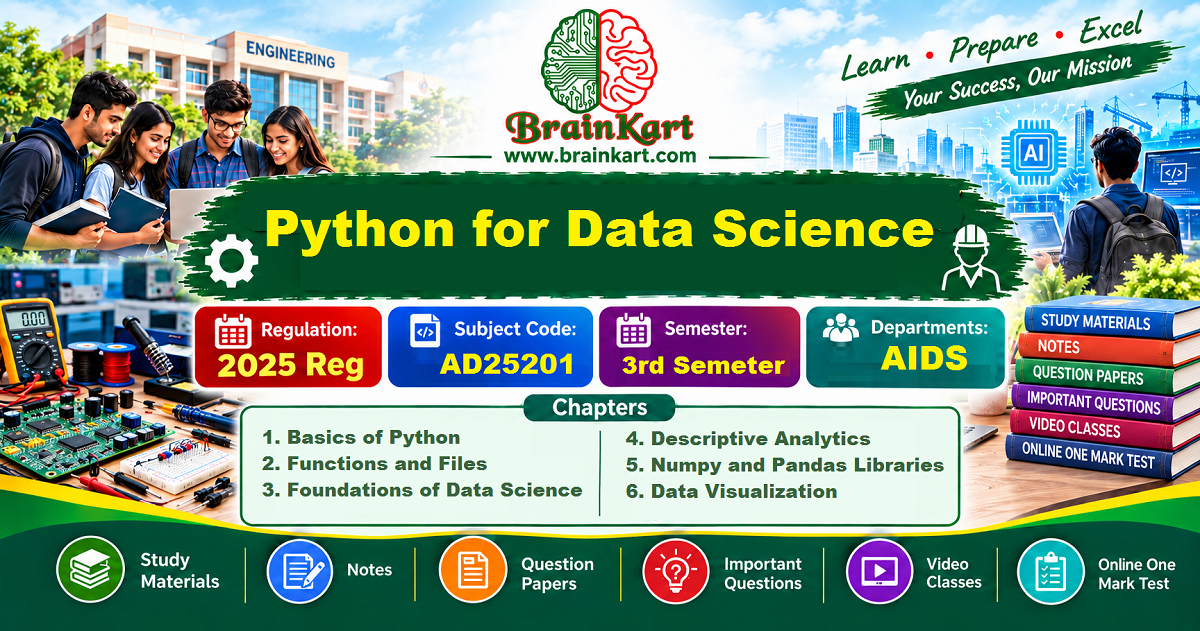
Python for Data Science - AD25201 - Question Bank PDF Download
[ 2nd Semester - AIDS - Artificial Intelligence and Data Science Department, 4th Semester - CSE(CY) - Computer Science and Engineering (Cyber Security) Department ]
Under Class: | 2nd Semester [AIDS Dept Anna University 2025 Regulation] | | 4th Semester [CSE Dept Anna University 2025 Regulation] | | 4th Semester [CSE(CY) Dept Anna University 2025 Regulation] |
Engineering - Python for Data Science - AD25201 Subject (under Anna University 2nd Semester - AIDS - Artificial Intelligence and Data Science Department Engineering Regulation 2025), 4th Semester - CSE(CY) - Computer Science and Engineering (Cyber Security) Department Regulation 2025) - Study Materials, Written and lecture Notes, Important Questions, Semester Question Paper PDF Download
Computer Science 12th Std
UNIT I: Problem Solving Techniques:
Chapter 1: Function:
• Function: Introduction
• Function with respect to Programming language
• Interface Vs Implementation
• Pure functions
• Points to remember - Problem Solving Techniques : Function
• Function: Book Back Questions and Answers
Chapter 2: Data Abstraction:
• Data Abstraction - Introduction
• Abstract Data Types
• constructors and selectors
• Representation of Abstract datatype using Rational numbers
• Lists, Tuples
• Data Abstraction in Structure
• Data Abstraction : Points to remember
• Data Abstraction: Book Back Questions and Answers
Chapter 3: Scoping:
• Scoping
• Variable Scope
• LEGB rule
• Types of Variable Scope
• Module
• Scoping: Points to remember
• Scoping: Book Back Questions and Answers
Chapter 4: Algorithmic Strategies:
• Introduction to Algorithmic strategies
• Complexity of an Algorithm
• Efficiency of an algorithm
• Algorithm for Searching Techniques
• Sorting Techniques
• Dynamic programming
• Algorithmic Strategies: Points to remember
• Algorithmic Strategies: Book Back Questions and Answers
UNIT II: Core Python:
Chapter 5: Python Variables and Operators:
• Python Introduction
• Key features of Python
• Programming in Python
• Input and Output Functions
• Comments in Python
• Indentation
• Tokens
• Python Data types
• Python Variables and Operators: Points to remember
• Python Variables and Operators: Book Back Questions and Answers
Chapter 6: Control Structures:
• Introduction of Python Control Structures
• Python Control Structures
• Python Control Structures: Points to remember
• Python Control Structures: Book Back Questions and Answers
Chapter 7: Python Functions:
• Python Functions
• Types of Python Functions
• Defining Functions in Python
• Calling a Function
• Passing Parameters in Functions
• Function Arguments
• Anonymous Functions
• The return Statement
• Scope of Variables
• Functions using libraries
• Python recursive functions
• Python Functions: Points to remember
• Python Functions: Book Back Questions and Answers
Chapter 8: Strings and String Manipulation:
• Strings and String Manipulation - Introduction
• Creating Strings
• Accessing characters in a String
• Modifying and Deleting Strings
• String Operators
• String Formatting Operators
• Formatting characters
• The format( ) function
• Built-in String functions
• Membership Operators
• Programs using Strings
• Python Strings and String Manipulation: Points to remember
• Python Strings and String Manipulation: Book Back Questions and Answers
UNIT III: Python Modularity and OOPS:
Chapter 9: Lists, Tuples, Sets And Dictionary:
• Introduction to List
• Python Programs using List
• Introduction to Tuples
• Programs using Tuples
• Dictionaries
• Python Lists, Tuples, Sets And Dictionary: Points to remember
• Python Lists, Tuples, Sets And Dictionary : Book Back Questions and Answers
Chapter 10: Python Classes and Objects:
• Python Classes and Objects
• Defining classes
• Creating Objects
• Accessing Class Members
• Class Methods
• Constructor and Destructor in Python
• Public and Private Data Members
• Sample Python Programs to illustrate classes and objects
• Points to remember
• Python Classes and Objects: Book Back Questions and Answers
Problem Solving and Python Programming
UNIT I: COMPUTATIONAL THINKING AND PROBLEM SOLVING:
• Problem Solving Techniques
• Algorithm
• Building blocks of algorithms (statements, state, control flow, functions)
• Notation
• Flow chart
• Pseudo code
• programming language
• Categories of programming languages
• Algorithmic problem solving
• Simple Strategies For Developing Algorithms
• Examples algorithms: pseudo code, flow chart, programming language
• Basic python programs
• Python Algorithmic Problem Solving: short important questions and answers
• Python Algorithmic Problem Solving: brief important questions and answers
UNIT II: DATA TYPES, EXPRESSIONS, STATEMENTS:
• Introduction to Python
• Python interpreter
• Modes of Python Interpreter
• Values and Data Types
• Variables - Python
• Keywords - Python
• Identifiers - Python
• Statements and Expressions - Python
• Input and Output - Python
• Comments - Python
• Docstring - Python
• Lines and Indentation - Python
• Quotation in Python
• Tuple Assignment - Python
• Operators and Types of Operators - Python
• Operator Precedence - Python
• Functions - Python
• Types of function
• Function definition(Sub program) - Python
• Flow of Execution - Python
• Function Prototypes
• Parameters and Arguments - Python
• Modules - Python
• Python Programs - Data, Expressions, Statements
• Python Data, Expressions, Statements: short important questions and answers
• Python Data, Expressions, Statements: brief important questions and answers
UNIT III: CONTROL FLOW, FUNCTIONS, STRINGS:
• Boolean Values
• Conditionals - Python
• Iteration/Control Statements - Python
• Fruitful Function - Python
• Strings - Python
• List as array - Python
• Example Python Programs: Control Flow, Functions
• Python Control Flow, Functions: short important questions and answers
• Python Control Flow, Functions: brief important questions and answers
UNIT IV: LISTS, TUPLES, DICTIONARIES:
• Lists - Python
• Tuple - Python
• Dictionaries - Python
• Difference between List, Tuples and dictionary
• Advanced list processing - Python
• Python Programs on matrix
• Python Programs on Lists, Tuples, Dictionaries
• Python Lists, Tuples, Dictionaries: short important questions and answers
• Python Lists, Tuples, Dictionaries: brief important questions and answers
UNIT I : Algorithmic Problem Solving:
• Programming Algorithm
• Flowcharts
• Guidelines For Drawing a Flowchart
• Pseudocode
• Example Programming Algorithm, Pseudocode, Flowchart
UNIT II : Data Expressions Statements:
• What is a program?
• Python programming language
• Values and types - Python
• Expressions and statements - Python
• Python Tuple
• Python Strings
• Comments - Python
• Python Output Using print() function
• Modules - Python
• Python Import
• Operators and operands
• Type of operators in Python
• Functions - Python
• Flow of execution - Python
• Parameters and arguments - Python
• Python Basic Programs
UNIT III : Control Flow Functions:
• Conditionals - Python
• Recursion - Python
• Iteration - Python
• Fruitful Functions - Python
• Strings - Python
• Example Python Programs on Control Flow, Functions
UNIT IV : Lists Tuples Dictionaries:
• Lists - Python
• Tuples - Python
• Python dictionary
• Python Advanced list processing
• Example Python Programs on Lists, Tuples, Dictionaries
UNIT V : Files Modules Packages:
• Files - Python
• Exception - Python
• Modules - Python
• Package - Python
• Python Files, Modules, Packages: short important questions and answers
• Example Python Programs on Files, Modules, Packages
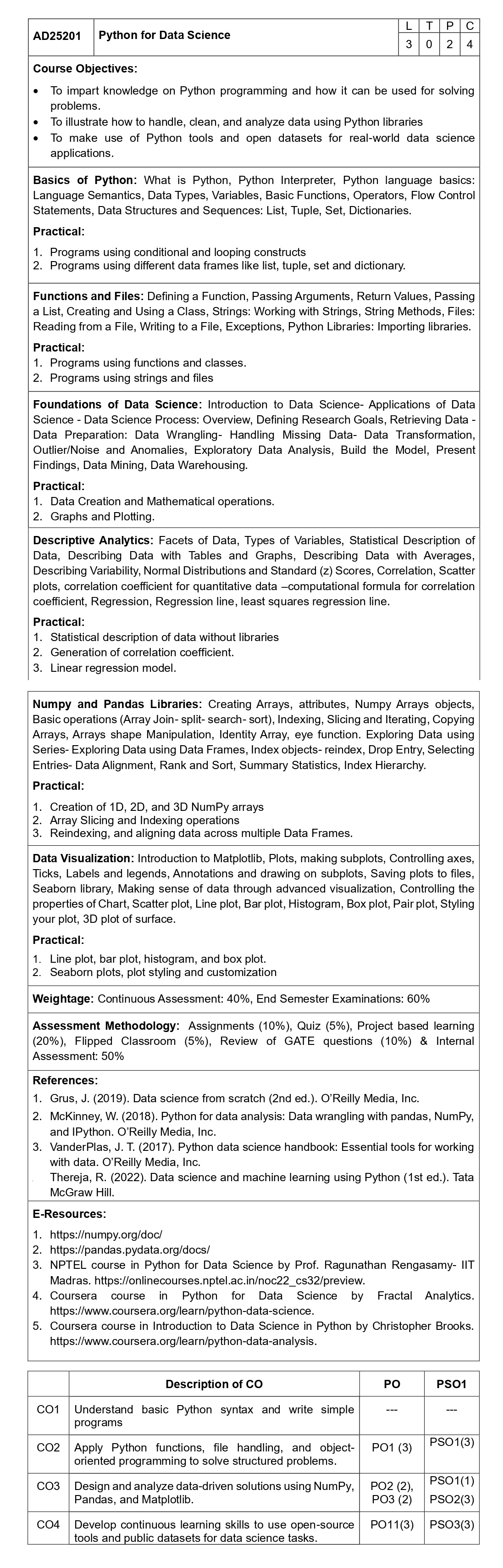
Course
Objectives:
•
To impart knowledge on Python programming and how it can be used for solving
problems.
•
To illustrate how to handle, clean, and analyze data using Python libraries
•
To make use of Python tools and open datasets for real-world data science
applications.
Basics of
Python: What is Python, Python Interpreter,
Python language basics: Language Semantics, Data Types, Variables, Basic
Functions, Operators, Flow Control Statements, Data Structures and Sequences:
List, Tuple, Set, Dictionaries.
Practical:
1.
Programs using conditional and looping constructs
2.
Programs using different data frames like list, tuple, set and dictionary.
Functions
and Files: Defining a Function, Passing Arguments,
Return Values, Passing a List, Creating and Using a Class, Strings: Working
with Strings, String Methods, Files: Reading from a File, Writing to a File,
Exceptions, Python Libraries: Importing libraries.
Practical:
1.
Programs using functions and classes.
2.
Programs using strings and files
Foundations
of Data Science: Introduction to Data Science-
Applications of Data Science - Data Science Process: Overview, Defining
Research Goals, Retrieving Data - Data Preparation: Data Wrangling- Handling
Missing Data- Data Transformation, Outlier/Noise and Anomalies, Exploratory
Data Analysis, Build the Model, Present Findings, Data Mining, Data
Warehousing.
Practical:
1.
Data Creation and Mathematical operations.
2.
Graphs and Plotting.
Descriptive
Analytics: Facets of Data, Types of Variables,
Statistical Description of Data, Describing Data with Tables and Graphs,
Describing Data with Averages, Describing Variability, Normal Distributions and
Standard (z) Scores, Correlation, Scatter plots, correlation coefficient for
quantitative data –computational formula for correlation coefficient,
Regression, Regression line, least squares regression line.
Practical:
1.
Statistical description of data without libraries
2.
Generation of correlation coefficient.
3.
Linear regression model.
Numpy and
Pandas Libraries: Creating Arrays, attributes, Numpy
Arrays objects, Basic operations (Array Join- split- search- sort), Indexing,
Slicing and Iterating, Copying Arrays, Arrays shape Manipulation, Identity
Array, eye function. Exploring Data using Series- Exploring Data using Data
Frames, Index objects- reindex, Drop Entry, Selecting Entries- Data Alignment,
Rank and Sort, Summary Statistics, Index Hierarchy.
Practical:
1.
Creation of 1D, 2D, and 3D NumPy arrays
2.
Array Slicing and Indexing operations
3.
Reindexing, and aligning data across multiple Data Frames.
Data
Visualization: Introduction to Matplotlib, Plots,
making subplots, Controlling axes, Ticks, Labels and legends, Annotations and
drawing on subplots, Saving plots to files, Seaborn library, Making sense of
data through advanced visualization, Controlling the properties of Chart, Scatter
plot, Line plot, Bar plot, Histogram, Box plot, Pair plot, Styling your plot,
3D plot of surface.
Practical:
1.
Line plot, bar plot, histogram, and box plot.
2.
Seaborn plots, plot styling and customization
Weightage: Continuous Assessment: 40%, End Semester Examinations: 60%
Assessment Methodology:
Assignments (10%), Quiz (5%), Project based learning (20%), Flipped Classroom
(5%), Review of GATE questions (10%) & Internal Assessment: 50%
References:
1.
Grus, J. (2019). Data science from scratch (2nd ed.). O’Reilly Media, Inc.
2.
McKinney, W. (2018). Python for data analysis: Data wrangling with pandas,
NumPy, and IPython. O’Reilly Media, Inc.
3.
VanderPlas, J. T. (2017). Python data science handbook: Essential tools for
working with data. O’Reilly Media, Inc.
4.
Thereja, R. (2022). Data science and machine learning using Python (1st ed.).
Tata
McGraw
Hill.
E-Resources:
1.
https://numpy.org/doc/
2.
https://pandas.pydata.org/docs/
3.
NPTEL course in Python for Data Science by Prof. Ragunathan Rengasamy- IIT
Madras. https://onlinecourses.nptel.ac.in/noc22_cs32/preview.
4.
Coursera course in Python for Data Science by Fractal Analytics.
https://www.coursera.org/learn/python-data-science.
5.
Coursera course in Introduction to Data Science in Python by Christopher
Brooks. https://www.coursera.org/learn/python-data-analysis.