Python for Data Science - AD25201
[ 2nd Semester - AIDS - Artificial Intelligence and Data Science Department ]
Under Class: | 2nd Semester [AIDS Dept Anna University 2025 Regulation] |
Python for Data Science - AD25201 - Study Materials, Notes, Important Questions, Anna University Semester Question Paper PDF Download
Engineering - Python for Data Science - AD25201 Subject (under Anna University 2nd Semester - AIDS - Artificial Intelligence and Data Science Department Engineering Regulation 2025) - Study Materials, Written and lecture Notes, Important Questions, Semester Question Paper PDF Download
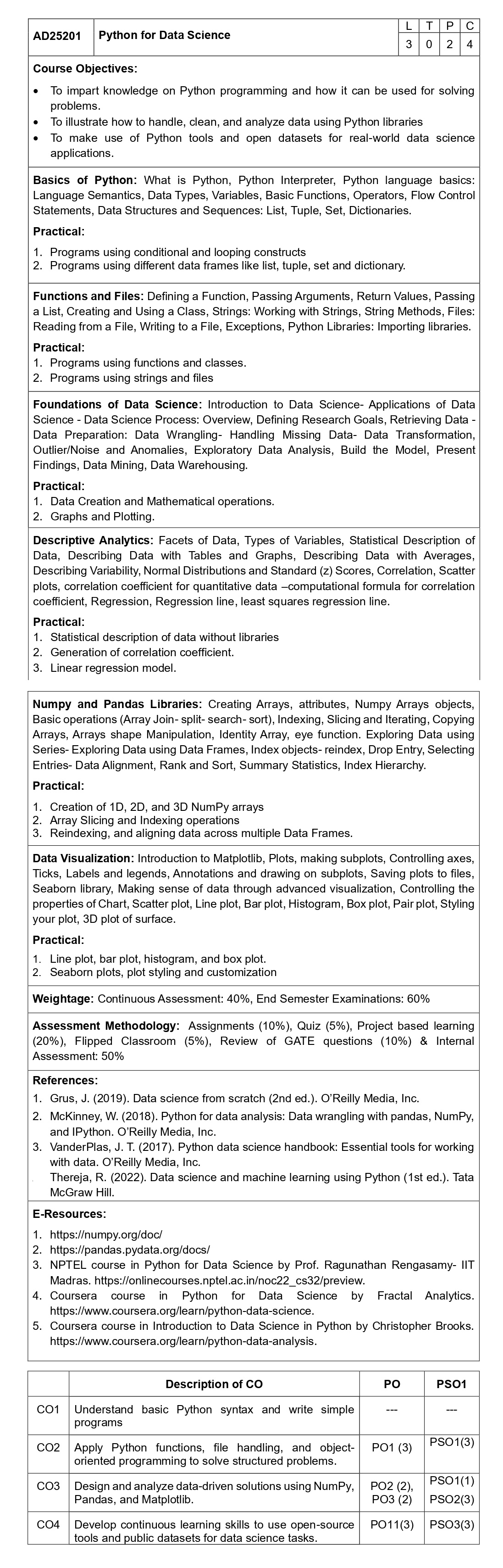
Course
Objectives:
•
To impart knowledge on Python programming and how it can be used for solving
problems.
•
To illustrate how to handle, clean, and analyze data using Python libraries
•
To make use of Python tools and open datasets for real-world data science
applications.
Basics of
Python: What is Python, Python Interpreter,
Python language basics: Language Semantics, Data Types, Variables, Basic
Functions, Operators, Flow Control Statements, Data Structures and Sequences:
List, Tuple, Set, Dictionaries.
Practical:
1.
Programs using conditional and looping constructs
2.
Programs using different data frames like list, tuple, set and dictionary.
Functions
and Files: Defining a Function, Passing Arguments,
Return Values, Passing a List, Creating and Using a Class, Strings: Working
with Strings, String Methods, Files: Reading from a File, Writing to a File,
Exceptions, Python Libraries: Importing libraries.
Practical:
1.
Programs using functions and classes.
2.
Programs using strings and files
Foundations
of Data Science: Introduction to Data Science-
Applications of Data Science - Data Science Process: Overview, Defining
Research Goals, Retrieving Data - Data Preparation: Data Wrangling- Handling
Missing Data- Data Transformation, Outlier/Noise and Anomalies, Exploratory
Data Analysis, Build the Model, Present Findings, Data Mining, Data
Warehousing.
Practical:
1.
Data Creation and Mathematical operations.
2.
Graphs and Plotting.
Descriptive
Analytics: Facets of Data, Types of Variables,
Statistical Description of Data, Describing Data with Tables and Graphs,
Describing Data with Averages, Describing Variability, Normal Distributions and
Standard (z) Scores, Correlation, Scatter plots, correlation coefficient for
quantitative data –computational formula for correlation coefficient,
Regression, Regression line, least squares regression line.
Practical:
1.
Statistical description of data without libraries
2.
Generation of correlation coefficient.
3.
Linear regression model.
Numpy and
Pandas Libraries: Creating Arrays, attributes, Numpy
Arrays objects, Basic operations (Array Join- split- search- sort), Indexing,
Slicing and Iterating, Copying Arrays, Arrays shape Manipulation, Identity
Array, eye function. Exploring Data using Series- Exploring Data using Data
Frames, Index objects- reindex, Drop Entry, Selecting Entries- Data Alignment,
Rank and Sort, Summary Statistics, Index Hierarchy.
Practical:
1.
Creation of 1D, 2D, and 3D NumPy arrays
2.
Array Slicing and Indexing operations
3.
Reindexing, and aligning data across multiple Data Frames.
Data
Visualization: Introduction to Matplotlib, Plots,
making subplots, Controlling axes, Ticks, Labels and legends, Annotations and
drawing on subplots, Saving plots to files, Seaborn library, Making sense of
data through advanced visualization, Controlling the properties of Chart, Scatter
plot, Line plot, Bar plot, Histogram, Box plot, Pair plot, Styling your plot,
3D plot of surface.
Practical:
1.
Line plot, bar plot, histogram, and box plot.
2.
Seaborn plots, plot styling and customization
Weightage: Continuous Assessment: 40%, End Semester Examinations: 60%
Assessment Methodology:
Assignments (10%), Quiz (5%), Project based learning (20%), Flipped Classroom
(5%), Review of GATE questions (10%) & Internal Assessment: 50%
References:
1.
Grus, J. (2019). Data science from scratch (2nd ed.). O’Reilly Media, Inc.
2.
McKinney, W. (2018). Python for data analysis: Data wrangling with pandas,
NumPy, and IPython. O’Reilly Media, Inc.
3.
VanderPlas, J. T. (2017). Python data science handbook: Essential tools for
working with data. O’Reilly Media, Inc.
4.
Thereja, R. (2022). Data science and machine learning using Python (1st ed.).
Tata
McGraw
Hill.
E-Resources:
1.
https://numpy.org/doc/
2.
https://pandas.pydata.org/docs/
3.
NPTEL course in Python for Data Science by Prof. Ragunathan Rengasamy- IIT
Madras. https://onlinecourses.nptel.ac.in/noc22_cs32/preview.
4.
Coursera course in Python for Data Science by Fractal Analytics.
https://www.coursera.org/learn/python-data-science.
5.
Coursera course in Introduction to Data Science in Python by Christopher
Brooks. https://www.coursera.org/learn/python-data-analysis.