Foundations of Data Science using Python - IT25201
[ 2nd Semester - IT - Information Technology Department ]
Under Class: | 2nd Semester [IT Dept Anna University 2025 Regulation] |
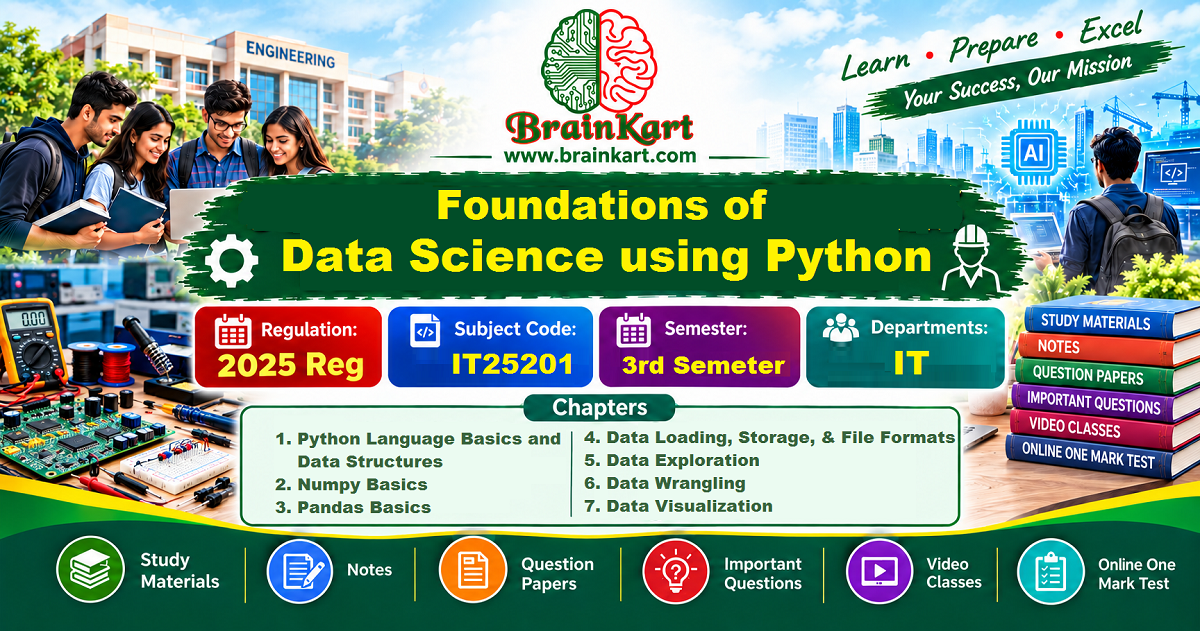
Foundations of Data Science using Python - IT25201 - Study Materials, Notes, Important Questions, Anna University Semester Question Paper PDF Download
Engineering - Foundations of Data Science using Python - IT25201 Subject (under Anna University 2nd Semester - IT Information Technology Engineering Regulation 2025) - Study Materials, Written and lecture Notes, Important Questions, Semester Question Paper PDF Download
Computer Science 12th Std
UNIT I: Problem Solving Techniques:
Chapter 1: Function:
• Function: Introduction
• Function with respect to Programming language
• Interface Vs Implementation
• Pure functions
• Points to remember - Problem Solving Techniques : Function
• Function: Book Back Questions and Answers
Chapter 2: Data Abstraction:
• Data Abstraction - Introduction
• Abstract Data Types
• constructors and selectors
• Representation of Abstract datatype using Rational numbers
• Lists, Tuples
• Data Abstraction in Structure
• Data Abstraction : Points to remember
• Data Abstraction: Book Back Questions and Answers
Chapter 3: Scoping:
• Scoping
• Variable Scope
• LEGB rule
• Types of Variable Scope
• Module
• Scoping: Points to remember
• Scoping: Book Back Questions and Answers
Chapter 4: Algorithmic Strategies:
• Introduction to Algorithmic strategies
• Complexity of an Algorithm
• Efficiency of an algorithm
• Algorithm for Searching Techniques
• Sorting Techniques
• Dynamic programming
• Algorithmic Strategies: Points to remember
• Algorithmic Strategies: Book Back Questions and Answers
UNIT II: Core Python:
Chapter 5: Python Variables and Operators:
• Python Introduction
• Key features of Python
• Programming in Python
• Input and Output Functions
• Comments in Python
• Indentation
• Tokens
• Python Data types
• Python Variables and Operators: Points to remember
• Python Variables and Operators: Book Back Questions and Answers
Chapter 6: Control Structures:
• Introduction of Python Control Structures
• Python Control Structures
• Python Control Structures: Points to remember
• Python Control Structures: Book Back Questions and Answers
Chapter 7: Python Functions:
• Python Functions
• Types of Python Functions
• Defining Functions in Python
• Calling a Function
• Passing Parameters in Functions
• Function Arguments
• Anonymous Functions
• The return Statement
• Scope of Variables
• Functions using libraries
• Python recursive functions
• Python Functions: Points to remember
• Python Functions: Book Back Questions and Answers
Chapter 8: Strings and String Manipulation:
• Strings and String Manipulation - Introduction
• Creating Strings
• Accessing characters in a String
• Modifying and Deleting Strings
• String Operators
• String Formatting Operators
• Formatting characters
• The format( ) function
• Built-in String functions
• Membership Operators
• Programs using Strings
• Python Strings and String Manipulation: Points to remember
• Python Strings and String Manipulation: Book Back Questions and Answers
UNIT III: Python Modularity and OOPS:
Chapter 9: Lists, Tuples, Sets And Dictionary:
• Introduction to List
• Python Programs using List
• Introduction to Tuples
• Programs using Tuples
• Dictionaries
• Python Lists, Tuples, Sets And Dictionary: Points to remember
• Python Lists, Tuples, Sets And Dictionary : Book Back Questions and Answers
Chapter 10: Python Classes and Objects:
• Python Classes and Objects
• Defining classes
• Creating Objects
• Accessing Class Members
• Class Methods
• Constructor and Destructor in Python
• Public and Private Data Members
• Sample Python Programs to illustrate classes and objects
• Points to remember
• Python Classes and Objects: Book Back Questions and Answers
Problem Solving and Python Programming
UNIT I: COMPUTATIONAL THINKING AND PROBLEM SOLVING:
• Problem Solving Techniques
• Algorithm
• Building blocks of algorithms (statements, state, control flow, functions)
• Notation
• Flow chart
• Pseudo code
• programming language
• Categories of programming languages
• Algorithmic problem solving
• Simple Strategies For Developing Algorithms
• Examples algorithms: pseudo code, flow chart, programming language
• Basic python programs
• Python Algorithmic Problem Solving: short important questions and answers
• Python Algorithmic Problem Solving: brief important questions and answers
UNIT II: DATA TYPES, EXPRESSIONS, STATEMENTS:
• Introduction to Python
• Python interpreter
• Modes of Python Interpreter
• Values and Data Types
• Variables - Python
• Keywords - Python
• Identifiers - Python
• Statements and Expressions - Python
• Input and Output - Python
• Comments - Python
• Docstring - Python
• Lines and Indentation - Python
• Quotation in Python
• Tuple Assignment - Python
• Operators and Types of Operators - Python
• Operator Precedence - Python
• Functions - Python
• Types of function
• Function definition(Sub program) - Python
• Flow of Execution - Python
• Function Prototypes
• Parameters and Arguments - Python
• Modules - Python
• Python Programs - Data, Expressions, Statements
• Python Data, Expressions, Statements: short important questions and answers
• Python Data, Expressions, Statements: brief important questions and answers
UNIT III: CONTROL FLOW, FUNCTIONS, STRINGS:
• Boolean Values
• Conditionals - Python
• Iteration/Control Statements - Python
• Fruitful Function - Python
• Strings - Python
• List as array - Python
• Example Python Programs: Control Flow, Functions
• Python Control Flow, Functions: short important questions and answers
• Python Control Flow, Functions: brief important questions and answers
UNIT IV: LISTS, TUPLES, DICTIONARIES:
• Lists - Python
• Tuple - Python
• Dictionaries - Python
• Difference between List, Tuples and dictionary
• Advanced list processing - Python
• Python Programs on matrix
• Python Programs on Lists, Tuples, Dictionaries
• Python Lists, Tuples, Dictionaries: short important questions and answers
• Python Lists, Tuples, Dictionaries: brief important questions and answers
UNIT I : Algorithmic Problem Solving:
• Programming Algorithm
• Flowcharts
• Guidelines For Drawing a Flowchart
• Pseudocode
• Example Programming Algorithm, Pseudocode, Flowchart
UNIT II : Data Expressions Statements:
• What is a program?
• Python programming language
• Values and types - Python
• Expressions and statements - Python
• Python Tuple
• Python Strings
• Comments - Python
• Python Output Using print() function
• Modules - Python
• Python Import
• Operators and operands
• Type of operators in Python
• Functions - Python
• Flow of execution - Python
• Parameters and arguments - Python
• Python Basic Programs
UNIT III : Control Flow Functions:
• Conditionals - Python
• Recursion - Python
• Iteration - Python
• Fruitful Functions - Python
• Strings - Python
• Example Python Programs on Control Flow, Functions
UNIT IV : Lists Tuples Dictionaries:
• Lists - Python
• Tuples - Python
• Python dictionary
• Python Advanced list processing
• Example Python Programs on Lists, Tuples, Dictionaries
UNIT V : Files Modules Packages:
• Files - Python
• Exception - Python
• Modules - Python
• Package - Python
• Python Files, Modules, Packages: short important questions and answers
• Example Python Programs on Files, Modules, Packages
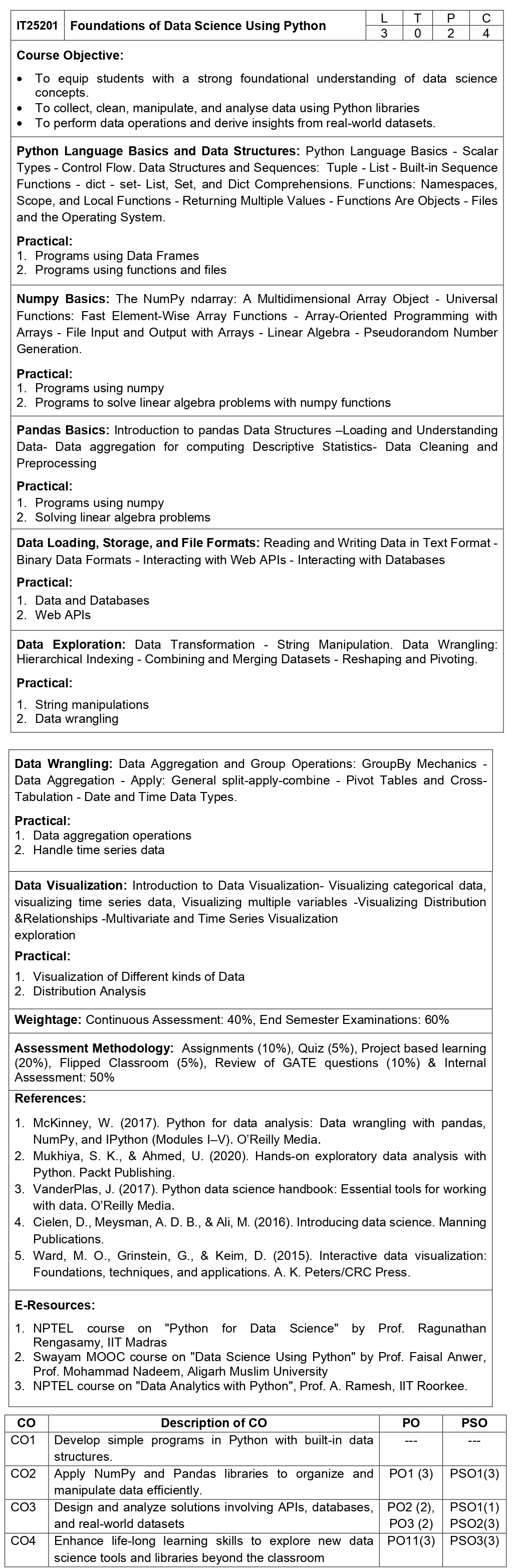
IT25201:
Foundations of Data Science Using Python
Course
Objective:
•
To equip students with a strong foundational understanding of data science
concepts.
•
To collect, clean, manipulate, and analyse data using Python libraries
•
To perform data operations and derive insights from real-world datasets.
Python
Language Basics and Data Structures: Python Language Basics
- Scalar Types - Control Flow. Data Structures and Sequences: Tuple - List -
Built-in Sequence Functions - dict - set- List, Set, and Dict Comprehensions.
Functions: Namespaces, Scope, and Local Functions - Returning Multiple Values -
Functions Are Objects - Files and the Operating System.
Practical:
1.
Programs using Data Frames
2.
Programs using functions and files.
Numpy
Basics: The NumPy ndarray: A Multidimensional
Array Object - Universal Functions: Fast Element-Wise Array Functions -
Array-Oriented Programming with Arrays - File Input and Output with Arrays -
Linear Algebra - Pseudorandom Number Generation.
Practical:
1.Programs
using numpy
2.Programs
to solve linear algebra problems with numpy functions
Pandas
Basics: Introduction to pandas Data Structures
–Loading and Understanding Data- Data aggregation for computing Descriptive
Statistics- Data Cleaning and Preprocessing
Practical:
1.
Programs using numpy
2.
Solving linear algebra problems
Data
Loading, Storage, and File Formats: Reading and Writing
Data in Text Format - Binary Data Formats - Interacting with Web APIs -
Interacting with Databases
Practical:
1.
Data and Databases
2.
Web APIs
Data
Exploration: Data Transformation - String
Manipulation. Data Wrangling: Hierarchical Indexing - Combining and Merging
Datasets - Reshaping and Pivoting.
Practical:
1.
String manipulations
2.
Data wrangling
Data
Wrangling: Data Aggregation and Group Operations:
GroupBy Mechanics - Data Aggregation - Apply: General split-apply-combine -
Pivot Tables and Cross-Tabulation - Date and Time Data Types.
Practical:
1.
Data aggregation operations
2.
Handle time series data
Data
Visualization: Introduction to Data Visualization-
Visualizing categorical data, visualizing time series data, Visualizing
multiple variables -Visualizing Distribution &Relationships -Multivariate
and Time Series Visualization exploration
Practical:
1.
Visualization of Different kinds of Data
2.
Distribution Analysis
Weightage:
Continuous Assessment: 40%, End Semester Examinations: 60%
Assessment Methodology:
Assignments (10%), Quiz (5%), Project based learning (20%), Flipped Classroom
(5%), Review of GATE questions (10%) & Internal Assessment: 50%
References:
1.
McKinney, W. (2017). Python for data analysis: Data wrangling with pandas,
NumPy, and IPython (Modules I–V). O’Reilly Media.
2.
Mukhiya, S. K., & Ahmed, U. (2020). Hands-on exploratory data analysis with
Python. Packt Publishing.
3.
VanderPlas, J. (2017). Python data science handbook: Essential tools for
working with data. O’Reilly Media.
4.
Cielen, D., Meysman, A. D. B., & Ali, M. (2016). Introducing data science.
Manning Publications.
5.
Ward, M. O., Grinstein, G., & Keim, D. (2015). Interactive data
visualization: Foundations, techniques, and applications. A. K. Peters/CRC
Press.