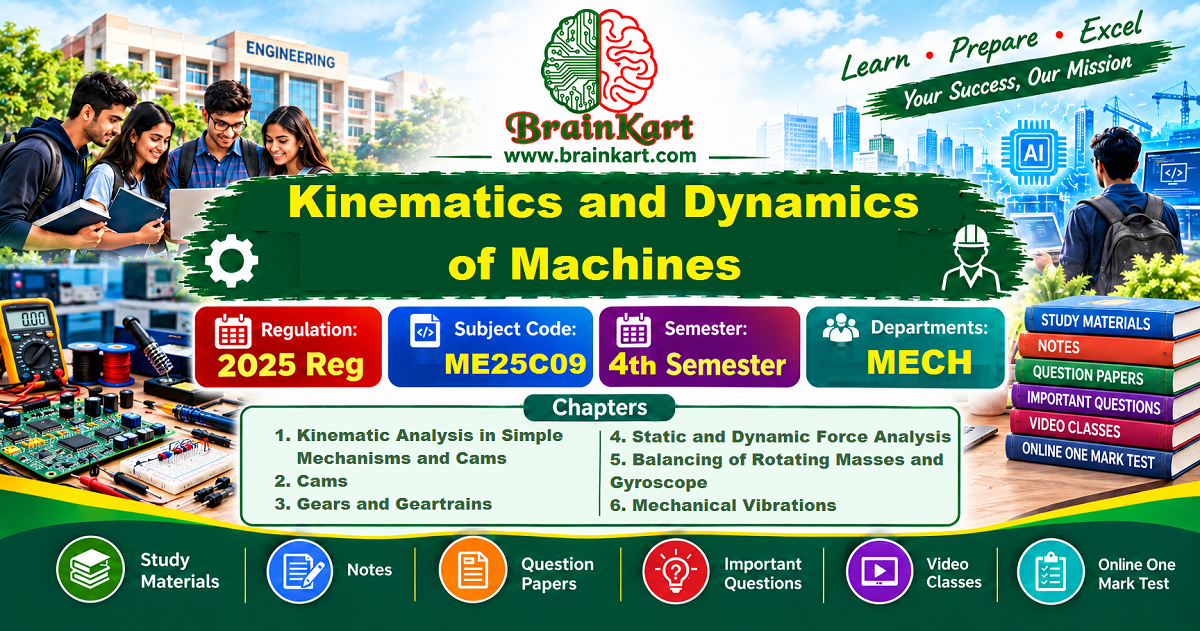
Kinematics and Dynamics of Machines - ME25C09
[ 4th Semester - Mechanical Engineering Department ]
Under Class: | 4th Semester [Mechanical Dept Anna University 2025 Regulation] |
Kinematics and Dynamics of Machines - ME25C09 - Study Materials, Notes, Important Questions, Anna University Semester Question Paper PDF Download
Engineering - Kinematics and Dynamics of Machines - ME25C09 Subject (under Anna University 4th Semester - Mechanical Engineering Department Regulation 2025) - Study Materials, Written and lecture Notes, Important Questions, Semester Question Paper PDF Download
Kinematics of Machinery
BASICS OF MECHANISMS:
• Basics of Mechanisms
• Types of Kinematic Pairs
• Degrees of Freedom
• Kutzbach criterion, Grashoff's law Kutzbach criterion
• Grashoff's law
• Kinematic Inversions of 4-bar chain and slider crank chains
• Whitworth quick return motion mechanism
• Description of common mechanisms-Single, Double and offset slider mechanisms - Quick return mechanisms
• Straight line generators, Design of Crank-rocker Mechanisms
• Important Short Questions and Answers: Basics of Mechanisms
KINEMATICS OF LINKAGE MECHANISMS:
• Kinematics of Linkage Mechanisms
• Important Short Questions and Answers: Kinematics Of Linkage Mechanisms
KINEMATICS OF CAM MECHANISMS:
• Kinematics of Cam Mechanisms Cams
• Important Short Questions and Answers: Kinematics of Cam Mechanisms Cams
GEARS AND GEAR TRAINS:
• Gears and Trains
• Fundamental Law of Gear-Tooth
• Spur Gear Terminology
• Worm, Rack and Pinion Gears
• Parallel axis and Epicyclic gear trains
• Gear Classification
• Important Short Questions and Answers: Gears and Trains
FRICTION IN MACHINE ELEMENTS:
• Friction in the Machine Elements
• Important Short Questions and Answers: Friction in the Machine Elements
Dynamics of Machines
FORCE ANALYSIS:
• Venture Capital
• Short Answers: Fund Based Financial Services
• Force Analysis
• Types of Force Analysis
• Dynamic Analysis of Four Bar Mechanism
• Klien�s Construction
• Approximate Analytical Method for Velocity and Acceleration of the Piston
• Angular Velocity and Acceleration of the Connecting Rod
• Forces on the Reciprocating Parts of an Engine, Neglecting the Weight of the Connecting Rod
• Equivalent Dynamical System
• Correction Couple to be Applied to Make two Mass System Dynamically Equivalent
• Inertia Forces in a Reciprocating Engine, Considering the Weight of connecting Rod
• Turning Moment Diagram
• Fluctuation of Energy
• Flywheel
• Important Short Question and Answers: Force Analysis
BALANCING:
• Balancing of Rotating Masses
• Balancing of a Single, Several and Reciprocating Rotating Mass
• Balancing of Single Cylinder Engine
• Balancing of Inertial Forces in the Multi-Cylinder Engine
• Partial Balancing of Locomotives
• Balancing of Inline Engines and Radial Engines
• Solved Problems: Dynamics of Machines - Balancing
• Important Short Questions and Answers: Dynamics of Machines - Balancing
FREE VIBRATION:
• Single Degree Free Vibration
• Solved Problems: Single Degree Free Vibration
• Important Short Questions and Answers: Single Degree Free Vibration
FORCED VIBRATION:
• Forced Vibration
• Solved Problems: Forced Vibration
• Important Short Questions and Answers: Forced Vibration
MECHANISM FOR CONTROL:
• Mechanisms For Control
• Solved Problems: Mechanisms For Control
• Important Short Questions and Answers: Mechanisms For Control
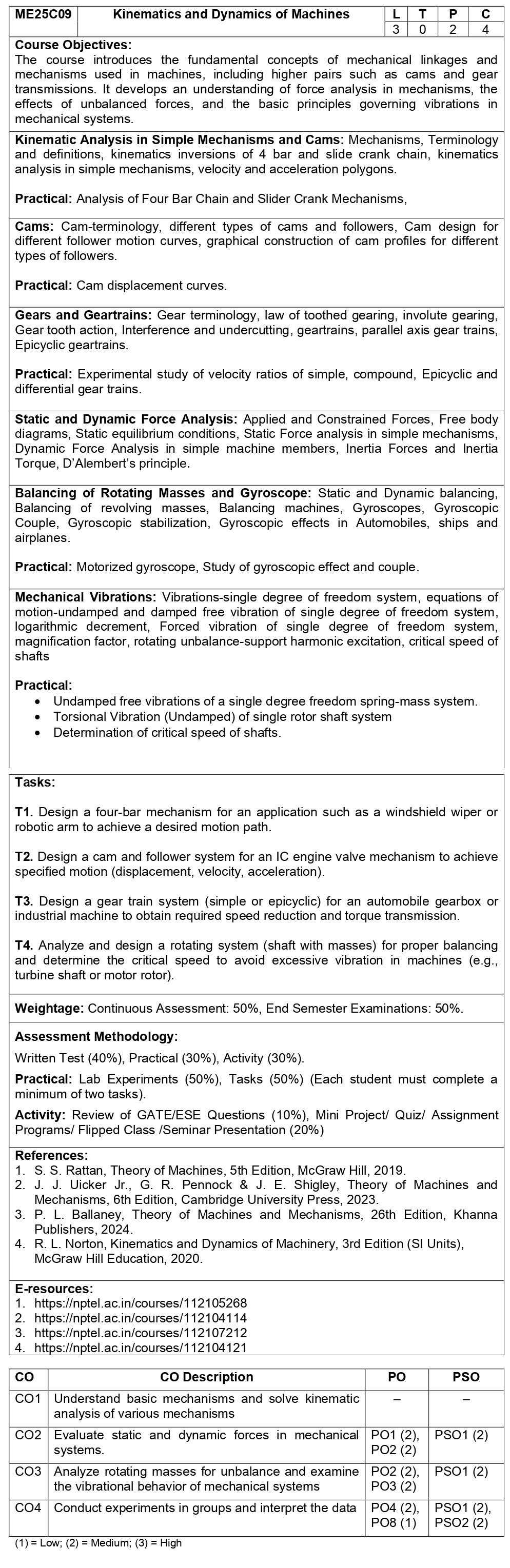
ME25C09:
Kinematics
and Dynamics of Machines
Course
Objectives:
The
course introduces the fundamental concepts of mechanical linkages and
mechanisms used in machines, including higher pairs such as cams and gear
transmissions. It develops an understanding of force analysis in mechanisms,
the effects of unbalanced forces, and the basic principles governing vibrations
in mechanical systems.
Kinematic
Analysis in Simple Mechanisms and Cams: Mechanisms,
Terminology and definitions, kinematics inversions of 4 bar and slide crank
chain, kinematics analysis in simple mechanisms, velocity and acceleration
polygons.
Practical:
Analysis of Four Bar Chain and Slider Crank Mechanisms,
Cams:
Cam-terminology, different types of cams and followers, Cam design for
different follower motion curves, graphical construction of cam profiles for
different types of followers.
Practical:
Cam displacement curves.
Gears and
Geartrains: Gear terminology, law of toothed
gearing, involute gearing, Gear tooth action, Interference and undercutting,
geartrains, parallel axis gear trains, Epicyclic geartrains.
Practical:
Experimental study of velocity ratios of simple, compound, Epicyclic and
differential gear trains.
Static
and Dynamic Force Analysis: Applied and Constrained
Forces, Free body diagrams, Static equilibrium conditions, Static Force
analysis in simple mechanisms, Dynamic Force Analysis in simple machine
members, Inertia Forces and Inertia Torque, D’Alembert’s principle.
Balancing
of Rotating Masses and Gyroscope: Static and Dynamic
balancing, Balancing of revolving masses, Balancing machines, Gyroscopes,
Gyroscopic Couple, Gyroscopic stabilization, Gyroscopic effects in Automobiles,
ships and airplanes.
Practical:
Motorized gyroscope, Study of gyroscopic effect and couple.
Mechanical
Vibrations: Vibrations-single degree of freedom
system, equations of motion-undamped and damped free vibration of single degree
of freedom system, logarithmic decrement, Forced vibration of single degree of
freedom system, magnification factor, rotating unbalance-support harmonic
excitation, critical speed of shafts
Practical:
•
Undamped free vibrations of a single degree freedom spring-mass system.
•
Torsional Vibration (Undamped) of single rotor shaft system
•
Determination of critical speed of shafts.
Tasks:
T1. Design
a four-bar mechanism for an application such as a windshield wiper or robotic
arm to achieve a desired motion path.
T2. Design
a cam and follower system for an IC engine valve mechanism to achieve specified
motion (displacement, velocity, acceleration).
T3. Design
a gear train system (simple or epicyclic) for an automobile gearbox or
industrial machine to obtain required speed reduction and torque transmission.
T4. Analyze
and design a rotating system (shaft with masses) for proper balancing and
determine the critical speed to avoid excessive vibration in machines (e.g.,
turbine shaft or motor rotor).
Weightage:
Continuous Assessment: 50%, End Semester Examinations: 50%.
Assessment Methodology: Written Test (40%), Practical (30%), Activity (30%).
Practical:
Lab Experiments (50%), Tasks (50%) (Each student must complete a minimum of two
tasks).
Activity:
Review of GATE/ESE Questions (10%), Mini Project/ Quiz/ Assignment Programs/
Flipped Class /Seminar Presentation (20%)
References:
1.
S. S. Rattan, Theory of Machines, 5th Edition, McGraw Hill, 2019.
2.
J. J. Uicker Jr., G. R. Pennock & J. E. Shigley, Theory of Machines and
Mechanisms, 6th Edition, Cambridge University Press, 2023.
3.
P. L. Ballaney, Theory of Machines and Mechanisms, 26th Edition, Khanna
Publishers, 2024.
4.
R. L. Norton, Kinematics and Dynamics of Machinery, 3rd Edition (SI Units),
McGraw Hill Education, 2020.