Engineering Thermodynamics - ME25301 - Question Bank PDF Download
[ 3rd Semester - Mechanical Engineering Department ]
Under Class: | 3rd Semester [Mechanical Dept Anna University 2025 Regulation] |
Engineering - Engineering Thermodynamics - ME25301 Subject (under Anna University 3rd Semester - Mechanical Engineering Department Regulation 2025) - Study Materials, Written and lecture Notes, Important Questions, Semester Question Paper PDF Download
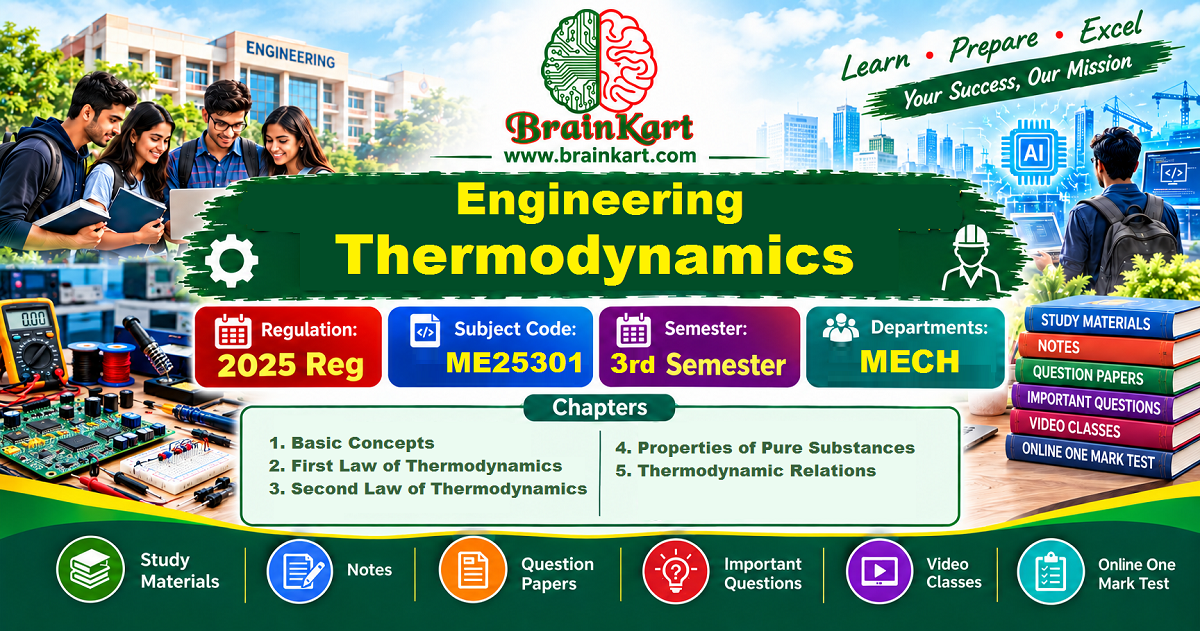
Engineering Thermodynamics
BASIC CONCEPTS AND FIRST LAW:
• Statistical and Classical Thermodynamics
• Types of Thermodynamic Systems
• Thermodynamic Properties
• Thermodynamic State and Equilibrium
• Processes and Cycles
• Point and Path Functions
• Temperature and Zeroth Law
• Temperature Scales
• Pure Substances and Concept of continuum
• Work and Heat
• Units of Work and Power
• Displacement Work
• Heat
• Sensible and Latent Heat
• First Law of Thermodynamics
• The Steady-state Flow Process
• Solved Problems: Basic Concepts and Thermodynamics First Law
• Important Questions and Answers: Basic Concepts and Thermodynamics First Law
SECOND LAW AND AVAILABILITY ANALYSIS:
• Limitations of First Law of Thermodynamics
• The Second law of Thermodynamics
• Equivalence of Kelvin-Planck and Clausius Statements
• Reversible Process
• Entropy
• Solved Problems: Entropy
• Available Energy, Availability And Irreversibility
• Solved Problems: Thermodynamics Second Law
• Important Questions and Answers: Thermodynamics Second Law and Availability Analysis
PROPERTIES OF PURE SUBSTANCE AND STEAM POWER CYCLE:
• Pure Substance
• Formation of Steam and Properties
• Solved Problems: Steam Power Cycle
• The Measurements of Dryness Fraction
• Regenerative Brayton Cycle
• Gas Power / Air Standard Cycles
• Brayton cycle, Rankine Cycle, Otto Cycle
• Important Questions and Answers: Pure Substance and Steam Power Cycle
• Solved Problems: Pure Substance and Steam Power Cycle
IDEAL AND REAL GASES and THERMODYNAMIC RELATIONS:
• Ideal and Real Gases, Thermodynamic Relations
• Solved Problems: Ideal And Real Gases, Thermodynamic Relations
• Important Questions and Answers: Ideal And Real Gases, Thermodynamic Relations
GAS MIXTURES AND PSYCHROMETRY:
• Gas Mixtures
• P-v-T Behavior Of Gas Mixtures: Ideal And Real Gases
• Psychrometry
• Solved Problems: Gas Mixtures and Psychrometry
• Important Questions and Answers: Gas Mixtures and Psychrometry
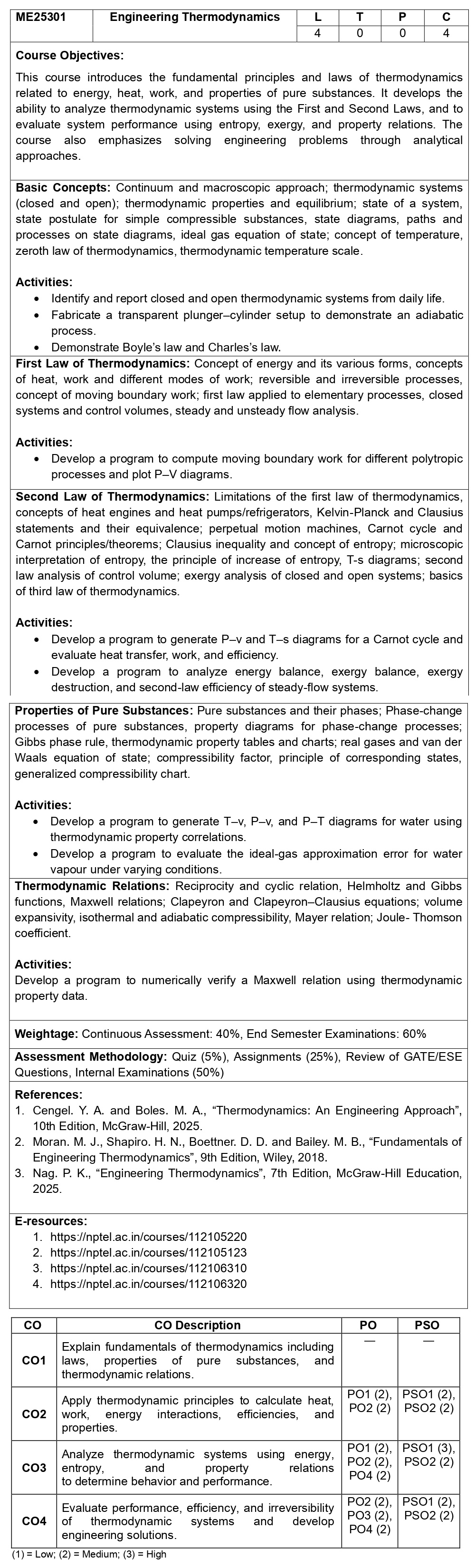
ME25301
Engineering
Thermodynamics
Course
Objectives:
This
course introduces the fundamental principles and laws of thermodynamics related
to energy, heat, work, and properties of pure substances. It develops the
ability to analyze thermodynamic systems using the First and Second Laws, and
to evaluate system performance using entropy, exergy, and property relations.
The course also emphasizes solving engineering problems through analytical
approaches.
Basic
Concepts: Continuum and macroscopic approach;
thermodynamic systems (closed and open); thermodynamic properties and
equilibrium; state of a system, state postulate for simple compressible
substances, state diagrams, paths and processes on state diagrams, ideal gas
equation of state; concept of temperature, zeroth law of thermodynamics,
thermodynamic temperature scale.
Activities:
•
Identify and report closed and open thermodynamic systems from daily life.
•
Fabricate a transparent plunger–cylinder setup to demonstrate an adiabatic
process.
•
Demonstrate Boyle’s law and Charles’s law.
First Law
of Thermodynamics: Concept of energy and its various
forms, concepts of heat, work and different modes of work; reversible and
irreversible processes, concept of moving boundary work; first law applied to
elementary processes, closed systems and control volumes, steady and unsteady
flow analysis.
Activities:
•
Develop a program to compute moving boundary work for different polytropic
processes and plot P–V diagrams.
Second
Law of Thermodynamics: Limitations of the first law of
thermodynamics, concepts of heat engines and heat pumps/refrigerators,
Kelvin-Planck and Clausius statements and their equivalence; perpetual motion
machines, Carnot cycle and Carnot principles/theorems; Clausius inequality and
concept of entropy; microscopic interpretation of entropy, the principle of
increase of entropy, T-s diagrams; second law analysis of control volume;
exergy analysis of closed and open systems; basics of third law of
thermodynamics.
Activities:
•
Develop a program to generate P–v and T–s diagrams for a Carnot cycle and
evaluate heat transfer, work, and efficiency.
•
Develop a program to analyze energy balance, exergy balance, exergy destruction,
and second-law efficiency of steady-flow systems.
Properties
of Pure Substances: Pure substances and their phases;
Phase-change processes of pure substances, property diagrams for phase-change
processes; Gibbs phase rule, thermodynamic property tables and charts; real
gases and van der Waals equation of state; compressibility factor, principle of
corresponding states, generalized compressibility chart.
Activities:
•
Develop a program to generate T–v, P–v, and P–T diagrams for water using thermodynamic
property correlations.
•
Develop a program to evaluate the ideal-gas approximation error for water vapour
under varying conditions.
Thermodynamic
Relations: Reciprocity and cyclic relation,
Helmholtz and Gibbs functions, Maxwell relations; Clapeyron and
Clapeyron–Clausius equations; volume expansivity, isothermal and adiabatic
compressibility, Mayer relation; Joule- Thomson coefficient.
Activities:
Develop
a program to numerically verify a Maxwell relation using thermodynamic property
data.
Weightage:
Continuous Assessment: 40%, End Semester Examinations: 60%
Assessment Methodology:
Quiz (5%), Assignments (25%), Review of GATE/ESE
Questions,
Internal Examinations (50%)
References:
1.
Cengel. Y. A. and Boles. M. A., “Thermodynamics: An Engineering Approach”, 10th
Edition, McGraw-Hill, 2025.
2.
Moran. M. J., Shapiro. H. N., Boettner. D. D. and Bailey. M. B., “Fundamentals
of Engineering Thermodynamics”, 9th Edition, Wiley, 2018.
3.
Nag. P. K., “Engineering Thermodynamics”, 7th Edition, McGraw-Hill Education,
2025.