DC Machines and Transformers - EE25402 - Question Bank PDF Download
[ 4th Semester - EEE - Electrical and Electronics Engineering Department ]
Under Class: | 4th Semester [EEE Dept Anna University 2025 Regulation] |
Engineering - DC Machines and Transformers - EE25402 Subject (under Anna University 4th Semester - EEE - Electrical and Electronics Engineering Department Regulation 2025) - Study Materials, Written and lecture Notes, Important Questions, Semester Question Paper PDF Download
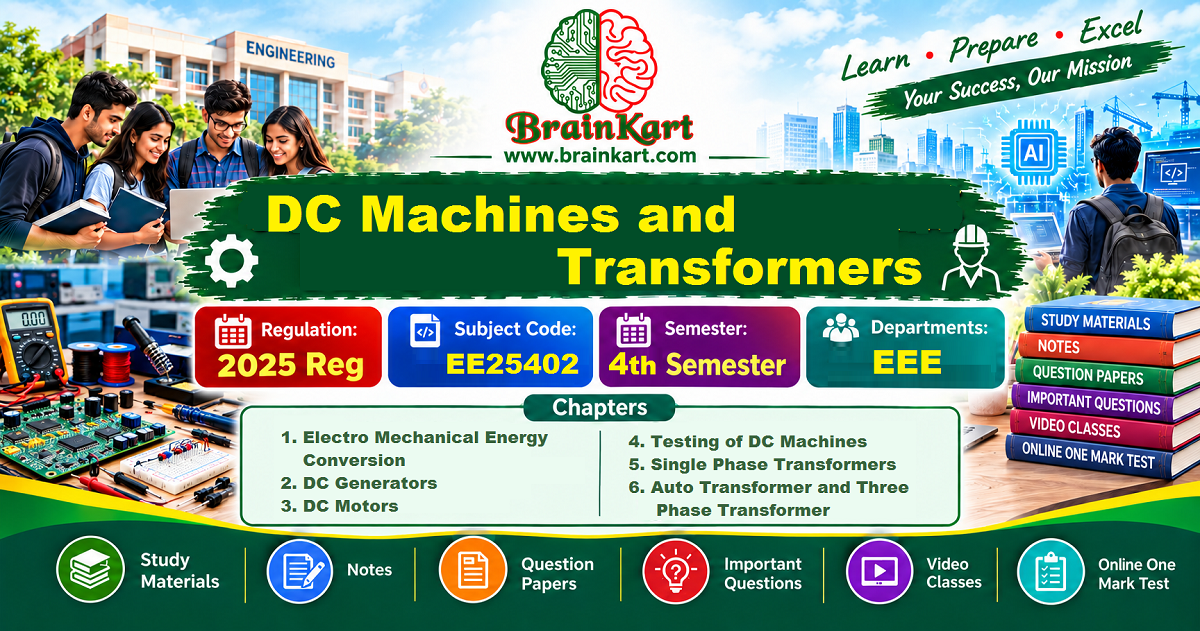
DC Machines and Transformers (or)
Electrical Machines I
MAGNETIC CIRCUITS AND MAGNETIC MATERIALS:
• Magnetic Circuits and Magnetic Materials
• Laws Governing Magnetic Circuits
• Flux Linkage, Inductance and Energy
• Statically and Dynamically Induced Emf
• Properties of Magnetic Materials
• Iron or Core losses
• AC Operation of Magnetic Circuits
• Transformer as a Magnetically Coupled Circuit
• Solved problems - Magnetic Circuits and Magnetic Materials
• Important Short Questions and Answers : Electrical machines - Magnetic Circuits and Magnetic Materials
ELECTROMECHANICAL ENERGY CONVERSION AND CONCEPTS IN ROTATING MACHINES:
• Energy In Magnetic Systems
• The Field Energy
• The Co Energy
• Force In A Singly Excited Magnetic Field System
• Force in a Multiply Excited Magnetic Field System
• Mmf of Distributed Windings
• Magnetic Fields In Rotating Machines
• Rotating Mmf Waves
• Torque in Ac And Dc Machines
• Solved Problems - Electromechanical Energy Conversion and Concepts in Rotating Machines
• Important Short Questions and Answers - Electromechanical Energy Conversion and Concepts in Rotating Machines
DC GENERATORS:
• Construction of DC Machines
• Lap Winding
• Wave Winding
• EMF Equation of DC Generators
• Armature reaction
• Methods of excitation of the field windings
• Methods of Excitation used for DC Generator
• Commutation and Interpoles
• DC Generator Characteristics
• Important short questions and answers: DC Generators
DC MOTORS:
• Principle of operation of a D.C. Motor
• Working of D.C. Motor
• Types of DC Motors
• DC Motor Characteristics
• Speed Control of DC Shunt Motor: Varying Armature Resistance, Field Resistance
• Starting of DC Motors
• Three Point Starter: Working principle
• Four Point Starter
• Swinburne�s Test
• Hopkinson�s test: Procedure, Calculation of efficiency, Advantages, Disadvantages
• Braking of DC shunt motor
• Important Short questions and answers: DC Motor - Electrical machines
TRANSFORMERS:
• Transformer: Principle of Operation
• An ideal Transformer: Principle of Operation
• Induction Law - Transformer
• Equivalent Circuit of Transformer
• Transformer Losses
• Transformer Tests
• Efficiency of a Transformer
• Voltage Regulation of Transformer
• Auto Transformer
• Three-phase autotransformer connection
• Parallel Operation of Transformers
• Tap Changing in Transformer
• Solved Problems - Transformer - Electrical machines
• Important Short Questions and Answers: Electrical machines - Transformer
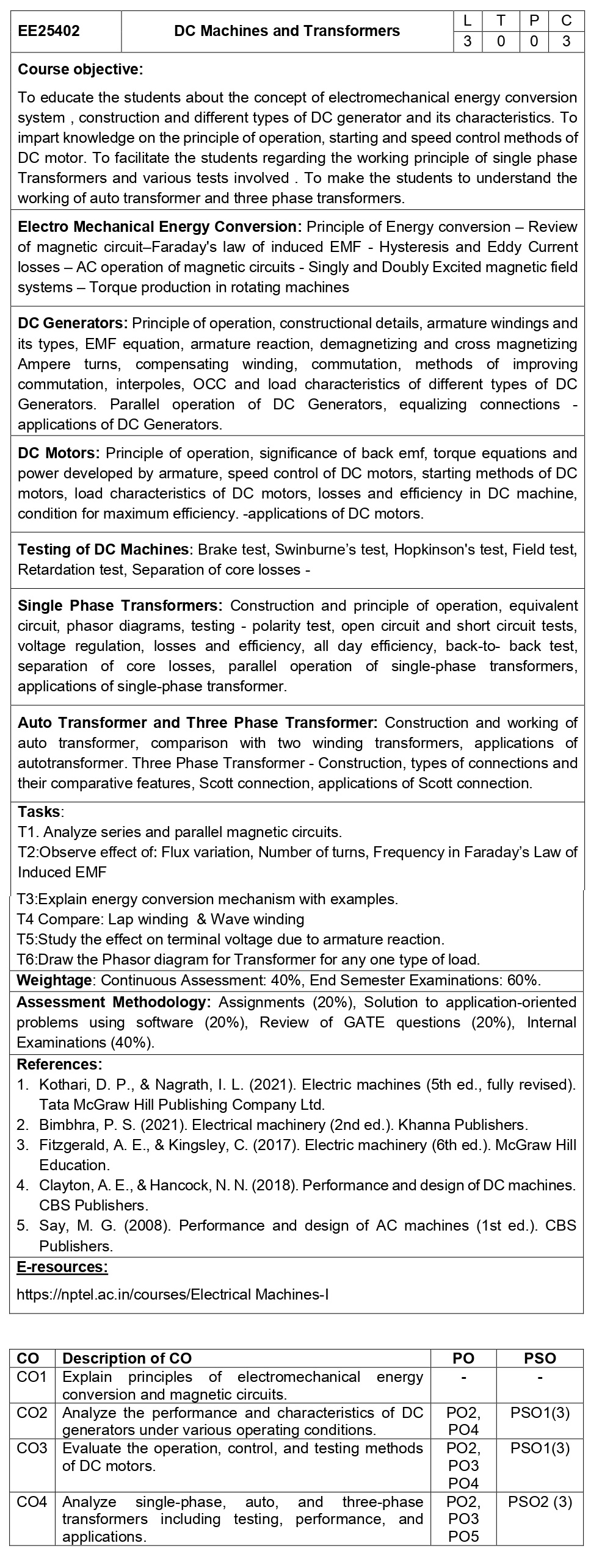
EE25402:
DC
Machines and Transformers
Course
objective:
To educate the students about the concept of electromechanical energy conversion system , construction and different types of DC generator and its characteristics. To impart knowledge on the principle of operation, starting and speed control methods of DC motor. To facilitate the students regarding the working principle of single phase Transformers and various tests involved . To make the students to understand the working of auto transformer and three phase transformers.
Electro
Mechanical Energy Conversion: Principle of Energy
conversion – Review of magnetic circuit–Faraday's law of induced EMF -
Hysteresis and Eddy Current losses – AC operation of magnetic circuits - Singly
and Doubly Excited magnetic field systems – Torque production in rotating
machines
DC
Generators: Principle of operation, constructional
details, armature windings and its types, EMF equation, armature reaction,
demagnetizing and cross magnetizing Ampere turns, compensating winding,
commutation, methods of improving commutation, interpoles, OCC and load
characteristics of different types of DC
Generators.ParalleloperationofDCGenerators,equalizingconnections-
applications
of DC Generators.
DC Motors:
Principle of operation, significance of back emf, torque equations and power
developed by armature, speed control of DC motors, starting methods of DC
motors, load characteristics of DC motors, losses and efficiency in DC machine,
condition for maximum efficiency. -applications of DC motors.
Testing
of DC Machines: Brake test, Swinburne’s test,
Hopkinson's test, Field test, Retardation test, Separation of core losses -
Single
Phase Transformers: Construction and principle of
operation, equivalent circuit, phasor diagrams, testing - polarity test, open
circuit and short circuit tests, voltage regulation, losses and efficiency, all
day efficiency, back-to- back test, separation of core losses, parallel
operation of single-phase transformers, applications of single-phase
transformer.
Auto
Transformer and Three Phase Transformer: Construction and
working of auto transformer, comparison with two winding transformers,
applications of autotransformer. Three Phase Transformer - Construction, types
of connections and their comparative features, Scott connection, applications
of Scott connection.
Tasks:
T1.
Analyze series and parallel magnetic circuits.
T2:Observe
effect of: Flux variation, Number of turns, Frequency in Faraday’s Law of
Induced EMF
T3:Explain
energy conversion mechanism with examples. T4 Compare: Lap winding & Wave
winding
T5:Study
the effect on terminal voltage due to armature reaction.
T6:Draw
the Phasor diagram for Transformer for any one type of load.
Weightage:
Continuous Assessment: 40%, End Semester Examinations: 60%.
Assessment Methodology:
Assignments (20%), Solution to application-oriented problems using software
(20%), Review of GATE questions (20%), Internal
Examinations
(40%).
References:
1.
Kothari, D. P., & Nagrath, I. L. (2021). Electric machines (5th ed., fully
revised). Tata McGraw Hill Publishing Company Ltd.
2.
Bimbhra, P. S. (2021). Electrical machinery (2nd ed.). Khanna Publishers.
3.
Fitzgerald, A. E., & Kingsley, C. (2017). Electric machinery (6th ed.).
McGraw Hill Education.
4.
Clayton, A. E., & Hancock, N. N. (2018). Performance and design of DC
machines. CBS Publishers.
5.
Say, M. G. (2008). Performance and design of AC machines (1st ed.). CBS Publishers.