DC Machines and Transformers - EE25402
[ 4th Semester - EEE - Electrical and Electronics Engineering Department ]
Under Class: | 4th Semester [EEE Dept Anna University 2025 Regulation] |
DC Machines and Transformers - EE25402 - Study Materials, Notes, Important Questions, Anna University Semester Question Paper PDF Download
Engineering - DC Machines and Transformers - EE25402 Subject (under Anna University 4th Semester - EEE - Electrical and Electronics Engineering Department Regulation 2025) - Study Materials, Written and lecture Notes, Important Questions, Semester Question Paper PDF Download
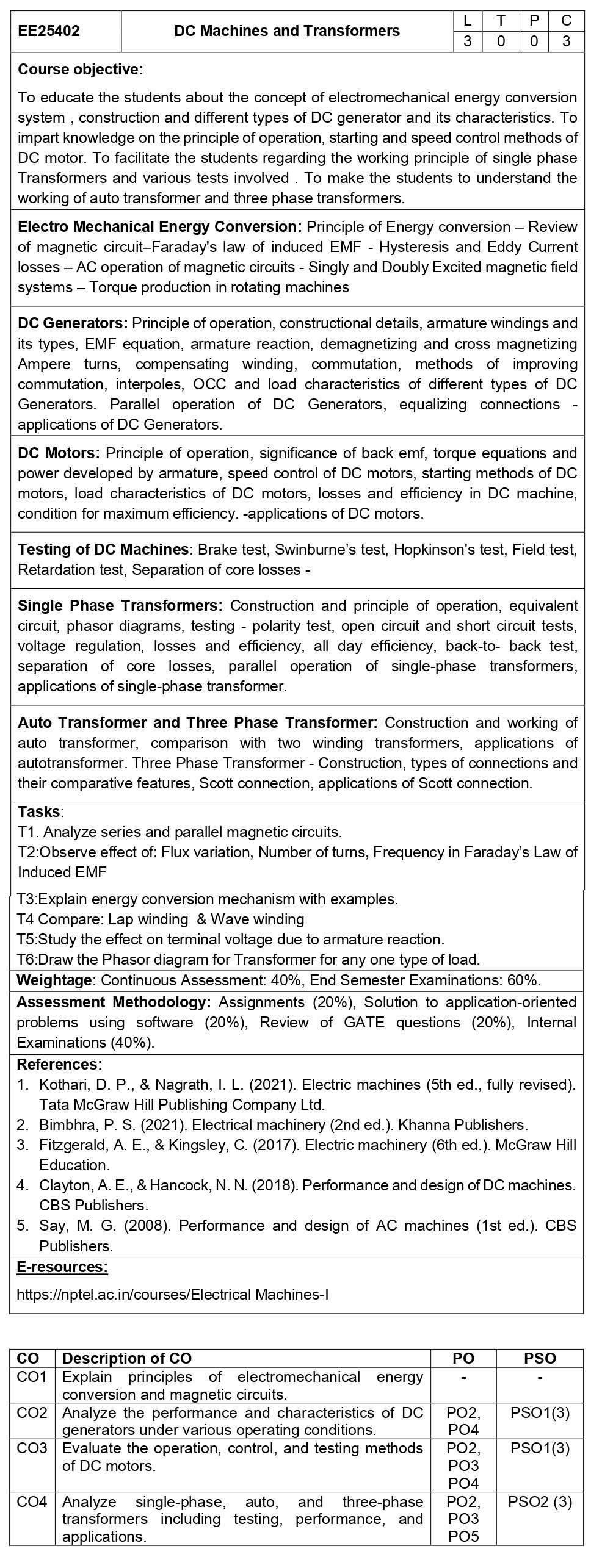
EE25402:
DC
Machines and Transformers
Course
objective:
To educate the students about the concept of electromechanical energy conversion system , construction and different types of DC generator and its characteristics. To impart knowledge on the principle of operation, starting and speed control methods of DC motor. To facilitate the students regarding the working principle of single phase Transformers and various tests involved . To make the students to understand the working of auto transformer and three phase transformers.
Electro
Mechanical Energy Conversion: Principle of Energy
conversion – Review of magnetic circuit–Faraday's law of induced EMF -
Hysteresis and Eddy Current losses – AC operation of magnetic circuits - Singly
and Doubly Excited magnetic field systems – Torque production in rotating
machines
DC
Generators: Principle of operation, constructional
details, armature windings and its types, EMF equation, armature reaction,
demagnetizing and cross magnetizing Ampere turns, compensating winding,
commutation, methods of improving commutation, interpoles, OCC and load
characteristics of different types of DC
Generators.ParalleloperationofDCGenerators,equalizingconnections-
applications
of DC Generators.
DC Motors:
Principle of operation, significance of back emf, torque equations and power
developed by armature, speed control of DC motors, starting methods of DC
motors, load characteristics of DC motors, losses and efficiency in DC machine,
condition for maximum efficiency. -applications of DC motors.
Testing
of DC Machines: Brake test, Swinburne’s test,
Hopkinson's test, Field test, Retardation test, Separation of core losses -
Single
Phase Transformers: Construction and principle of
operation, equivalent circuit, phasor diagrams, testing - polarity test, open
circuit and short circuit tests, voltage regulation, losses and efficiency, all
day efficiency, back-to- back test, separation of core losses, parallel
operation of single-phase transformers, applications of single-phase
transformer.
Auto
Transformer and Three Phase Transformer: Construction and
working of auto transformer, comparison with two winding transformers,
applications of autotransformer. Three Phase Transformer - Construction, types
of connections and their comparative features, Scott connection, applications
of Scott connection.
Tasks:
T1.
Analyze series and parallel magnetic circuits.
T2:Observe
effect of: Flux variation, Number of turns, Frequency in Faraday’s Law of
Induced EMF
T3:Explain
energy conversion mechanism with examples. T4 Compare: Lap winding & Wave
winding
T5:Study
the effect on terminal voltage due to armature reaction.
T6:Draw
the Phasor diagram for Transformer for any one type of load.
Weightage:
Continuous Assessment: 40%, End Semester Examinations: 60%.
Assessment Methodology:
Assignments (20%), Solution to application-oriented problems using software
(20%), Review of GATE questions (20%), Internal
Examinations
(40%).
References:
1.
Kothari, D. P., & Nagrath, I. L. (2021). Electric machines (5th ed., fully
revised). Tata McGraw Hill Publishing Company Ltd.
2.
Bimbhra, P. S. (2021). Electrical machinery (2nd ed.). Khanna Publishers.
3.
Fitzgerald, A. E., & Kingsley, C. (2017). Electric machinery (6th ed.).
McGraw Hill Education.
4.
Clayton, A. E., & Hancock, N. N. (2018). Performance and design of DC
machines. CBS Publishers.
5.
Say, M. G. (2008). Performance and design of AC machines (1st ed.). CBS Publishers.