Transmission and Distribution - EE25401 - Notes PDF Download
[ 4th Semester - EEE - Electrical and Electronics Engineering Department ]
Under Class: | 4th Semester [EEE Dept Anna University 2025 Regulation] |
Engineering - Transmission and Distribution - EE25401 Subject (under Anna University 4th Semester - EEE - Electrical and Electronics Engineering Department Regulation 2025) - Study Materials, Written and lecture Notes, Important Questions, Semester Question Paper PDF Download
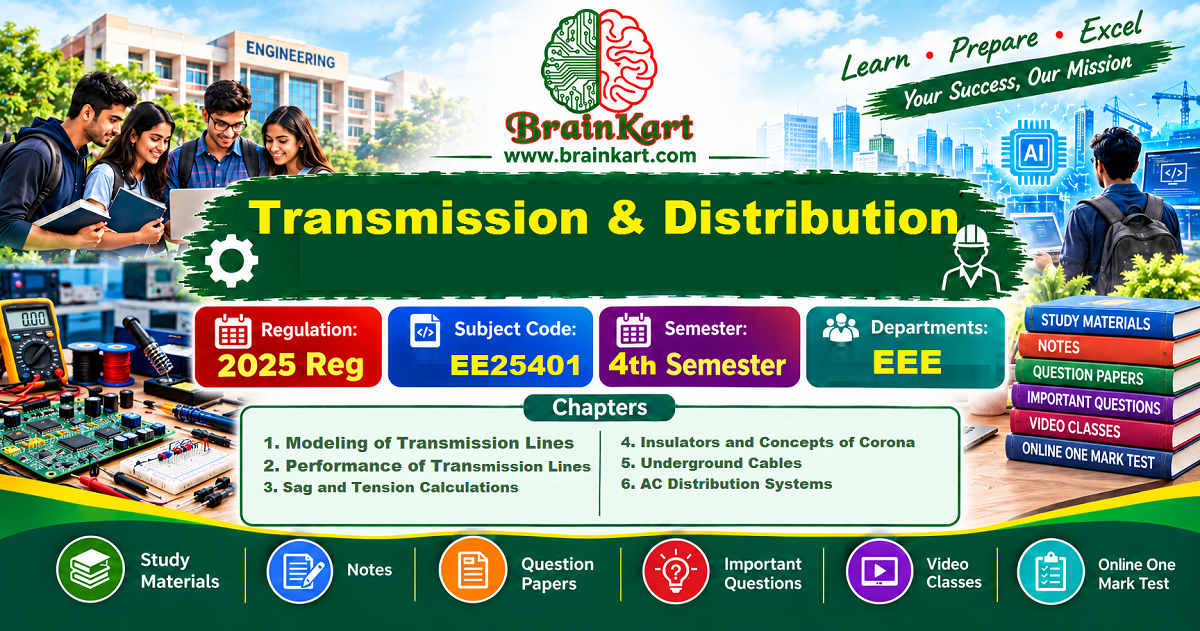
Transmission and Distribution
STRUCTURE OF POWER SYSTEM:
• Basic Electric Power and Structure of Power System
• Components and Elements of Power System
• Generation, Transmission and Distribution of Electric Power
• Distribution Systems
• Classification of Distribution Systems
• AC and DC Distribution
• Overhead Versus Underground Power System
• Connection Schemes of Distribution System
• Requirements of a Distribution System
• Design Considerations in Distribution System
• A.C. Distribution -Introduction
• Types of D.C. Distributors
• EHVAC and HVDC Transmission System
• Merits & Demerits of HVDC
• Economical Comparision EHVAC and HVDC
• Concept of FACTS
• Important Short Questions and Answers: Transmission and Distribution - Structure of Power System
TRANSMISSION LINE PARAMETERS:
• Parameters of Single and Three Phase Transmission Lines With Single and Double Circuits
• Inductance of a Single Phase Two-Wire Line
• Spiraling and Bundle Conductor Effect
• Concept of Self-GMD and Mutual-GMD
• Skin Effect
• Proximity Effect
• Capacitance of a Single Phase Two-Wire Line
• Inductive Interference with Neighbouring Communication Circuits
• Types of Conductor
• Corona
• Important Short Questions and Answers: Transmission Line Parameters
MODELLING AND PERFORMANCE OF TRANSMISSION LINES:
• Classification of Overhead Transmission Lines
• Performance of Single Phase Short Transmission Lines
• Medium Transmission Lines
• Long Transmission Lines
• Circle Diagrams - Transmission line
• Surge Impedance Loading
• Voltage Control - Introduction
• Location of Voltage Control Equipment
• Ferranti Effect
• Important Short Questions and Answers: Modelling and Performance of Transmission Lines
INSULATORS AND CABLES:
• Insulator - Introduction
• Types of Insulator
• Potential Distribution Over Suspension Insulator String
• String Efficiency
• Methods of Improving String Efficiency
• Testing of Insulator
• Insulator Testing Types
• Insulated Cable - Introduction
• Construction of Cables
• Insulating Materials For Cables
• Classification of Cables
• Grading of Cables
• Important Short Questions and Answers: Transmission and Distribution - Insulators and Cables
MECHANICAL DESIGN OF LINES AND GROUNDING:
• Mechanical Design of Transmission Line
• Tower spotting - Mechanical Design of Lines and Grounding
• Towers and Type of Towers - Mechanical Design of Lines and Grounding
• Substation: Classification and Layout
• Methods of Neutral Grounding
• Important Short Questions and Answers: Mechanical Design of Lines and Grounding
UNDER GROUND CABILITYS:
DISTRIBUTION SYSTEMS:
• Basic Electric Power and Structure of Power System
• Components and Elements of Power System
• Generation, Transmission and Distribution of Electric Power
• Distribution Systems
• Classification of Distribution Systems
• AC and DC Distribution
• Overhead Versus Underground Power System
• Connection Schemes of Distribution System
• Requirements of a Distribution System
• Design Considerations in Distribution System
• A.C. Distribution -Introduction
• Types of D.C. Distributors
• EHVAC and HVDC Transmission System
• Merits & Demerits of HVDC
• Economical Comparision EHVAC and HVDC
• Concept of FACTS
• Important Short Questions and Answers: Transmission and Distribution - Structure of Power System
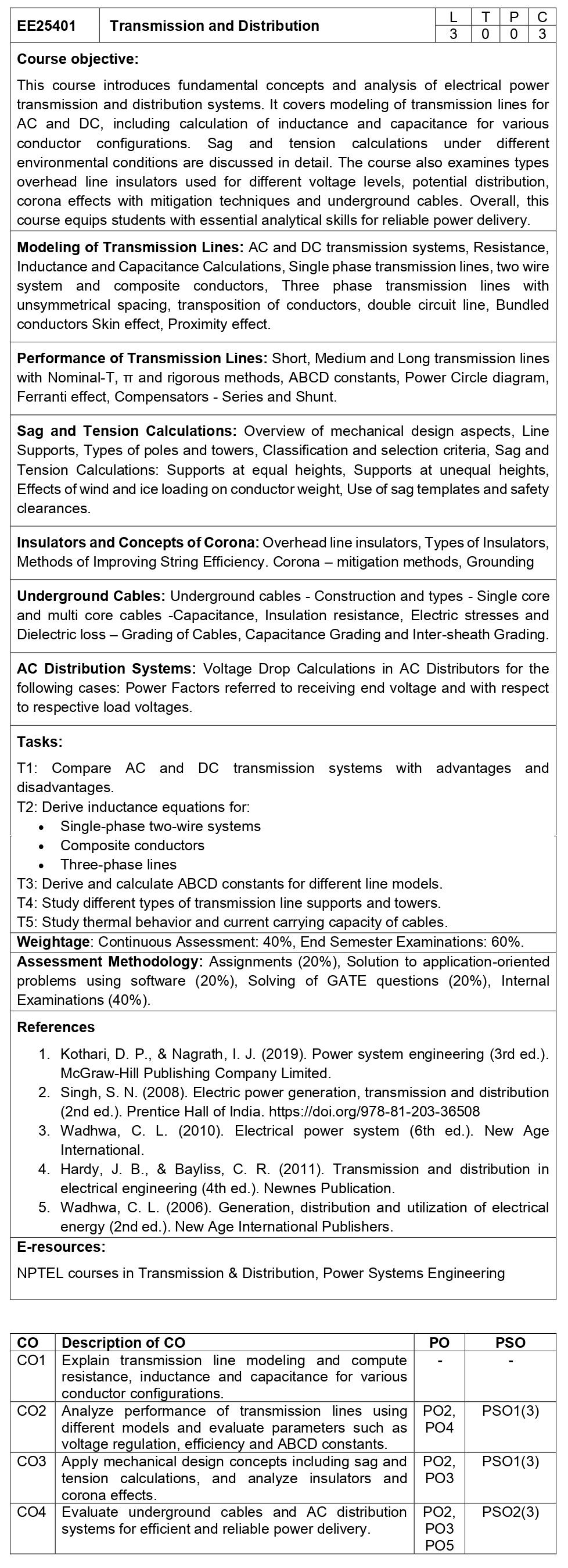
EE25401:
Transmission
and Distribution
Course
objective:
This
course introduces fundamental concepts and analysis of electrical power
transmission and distribution systems. It covers modeling of transmission lines
for AC and DC, including calculation of inductance and capacitance for various
conductor configurations. Sag and tension calculations under different
environmental conditions are discussed in detail. The course also examines
types overhead line insulators used for different voltage levels, potential
distribution, corona effects with mitigation techniques and underground cables.
Overall, this course equips students with essential analytical skills for reliable
power delivery.
Modeling
of Transmission Lines: AC and DC transmission systems,
Resistance, Inductance and Capacitance Calculations, Single phase transmission
lines, two wire system and composite conductors, Three phase transmission lines
with unsymmetrical spacing, transposition of conductors, double circuit line,
Bundled conductors Skin effect, Proximity effect.
Performance of Transmission Lines: Short,
Medium and Long transmission lines with Nominal-T, π and rigorous methods, ABCD
constants, Power Circle diagram, Ferranti effect, Compensators - Series and
Shunt.
Sag and
Tension Calculations: Overview of mechanical design
aspects, Line Supports, Types of poles and towers, Classification and selection
criteria, Sag and Tension Calculations: Supports at equal heights, Supports at
unequal heights, Effects of wind and ice loading on conductor weight, Use of
sag templates and safety clearances.
Insulators
and Concepts of Corona: Overhead line insulators, Types of
Insulators, Methods of Improving String Efficiency. Corona – mitigation
methods, Grounding
Underground
Cables: Underground cables - Construction and
types - Single core and multi core cables -Capacitance, Insulation resistance,
Electric stresses and Dielectric loss – Grading of Cables, Capacitance Grading
and Inter-sheath Grading.
AC
Distribution Systems: Voltage Drop Calculations in AC
Distributors for the following cases: Power Factors referred to receiving end
voltage and with respect to respective load voltages.
Tasks:
T1:
CompareAC and DC transmission systems with advantages and disadvantages.
T2:
Derive inductance equations for:
•
Single-phase two-wire systems
•
Composite conductors
•
Three-phase lines
T3:
Derive and calculate ABCD constants for different line models.
T4:
Study different types of transmission line supports and towers.
T5:
Study thermal behavior and current carrying capacity of cables.
Weightage:
Continuous Assessment: 40%, End Semester Examinations: 60%.
Assessment Methodology:
Assignments (20%), Solution to application-oriented problems using software
(20%), Solving of GATE questions (20%), Internal
Examinations
(40%).
References
1.
Kothari, D. P., & Nagrath, I. J. (2019). Power system engineering (3rd
ed.). McGraw-Hill Publishing Company Limited.
2.
Singh, S. N. (2008). Electric power generation, transmission and distribution
(2nd ed.). Prentice Hall of India. https://doi.org/978-81-203-36508
3.
Wadhwa, C. L. (2010). Electrical power system (6th ed.). New Age International.
4.
Hardy, J. B., & Bayliss, C. R. (2011). Transmission and distribution in
electrical engineering (4th ed.). Newnes Publication.
5.
Wadhwa, C. L. (2006). Generation, distribution and utilization of electrical
energy (2nd ed.). New Age International Publishers.