Basic Civil and Mechanical Engineering - GE25C01 - Notes PDF Download
[ 2nd Semester - EEE - Electrical and Electronics Engineering Department ]
Under Class: | 2nd Semester [EEE Dept Anna University 2025 Regulation] |
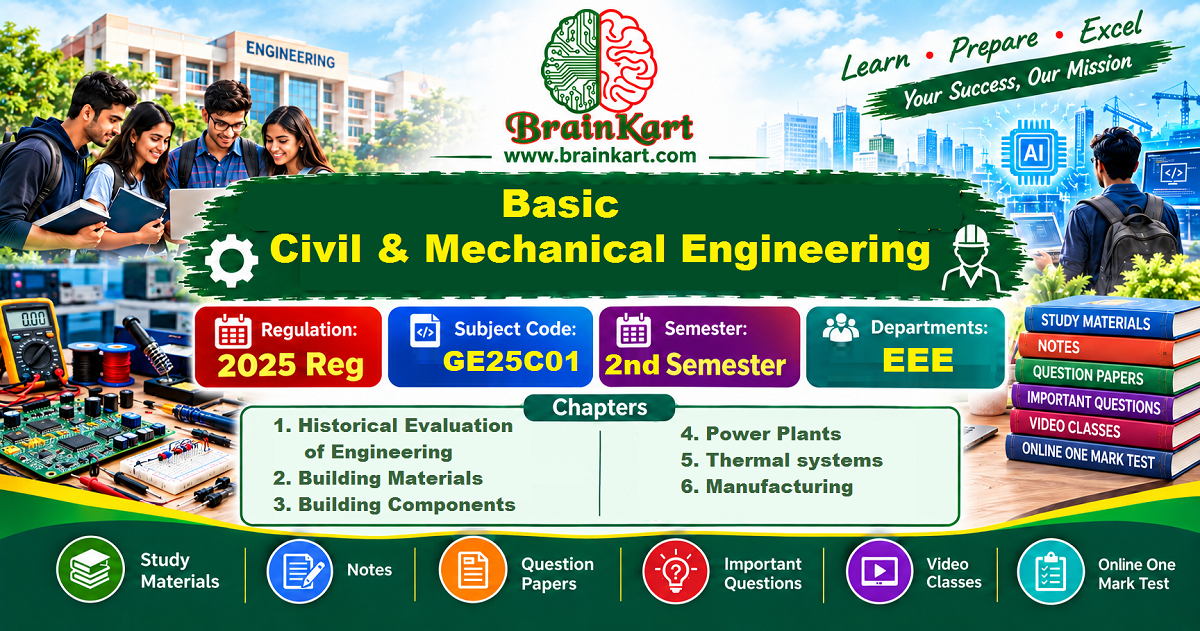
Engineering - Basic Civil and Mechanical Engineering - GE25C01 Subject (under Anna University 2nd Semester - EEE - Electrical and Electronics Engineering Engineering Regulation 2025) - Study Materials, Written and lecture Notes, Important Questions, Semester Question Paper PDF Download
CIVIL ENGINEERING MATERIALS:
• Stones
• Bricks
• Cement
• Sand
• Plain and Green concrete
• Ferrous Metals
BUILDING COMPONENTS AND STRUCTURES:
• Elements of a building
• Basic requirements of a building
• Planning For Building
• Conventional spread footings: R.C.C. footings and Grillage footing
• Arch foundation and Pile foundations
• Stone masonry
• Brick masonry
• Beams and Columns
• Lintels
• Flooring: Ground Floor
• Flooring: Upper Floor
• Roof
• Plastering
• Stress, strain and its type
• Elasticity
• Bridges
• Dams
• Basics of interior design
POWER PLANT ENGINEERING:
• Layout of steam power plant
• Selection of Site for Thermal Power Plant
• Gas power plant
• Diesel Power Plant
• Hydro Electric Power Plant
• Nuclear power plant
• Pumps
• Centrifugal Pumps
• Impulse Turbine and Reaction Turbine
IC ENGINES:
• Classification of Heat Engines
• Main Components of IC Engines and IC Engine
• Two Stroke Cycle Petrol Engines
• Two Stroke Cycle Diesel Engines
• Four Stroke Cycle Petrol Engines
• Four Stroke Diesel Engine
• Scavenging
• Comparison Between SI and CI Engines
• Comparison Between Four Stroke Cycle And Two Stroke Cycle Engine (Merits And Demerits)
• Terminolgogy and Major Parts of an IC Engine
• Steam Boilers
• Boiler Mountings and Accessories
• Boiler Accessories
REFRIGERATION
• Refrigeration
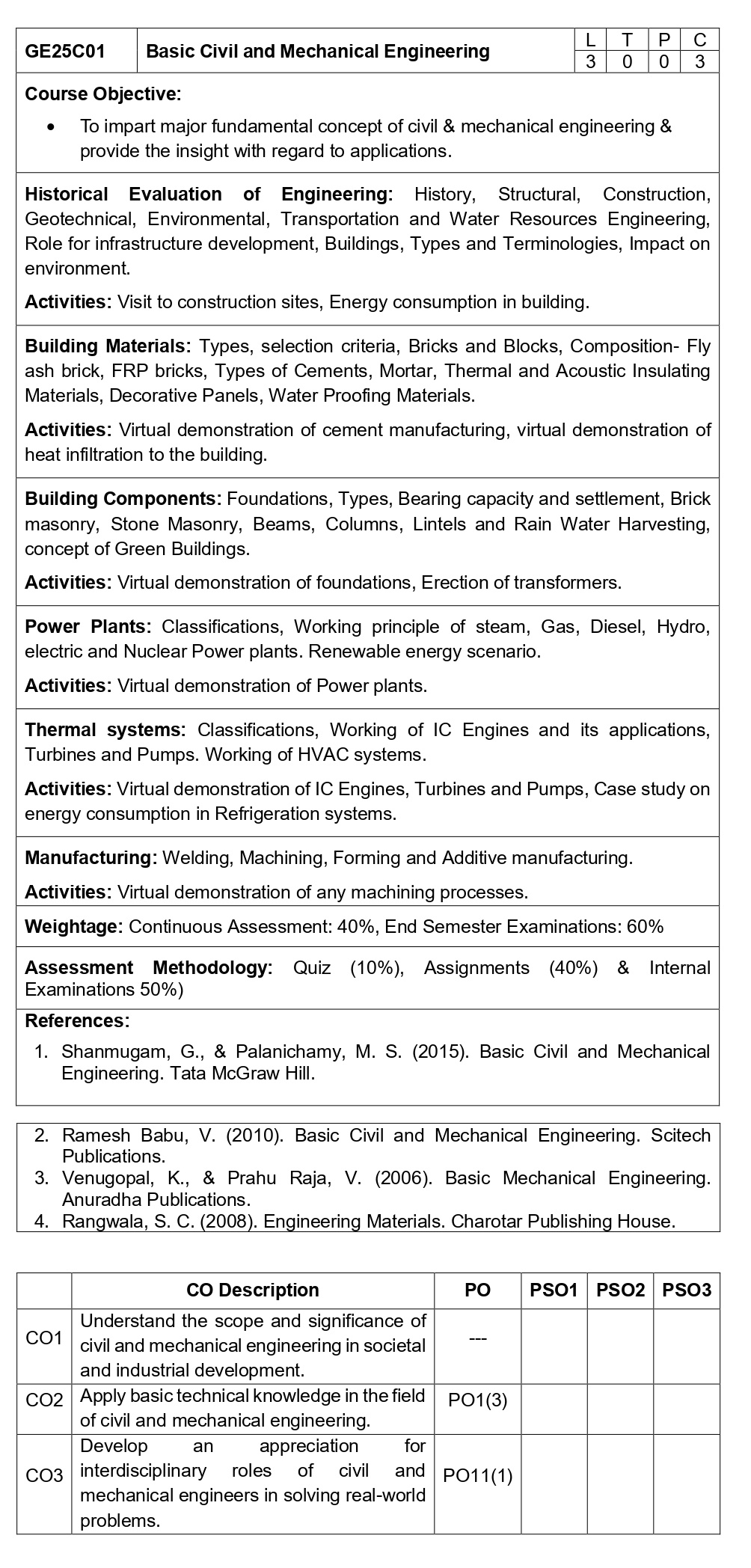
GE25C01:
Basic Civil and Mechanical Engineering
Course
Objective:
•
To impart major fundamental concept of civil & mechanical engineering &
provide the insight with regard to applications.
Historical
Evaluation of Engineering: History, Structural,
Construction, Geotechnical, Environmental, Transportation and Water Resources
Engineering, Role for infrastructure development, Buildings, Types and
Terminologies, Impact on environment.
Activities:
Visit to construction sites, Energy consumption in building.
Building
Materials: Types, selection criteria, Bricks and
Blocks, Composition- Fly ash brick, FRP bricks, Types of Cements, Mortar,
Thermal and Acoustic Insulating Materials, Decorative Panels, Water Proofing
Materials.
Activities:
Virtual demonstration of cement manufacturing, virtual demonstration of heat
infiltration to the building.
Building
Components: Foundations, Types, Bearing capacity
and settlement, Brick masonry, Stone Masonry, Beams, Columns, Lintels and Rain
Water Harvesting, concept of Green Buildings.
Activities:
Virtual demonstration of foundations, Erection of transformers.
Power
Plants: Classifications, Working principle of
steam, Gas, Diesel, Hydro, electric and Nuclear Power plants. Renewable energy
scenario.
Activities:
Virtual demonstration of Power plants.
Thermal
systems: Classifications, Working of IC Engines
and its applications, Turbines and Pumps. Working of HVAC systems.
Activities:
Virtual demonstration of IC Engines, Turbines and Pumps, Case study on energy
consumption in Refrigeration systems.
Manufacturing:
Welding, Machining, Forming and Additive manufacturing.
Activities: Virtual demonstration of any machining processes.
Weightage: Continuous Assessment: 40%, End Semester Examinations: 60%
Assessment Methodology:
Quiz (10%), Assignments (40%) & Internal Examinations 50%)
References:
1.
Shanmugam, G., & Palanichamy, M. S. (2015). Basic Civil and Mechanical
Engineering. Tata McGraw Hill.
2.
Ramesh Babu, V. (2010). Basic Civil and Mechanical Engineering. Scitech
Publications.
3.
Venugopal, K., & Prahu Raja, V. (2006). Basic Mechanical Engineering.
Anuradha Publications.
4.
Rangwala, S. C. (2008). Engineering Materials. Charotar Publishing House.