Chapter: Civil : Principles of Solid Mechanics : Torsion
Prandtl’s Stress Function
Prandtl’s Stress
Function
An alternative solution procedure that
leads to a much simpler boundary condition, but a somewhat more difficult field
equation, involves the intro-duction of a stress function ϕ(x,y)
defined as:
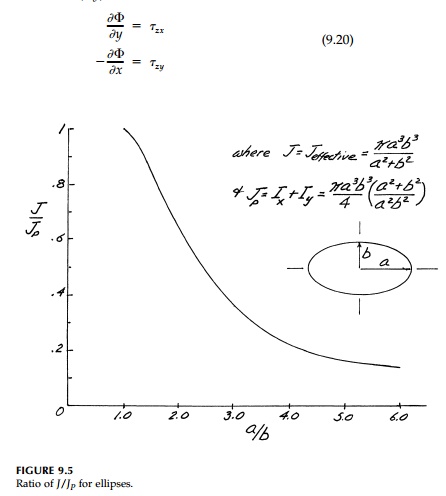
By this definition, the equilibrium
Equation (9.10) is automatically solved and the boundary condition Equation
(9.15) becomes:
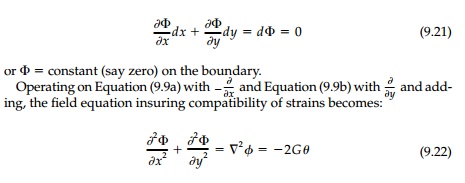
As noted in previews, this is a Poisson
equation for which a solution can always be found and the boundary condition
is particularly nice.
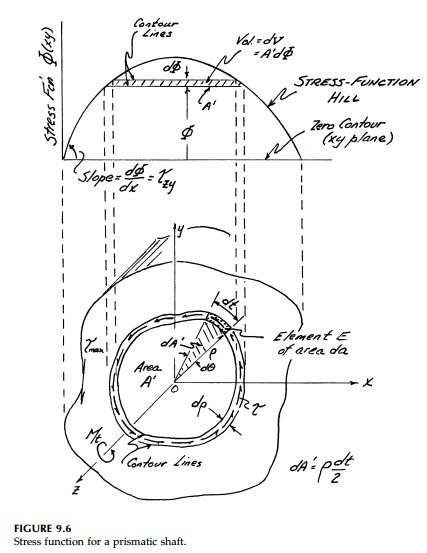
However, the power of the Prandtl stress function approach is in visualiz-ing torsional shear fields. It is easy to show that the stress function ϕ will transform in any direction as an invariant scalar function, and therefore in a new coordinate orientation x', y'

Thus at any point the shear stress in one direction is equal in magnitude to the slope of the ϕ surface in the perpendicular direction, and the maximum shear is the maximum slope of the stress function curve and acts tangent (along a contour) to that curve. If we visualize the stress function plotted in the z direction above the cross-section, then contours (of equal ϕ) can be plot-ted and:
a. The
shear τ acts along these contours and is
proportional to the shortest distance (slope normal) to the next contour;
b. τmax
occurs where the stress-hill contours become closest togeth-er, which will be
on the boundary of the cross-section (generally where r = Rt(x2+y2) is a minimum.
From Figure 9.6 it is
easy to show that the twisting moment Mt is propor-tional to
the volume of this stress-function hill. The shear force dS on a differ
ential element E will be
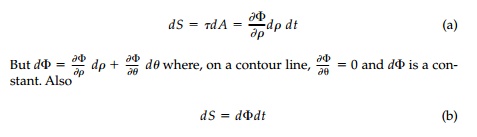
Therefore, between two
contour lines the resisting moment
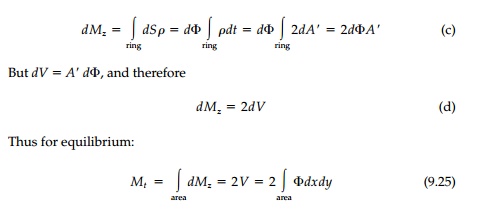
which is twice the
volume of the stress-function hill.
For example, consider
the elliptic cross-section discussed previously. Assume a stress function

which must satisfy
Equation (9.22), and the boundary condition ϕedge
=
0. The volume of the stress-function hill (a paraboloid) is 0.5 π abh and therefore:
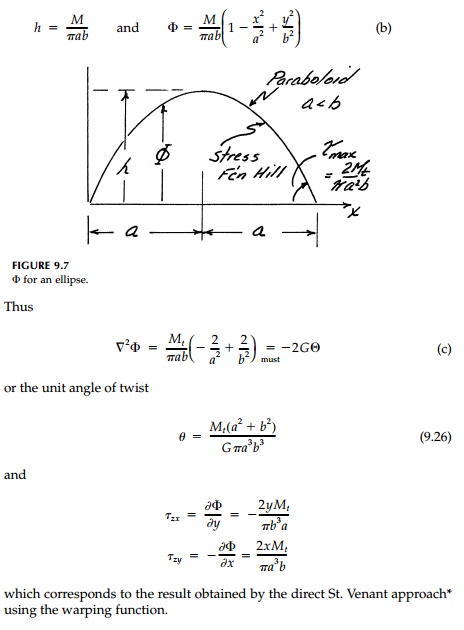
which corresponds to
the result obtained by the direct St. Venant approach* using the warping
function.
Related Topics