Chapter: Signals and Systems : Classification of Signals and Systems
Continuous Time Fourier Transform
Continuous Time Fourier
Transform:
The
Fourier expansion coefficient x[k] ( in ak OWN) of a periodic signal is
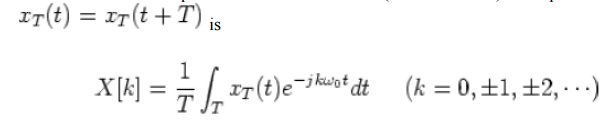
and the
Fourier expansion of the signal is:
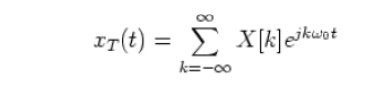
which can
also be written as:
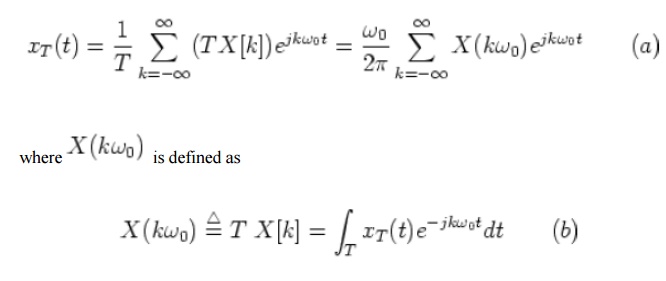
When the
period of xT(t) approaches infinity, T->(infinity) the periodic
signal xT(t) becomes a non-periodic signal and the following will
result:
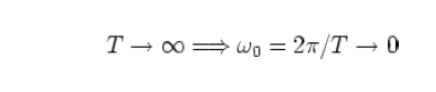
Interval
between two neighboring frequency components becomes zero:
Discrete
frequency becomes continuous frequency:

Summation
of the Fourier expansion in equation (a) becomes an integral:

the
second equal sign is due to the general fact:
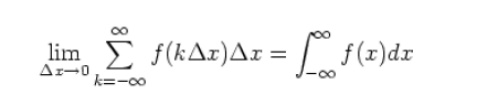
Time
integral over in equation (b) becomes over the entire time axis:

In
summary, when the signal is non-periodic x(t)=limT->infxT(t) the Fourier expansion becomes Fourier
transform. The forward transform (analysis) is:

and the
inverse transform (synthesis) is:
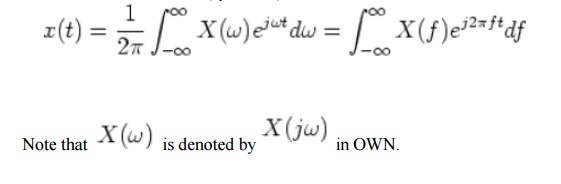
Comparing
Fourier coefficient of a periodic signal
xT(t) withwith Fourier spectrum of a non-periodic signal x(t)

we see
that the dimension of X(ω) is
different from that of X[k]:
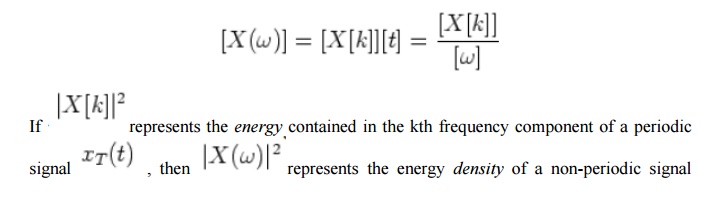
x(t) distributed
along the frequency axis. We can only speak of the energy contained in a particular
frequency band ω1<
ω< ω2
Related Topics