Chapter: Health Management in Aquaculture: Parasitic diseases and pests
Microsporeans - Crustacean Diseases Caused By Parasites
Microsporeans
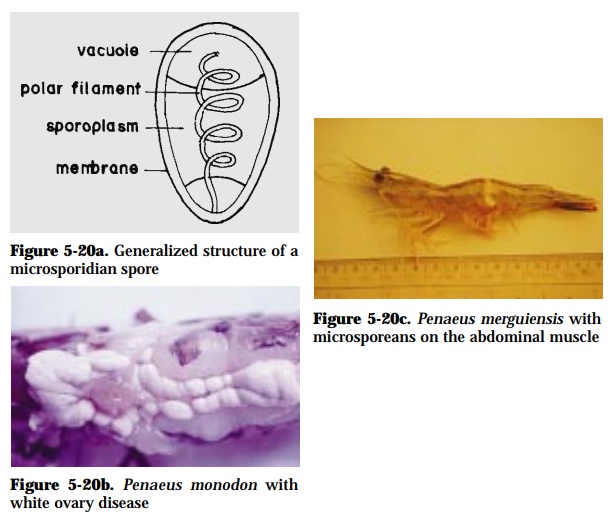
These are intracellular parasites with unicellular spores (3-10 µm) containing sporoplasm and coiled polar filament (Fig. 5-20a).
CAUSATIVE AGENTS:
Nosema (Ameson), Agmasoma (Thelohania), Pleistophora, Glugea, Ichthyosporidium
SPECIES AFFECTED:
Penaeid shrimps
GROSS SIGNS:
Affected hosts are weakened and easily stressed. Infected areas (cephal-othorax, abdominal muscle, ovary) turn opaque white because of the pres-ence of spores and other stages of the parasite, thus the term “cotton” or “milk” shrimp or “white ovary” disease (Fig. 5-20b, 5-20c). Infection may result in sterility of spawners with white ovaries.
EFFECT ON HOST:
Penaeids with spores in the ovaries become sterile. In crabs, microspori-dians cause lysis of muscle tissues and increase vulnerability to stress.
DIAGNOSIS:
Microscopic examination of fresh squashes of Giemsa-stained smears from infected areas will reveal spores. Histological sections also provide positive identification.
PREVENTION AND CONTROL:
• Isolate and destroy infected individuals
• Avoid contact of infected broodstock with offspring
• Disinfect culture systems with chlorine or iodine
Related Topics