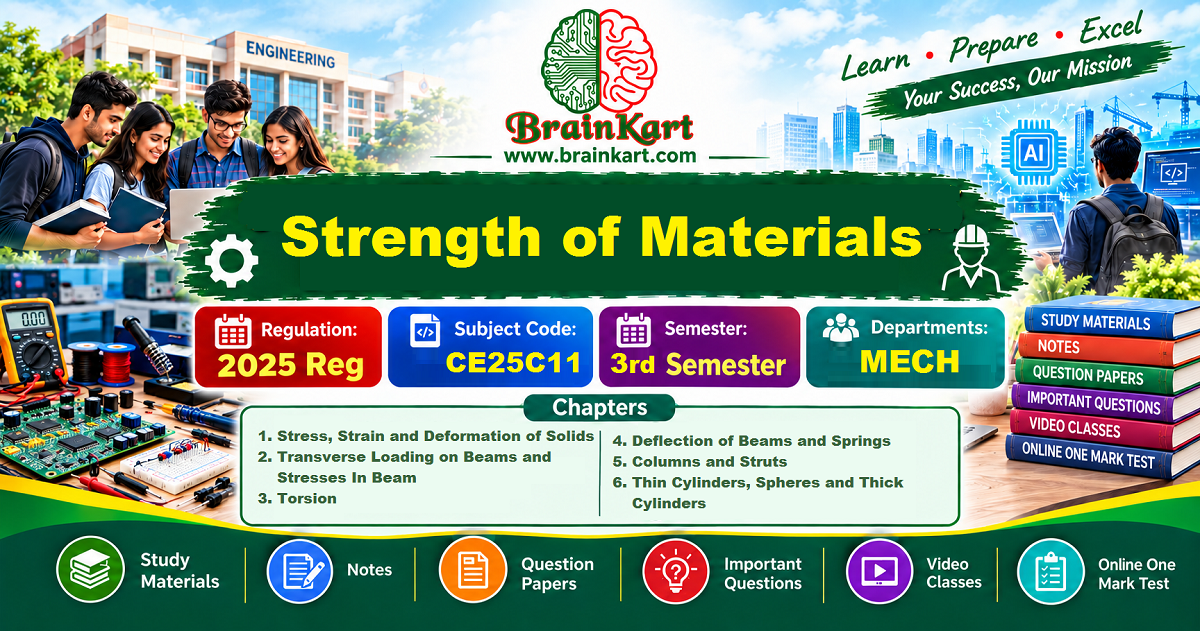
Strength of Materials - CE25C11
[ 3rd Semester - Mechanical Engineering Department ]
Under Class: | 3rd Semester [Mechanical Dept Anna University 2025 Regulation] |
Strength of Materials - CE25C11 - Study Materials, Notes, Important Questions, Anna University Semester Question Paper PDF Download
Engineering - Strength of Materials - CE25C11 Subject (under Anna University 3rd Semester - Mechanical Engineering Department Regulation 2025) - Study Materials, Written and lecture Notes, Important Questions, Semester Question Paper PDF Download
CE25C11
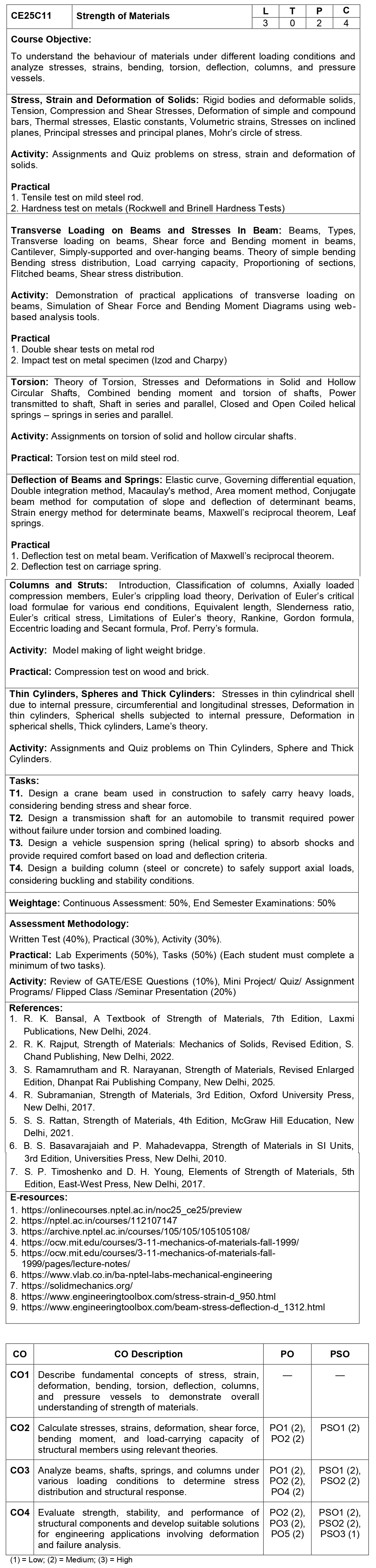
Strength of Materials
Course Objective:
To
understand the behaviour of materials under different loading conditions and
analyze stresses, strains, bending, torsion, deflection, columns, and pressure
vessels.
Stress,
Strain and Deformation of Solids: Rigid bodies and
deformable solids, Tension, Compression and Shear Stresses, Deformation of
simple and compound bars, Thermal stresses, Elastic constants, Volumetric
strains, Stresses on inclined planes, Principal stresses and principal planes,
Mohr’s circle of stress.
Activity:
Assignments and Quiz problems on stress, strain and deformation of solids.
Practical
1.
Tensile test on mild steel rod.
2.
Hardness test on metals (Rockwell and Brinell Hardness Tests)
Transverse
Loading on Beams and Stresses In Beam: Beams, Types, Transverse loading on
beams, Shear force and Bending moment in beams, Cantilever, Simply-supported
and over-hanging beams. Theory of simple bending Bending stress distribution,
Load carrying capacity, Proportioning of sections, Flitched beams, Shear stress
distribution.
Activity:
Demonstration of practical applications of transverse loading on beams,
Simulation of Shear Force and Bending Moment Diagrams using web-based analysis
tools.
Practical
1.
Double shear tests on metal rod
2.
Impact test on metal specimen (Izod and Charpy)
Torsion:
Theory of Torsion, Stresses and Deformations in Solid and Hollow Circular
Shafts, Combined bending moment and torsion of shafts, Power transmitted to
shaft, Shaft in series and parallel, Closed and Open Coiled helical springs –
springs in series and parallel.
Activity:
Assignments on torsion of solid and hollow circular shafts.
Practical:
Torsion test on mild steel rod.
Deflection
of Beams and Springs: Elastic curve, Governing
differential equation, Double integration method, Macaulay's method, Area
moment method, Conjugate beam method for computation of slope and deflection of
determinant beams, Strain energy method for determinate beams, Maxwell’s
reciprocal theorem, Leaf springs.
Practical
1.
Deflection test on metal beam. Verification of Maxwell’s reciprocal theorem.
2.
Deflection test on carriage spring.
Columns
and Struts: Introduction, Classification of
columns, Axially loaded compression members, Euler’s crippling load theory,
Derivation of Euler’s critical load formulae for various end conditions,
Equivalent length, Slenderness ratio, Euler’s critical stress, Limitations of
Euler’s theory, Rankine, Gordon formula, Eccentric loading and Secant formula,
Prof. Perry’s formula.
Activity:
Model making of light weight bridge.
Practical:
Compression test on wood and brick.
Thin
Cylinders, Spheres and Thick Cylinders: Stresses in
thin cylindrical shell due to internal pressure, circumferential and
longitudinal stresses, Deformation in thin cylinders, Spherical shells
subjected to internal pressure, Deformation in spherical shells, Thick
cylinders, Lame’s theory.
Activity: Assignments
and Quiz problems on Thin Cylinders, Sphere and Thick Cylinders.
Tasks:
T1.
Design a crane beam used in construction to safely carry heavy loads,
considering bending stress and shear force.
T2.
Design a transmission shaft for an automobile to transmit required power
without failure under torsion and combined loading.
T3.
Design a vehicle suspension spring (helical spring) to absorb shocks and
provide required comfort based on load and deflection criteria.
T4.
Design a building column (steel or concrete) to safely support axial loads,
considering buckling and stability conditions.
Weightage:
Continuous Assessment: 50%, End Semester Examinations: 50%
Assessment Methodology:
Written
Test (40%), Practical (30%), Activity (30%).
Practical:
Lab Experiments (50%), Tasks (50%) (Each student must complete a minimum of two
tasks).
Activity:
Review of GATE/ESE Questions (10%), Mini Project/ Quiz/ Assignment Programs/
Flipped Class /Seminar Presentation (20%)
References:
1.
R. K. Bansal, A Textbook of Strength of Materials, 7th Edition, Laxmi Publications,
New Delhi, 2024.
2.
R. K. Rajput, Strength of Materials: Mechanics of Solids, Revised Edition, S.
Chand Publishing, New Delhi, 2022.
3.
S. Ramamrutham and R. Narayanan, Strength of Materials, Revised Enlarged
Edition, Dhanpat Rai Publishing Company, New Delhi, 2025.
4.
R. Subramanian, Strength of Materials, 3rd Edition, Oxford University Press,
New Delhi, 2017.
5.
S. S. Rattan, Strength of Materials, 4th Edition, McGraw Hill Education, New
Delhi, 2021.
6.
B. S. Basavarajaiah and P. Mahadevappa, Strength of Materials in SI Units, 3rd
Edition, Universities Press, New Delhi, 2010.
7.
S. P. Timoshenko and D. H. Young, Elements of Strength of Materials, 5th
Edition, East-West Press, New Delhi, 2017.
E-resources:
1.
https://onlinecourses.nptel.ac.in/noc25_ce25/preview
2.
https://nptel.ac.in/courses/112107147
3.
https://archive.nptel.ac.in/courses/105/105/105105108/
4.
https://ocw.mit.edu/courses/3-11-mechanics-of-materials-fall-1999/
5.
https://ocw.mit.edu/courses/3-11-mechanics-of-materials-fall-1999/pages/lecture-notes/
6.
https://www.vlab.co.in/ba-nptel-labs-mechanical-engineering
7.
https://solidmechanics.org/
8.
https://www.engineeringtoolbox.com/stress-strain-d_950.html
9.
https://www.engineeringtoolbox.com/beam-stress-deflection-d_1312.html