Strategic Management - MB25C12
[ 3rd Semester - MBA - Master of Business Administration ]
Under Class: | 3rd Semester [MBA Dept Anna University 2025 Regulation] |
Strategic Management - MB25C12 - Study Materials, Notes, Important Questions, Anna University Semester Question Paper PDF Download
Mba - Strategic Management - MB25C12 Subject (under Anna University 3rd Semester - MBA - Master of Business Administration Regulation 2025) - Study Materials, Written and lecture Notes, Important Questions, Semester Question Paper PDF Download
MB25C12:
Strategic
Management
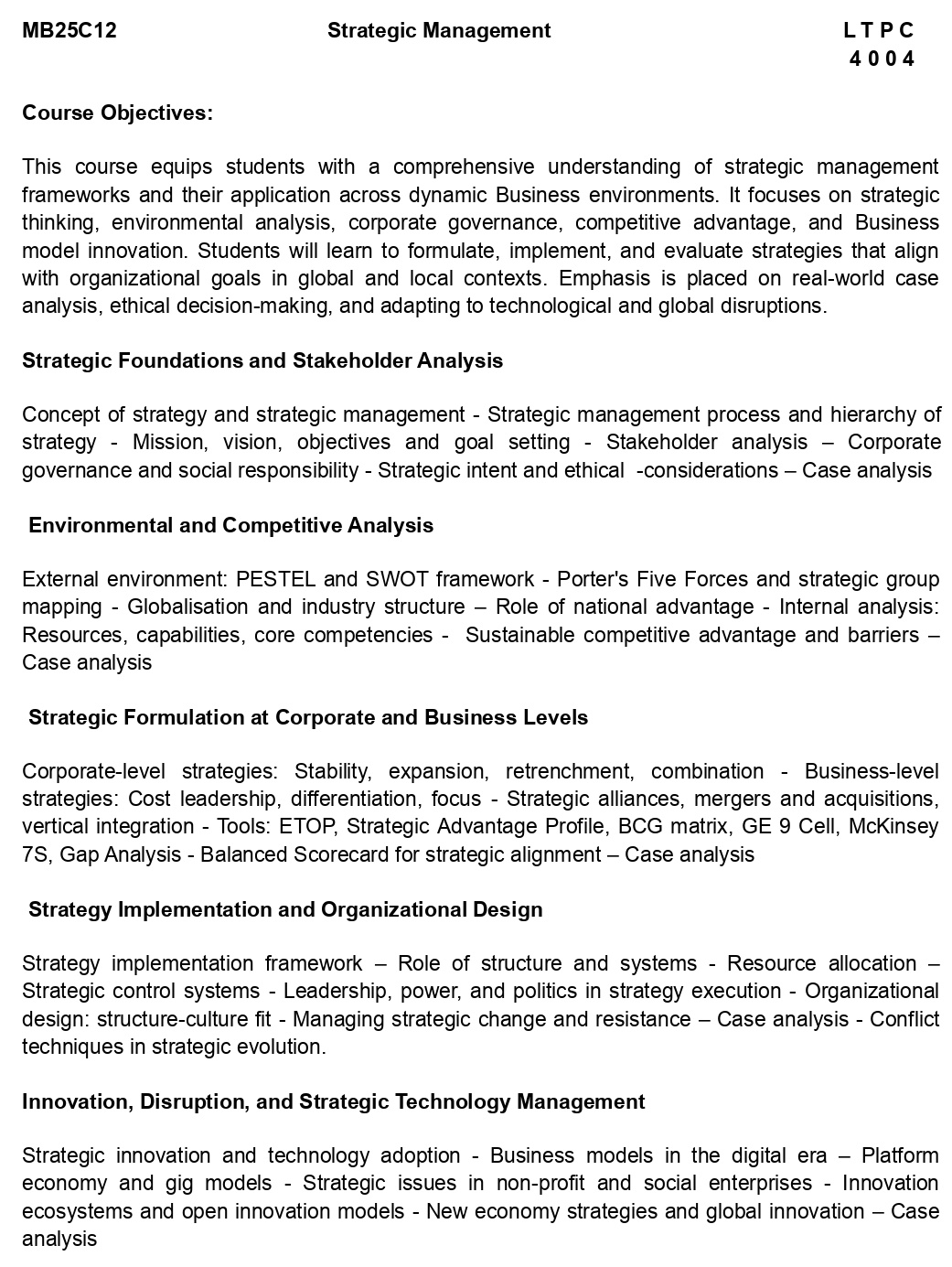
Course Objectives:
This
course equips students with a comprehensive understanding of strategic
management frameworks and their application across dynamic Business
environments. It focuses on strategic thinking, environmental analysis,
corporate governance, competitive advantage, and Business model innovation.
Students will learn to formulate, implement, and evaluate strategies that align
with organizational goals in global and local contexts. Emphasis is placed on
real-world case analysis, ethical decision-making, and adapting to
technological and global disruptions.
Strategic
Foundations and Stakeholder Analysis
Concept
of strategy and strategic management - Strategic management process and
hierarchy of strategy - Mission, vision, objectives and goal setting - Stakeholder
analysis – Corporate governance and social responsibility - Strategic intent
and ethical -considerations – Case analysis
Environmental
and Competitive Analysis
External
environment: PESTEL and SWOT framework - Porter's Five Forces and strategic
group mapping - Globalisation and industry structure – Role of national
advantage - Internal analysis: Resources, capabilities, core competencies -
Sustainable competitive advantage and barriers – Case analysis
Strategic
Formulation at Corporate and Business Levels
Corporate-level
strategies: Stability, expansion, retrenchment, combination - Business-level
strategies: Cost leadership, differentiation, focus - Strategic alliances,
mergers and acquisitions, vertical integration - Tools: ETOP, Strategic
Advantage Profile, BCG matrix, GE 9 Cell, McKinsey 7S, Gap Analysis - Balanced
Scorecard for strategic alignment – Case analysis
Strategy
Implementation and Organizational Design
Strategy
implementation framework – Role of structure and systems - Resource allocation
– Strategic control systems - Leadership, power, and politics in strategy
execution - Organizational design: structure-culture fit - Managing strategic
change and resistance – Case analysis - Conflict techniques in strategic
evolution.
Innovation,
Disruption, and Strategic Technology Management
Strategic
innovation and technology adoption - Business models in the digital era –
Platform economy and gig models - Strategic issues in non-profit and social
enterprises - Innovation ecosystems and open innovation models - New economy
strategies and global innovation – Case analysis
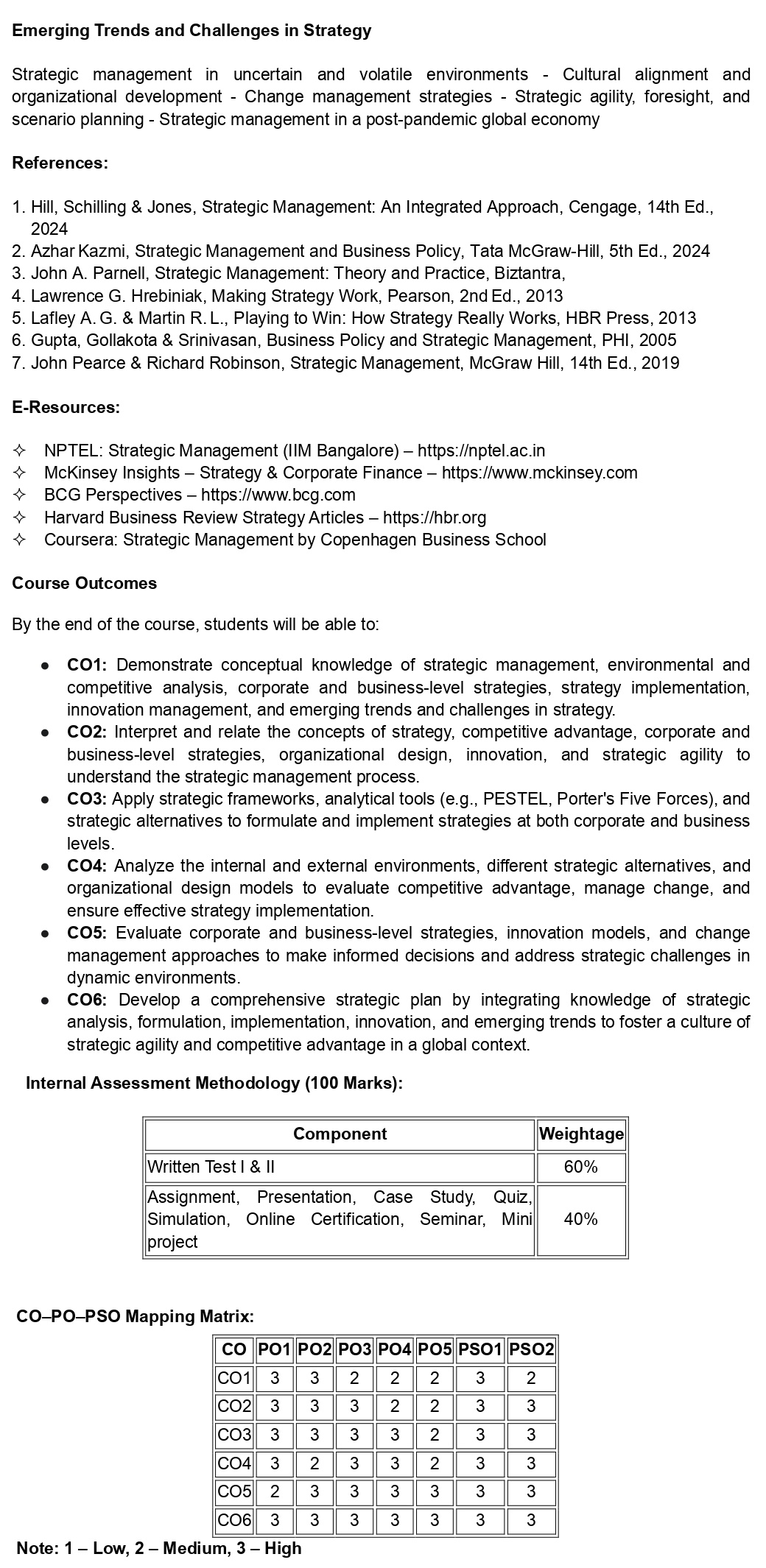
Emerging
Trends and Challenges in Strategy
Strategic
management in uncertain and volatile environments - Cultural alignment and
organizational development - Change management strategies - Strategic agility,
foresight, and scenario planning - Strategic management in a post-pandemic
global economy
References:
1.
Hill, Schilling & Jones, Strategic Management: An Integrated Approach,
Cengage, 14th Ed., 2024
2.
Azhar Kazmi, Strategic Management and Business Policy, Tata McGraw-Hill, 5th
Ed., 2024
3.
John A. Parnell, Strategic Management: Theory and Practice, Biztantra,
4.
Lawrence G. Hrebiniak, Making Strategy Work, Pearson, 2nd Ed., 2013
5.
Lafley A. G. & Martin R. L., Playing to Win: How Strategy Really Works, HBR
Press, 2013
6.
Gupta, Gollakota & Srinivasan, Business Policy and Strategic Management,
PHI, 2005
7.
John Pearce & Richard Robinson, Strategic Management, McGraw Hill, 14th
Ed., 2019
Course
Outcomes
By the end of the course, students will be able to:
● CO1:
Demonstrate conceptual knowledge of strategic management, environmental and
competitive analysis, corporate and business-level strategies, strategy
implementation, innovation management, and emerging trends and challenges in
strategy.
● CO2:
Interpret and relate the concepts of strategy, competitive advantage, corporate
and business-level strategies, organizational design, innovation, and strategic
agility to understand the strategic management process.
● CO3:
Apply strategic frameworks, analytical tools (e.g., PESTEL, Porter's Five
Forces), and strategic alternatives to formulate and implement strategies at
both corporate and business levels.
● CO4:
Analyze the internal and external environments, different strategic alternatives,
and organizational design models to evaluate competitive advantage, manage
change, and ensure effective strategy implementation.
● CO5:
Evaluate corporate and business-level strategies, innovation models, and change
management approaches to make informed decisions and address strategic
challenges in dynamic environments.
●
CO6: Develop a comprehensive
strategic plan by integrating knowledge of strategic analysis, formulation,
implementation, innovation, and emerging trends to foster a culture of strategic
agility and competitive advantage in a global context.