Signals and Systems - EC25C04
[ 3rd Semester - ECE - Electronics and Communication Engineering Department ]
Under Class: | 3rd Semester [ECE Dept Anna University 2025 Regulation] |
Signals and Systems - EC25C04 - Study Materials, Notes, Important Questions, Anna University Semester Question Paper PDF Download
Engineering - Signals and Systems - EC25C04 Subject (under Anna University 3rd Semester - ECE - Electronics and Communication Engineering Department Regulation 2025) - Study Materials, Written and lecture Notes, Important Questions, Semester Question Paper PDF Download
EC25C04:
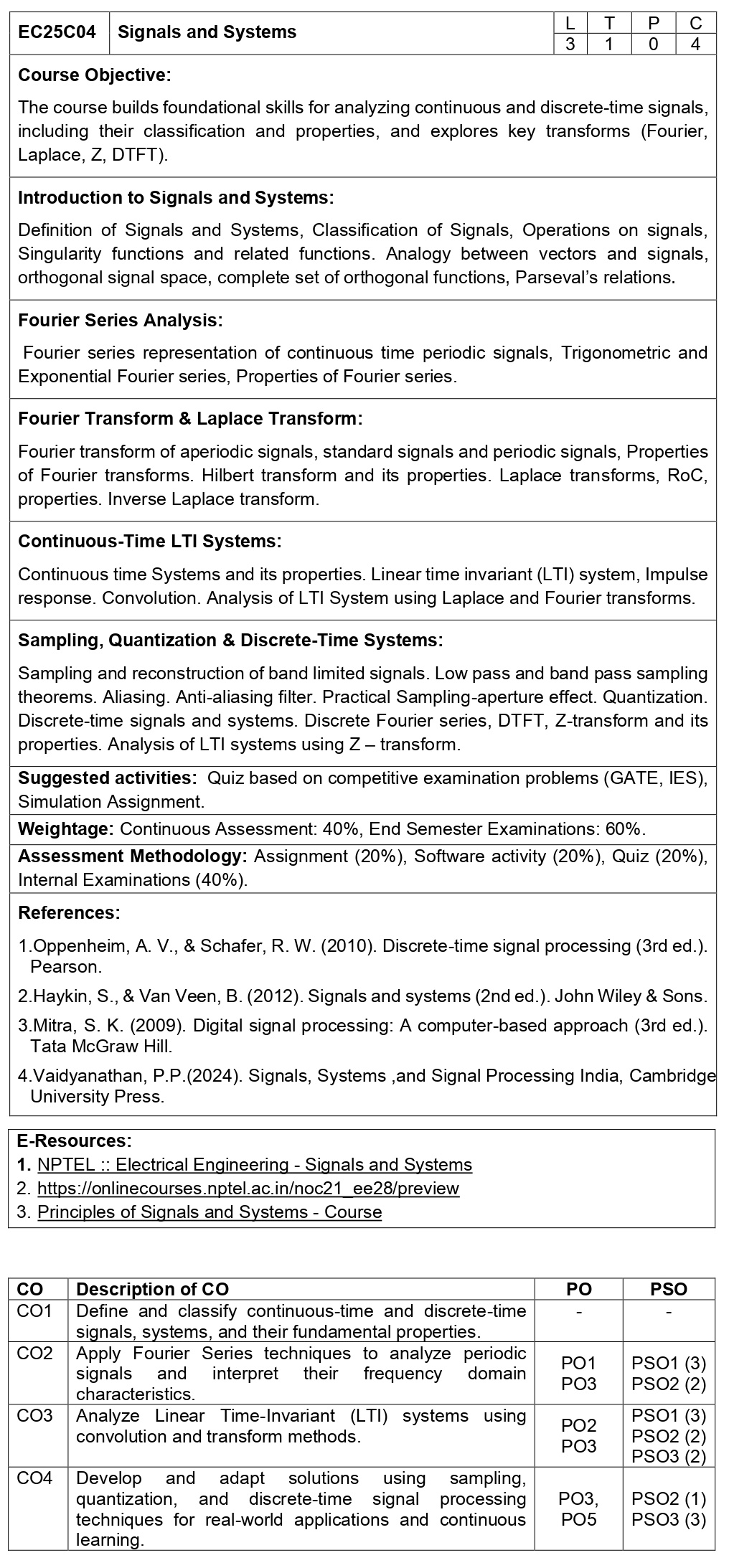
Signals and Systems
Course
Objective:
The
course builds foundational skills for analyzing continuous and discrete-time
signals, including their classification and properties, and explores key
transforms (Fourier, Laplace, Z, DTFT).
Introduction
to Signals and Systems:
Definition
of Signals and Systems, Classification of Signals, Operations on signals,
Singularity functions and related functions. Analogy between vectors and
signals, orthogonal signal space, complete set of orthogonal functions,
Parseval’s relations.
Fourier
Series Analysis:
Fourier
series representation of continuous time periodic signals, Trigonometric and
Exponential Fourier series, Properties of Fourier series.
Fourier
Transform & Laplace Transform:
Fourier
transform of aperiodic signals, standard signals and periodic signals,
Properties of Fourier transforms. Hilbert transform and its properties. Laplace
transforms, RoC, properties. Inverse Laplace transform.
Continuous-Time
LTI Systems:
Continuous
time Systems and its properties. Linear time invariant (LTI) system, Impulse
response. Convolution. Analysis of LTI System using Laplace and Fourier transforms.
Sampling,
Quantization & Discrete-Time Systems:
Sampling
and reconstruction of band limited signals. Low pass and band pass sampling
theorems. Aliasing. Anti-aliasing filter. Practical Sampling-aperture effect.
Quantization. Discrete-time signals and systems. Discrete Fourier series, DTFT,
Z-transform and its properties. Analysis of LTI systems using Z – transform.
Suggested activities:
Quiz based on competitive examination problems (GATE, IES),
Simulation
Assignment.
Weightage: Continuous
Assessment: 40%, End Semester Examinations: 60%.
Assessment Methodology:
Assignment (20%), Software activity (20%), Quiz (20%),
Internal
Examinations (40%).
References:
1.
Oppenheim, A. V., & Schafer, R. W. (2010). Discrete-time signal processing
(3rd ed.). Pearson.
2.
Haykin, S., & Van Veen, B. (2012). Signals and systems (2nd ed.). John
Wiley & Sons. 3. Mitra, S. K. (2009). Digital signal processing: A
computer-based approach (3rd ed.).
Tata
McGraw Hill.
4.
Vaidyanathan, P.P.(2024). Signals, Systems ,and Signal Processing India,
Cambridge University Press.