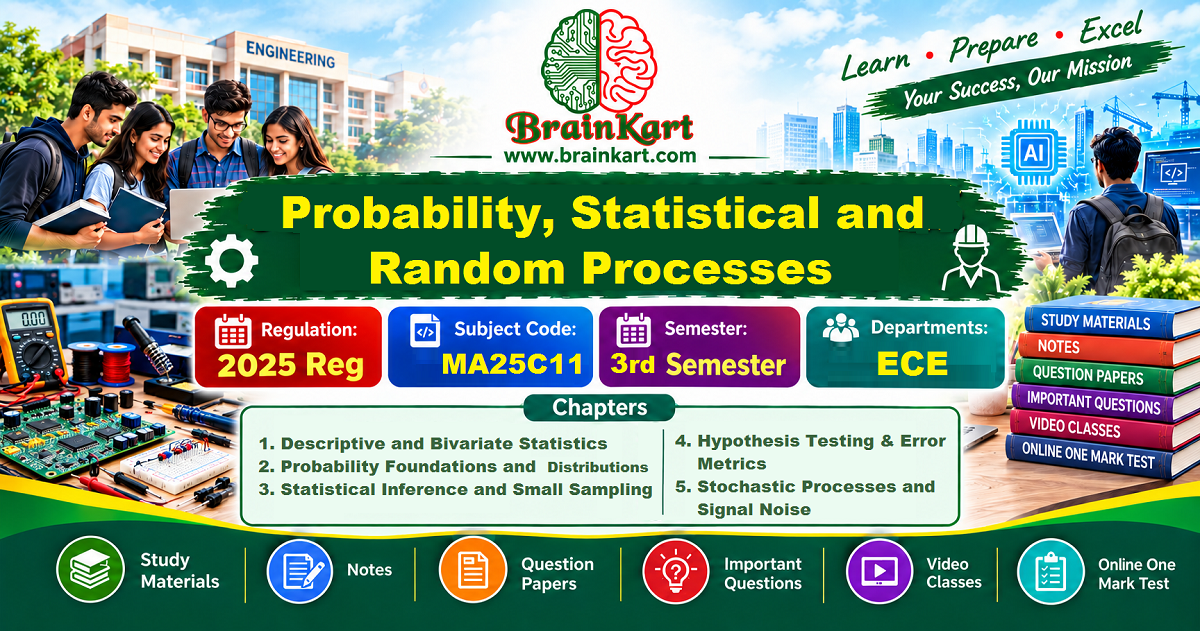
Probability, Statistical and Random Processes - MA25C11
[ 3rd Semester - ECE - Electronics and Communication Engineering Department ]
Under Class: | 3rd Semester [ECE Dept Anna University 2025 Regulation] |
Probability, Statistical and Random Processes - MA25C11 - Study Materials, Notes, Important Questions, Anna University Semester Question Paper PDF Download
Engineering - Probability, Statistical and Random Processes - MA25C11 Subject (under Anna University 3rd Semester - ECE - Electronics and Communication Engineering Department Regulation 2025) - Study Materials, Written and lecture Notes, Important Questions, Semester Question Paper PDF Download
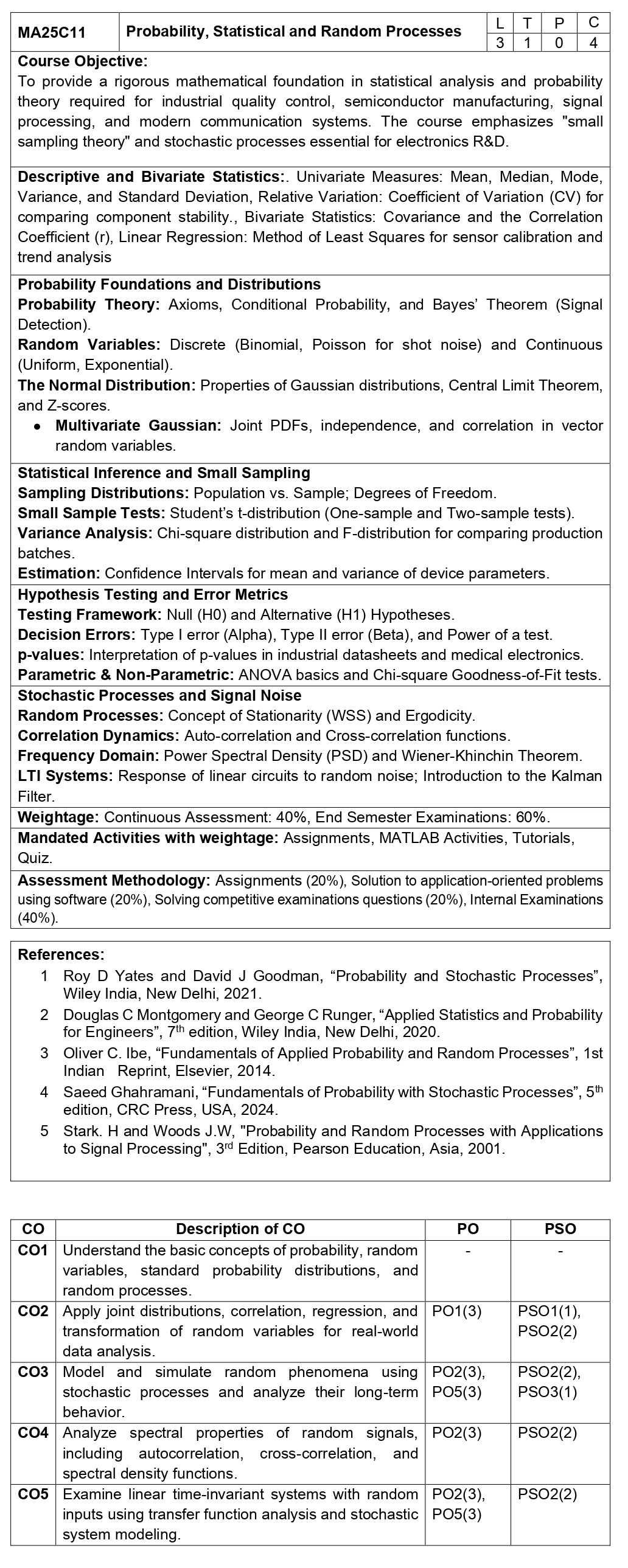
MA25C11:
Probability, Statistical and Random Processes
Course
Objective:
To
provide a rigorous mathematical foundation in statistical analysis and
probability theory required for industrial quality control, semiconductor
manufacturing, signal processing, and modern communication systems. The course
emphasizes "small sampling theory" and stochastic processes essential
for electronics R&D.
Descriptive
and Bivariate Statistics: Univariate Measures:
Mean, Median, Mode, Variance, and Standard Deviation, Relative Variation:
Coefficient of Variation (CV) for comparing component stability., Bivariate
Statistics: Covariance and the Correlation Coefficient (r), Linear Regression:
Method of Least Squares for sensor calibration and trend analysis
Probability
Foundations and Distributions
Probability Theory:
Axioms, Conditional Probability, and Bayes’ Theorem (Signal Detection).
Random Variables: Discrete
(Binomial, Poisson for shot noise) and Continuous (Uniform, Exponential).
The Normal
Distribution: Properties of Gaussian distributions,
Central Limit Theorem, and Z-scores.
●
Multivariate Gaussian: Joint PDFs,
independence, and correlation in vector random variables.
Statistical
Inference and Small Sampling
Sampling Distributions:
Population vs. Sample; Degrees of Freedom.
Small Sample Tests:
Student’s t-distribution (One-sample and Two-sample tests). Variance Analysis: Chi-square
distribution and F-distribution for comparing production batches.
Estimation:
Confidence Intervals for mean and variance of device parameters.
Hypothesis
Testing and Error Metrics
Testing Framework:
Null (H0) and Alternative (H1) Hypotheses.
Decision Errors:
Type I error (Alpha), Type II error (Beta), and Power of a test.
p-values:
Interpretation of p-values in industrial datasheets and medical electronics.
Parametric &
Non-Parametric: ANOVA basics and Chi-square
Goodness-of-Fit tests.
Stochastic
Processes and Signal Noise
Random Processes:
Concept of Stationarity (WSS) and Ergodicity.
Correlation Dynamics:
Auto-correlation and Cross-correlation functions.
Frequency Domain:
Power Spectral Density (PSD) and Wiener-Khinchin Theorem.
LTI Systems:
Response of linear circuits to random noise; Introduction to the Kalman Filter.
Weightage:
Continuous Assessment: 40%, End Semester Examinations: 60%.
Mandated Activities
with weightage: Assignments, MATLAB Activities,
Tutorials, Quiz.
Assessment Methodology:
Assignments (20%), Solution to application-oriented problems
using
software (20%), Solving competitive examinations questions (20%), Internal
Examinations (40%).
References:
1
Roy D Yates and David J Goodman, “Probability and Stochastic Processes”, Wiley
India, New Delhi, 2021.
2
Douglas C Montgomery and George C Runger, “Applied Statistics and Probability
for Engineers”, 7th edition, Wiley India, New Delhi, 2020.
3
Oliver C. Ibe, “Fundamentals of Applied Probability and Random Processes”, 1st
IndianReprint, Elsevier, 2014.
4
Saeed Ghahramani, “Fundamentals of Probability with Stochastic Processes”, 5th
edition, CRC Press, USA, 2024.
5
Stark. H and Woods J.W, "Probability and Random Processes with
Applications to Signal Processing", 3rd Edition, Pearson Education, Asia,
2001.