Principles of Soil Science and Engineering - AI25301
[ 3rd Semester - Agriculture Engineering Department ]
Under Class: | 3rd Semester [Agricultural Dept Anna University 2025 Regulation] |
Principles of Soil Science and Engineering - AI25301 - Study Materials, Notes, Important Questions, Anna University Semester Question Paper PDF Download
Engineering - Principles of Soil Science and Engineering - AI25301 Subject (under Anna University 3rd Semester - Agriculture Engineering Department Regulation 2025) - Study Materials, Written and lecture Notes, Important Questions, Semester Question Paper PDF Download
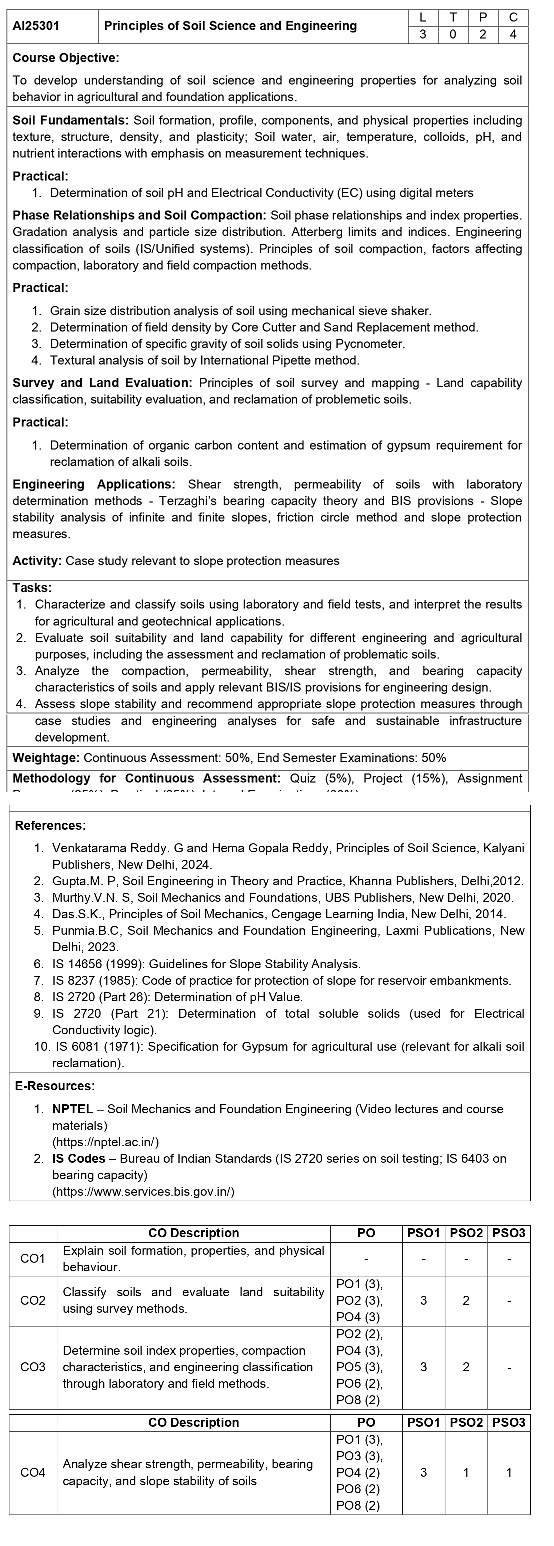
AI25301:
Principles
of Soil Science and Engineering
Course
Objective:
To
develop understanding of soil science and engineering properties for analyzing
soil behavior in agricultural and foundation applications.
Soil
Fundamentals: Soil formation, profile, components,
and physical properties including texture, structure, density, and plasticity;
Soil water, air, temperature, colloids, pH, and nutrient interactions with
emphasis on measurement techniques.
Practical:
1.
Determination of soil pH and Electrical Conductivity (EC) using digital meters
Phase Relationships and
Soil Compaction: Soil phase relationships and index
properties. Gradation analysis and particle size distribution. Atterberg limits
and indices. Engineering classification of soils (IS/Unified systems).
Principles of soil compaction, factors affecting compaction, laboratory and
field compaction methods.
Practical:
1.
Grain size distribution analysis of soil using mechanical sieve shaker.
2.
Determination of field density by Core Cutter and Sand Replacement method.
3.
Determination of specific gravity of soil solids using Pycnometer.
4.
Textural analysis of soil by International Pipette method.
Survey
and Land Evaluation: Principles of soil survey and
mapping - Land capability classification, suitability evaluation, and
reclamation of problemetic soils.
Practical:
1.
Determination of organic carbon content and estimation of gypsum requirement
for reclamation of alkali soils.
Engineering
Applications: Shear strength, permeability of soils
with laboratory determination methods - Terzaghi’s bearing capacity theory and
BIS provisions - Slope stability analysis of infinite and finite slopes,
friction circle method and slope protection measures.
Activity:
Case study relevant to slope protection measures
Tasks:
1.
Characterize and classify soils using laboratory and field tests, and interpret
the results for agricultural and geotechnical applications.
2.
Evaluate soil suitability and land capability for different engineering and
agricultural purposes, including the assessment and reclamation of problematic
soils.
3.
Analyze the compaction, permeability, shear strength, and bearing capacity
characteristics of soils and apply relevant BIS/IS provisions for engineering
design.
4.
Assess slope stability and recommend appropriate slope protection measures
through
case
studies and engineering analyses for safe and sustainable infrastructure development.
Weightage:
Continuous Assessment: 50%, End Semester Examinations: 50%
Methodology for
Continuous Assessment: Quiz (5%), Project (15%),
Assignment Programs (25%), Practical (25%), Internal Examinations (30%)
References:
1.
Venkatarama Reddy. G and Hema Gopala Reddy, Principles of Soil Science, Kalyani
Publishers, New Delhi, 2024.
2.
Gupta.M. P, Soil Engineering in Theory and Practice, Khanna Publishers,
Delhi,2012.
3.
Murthy.V.N. S, Soil Mechanics and Foundations, UBS Publishers, New Delhi, 2020.
4.
Das.S.K., Principles of Soil Mechanics, Cengage Learning India, New Delhi, 2014.
5.
Punmia.B.C, Soil Mechanics and Foundation Engineering, Laxmi Publications, New
Delhi, 2023.
6.
IS 14656 (1999): Guidelines for Slope Stability Analysis.
7.
IS 8237 (1985): Code of practice for protection of slope for reservoir
embankments.
8.
IS 2720 (Part 26): Determination of pH Value.
9.
IS 2720 (Part 21): Determination of total soluble solids (used for Electrical
Conductivity logic).
10. IS 6081 (1971): Specification for Gypsum for agricultural use (relevant for alkali soil reclamation).