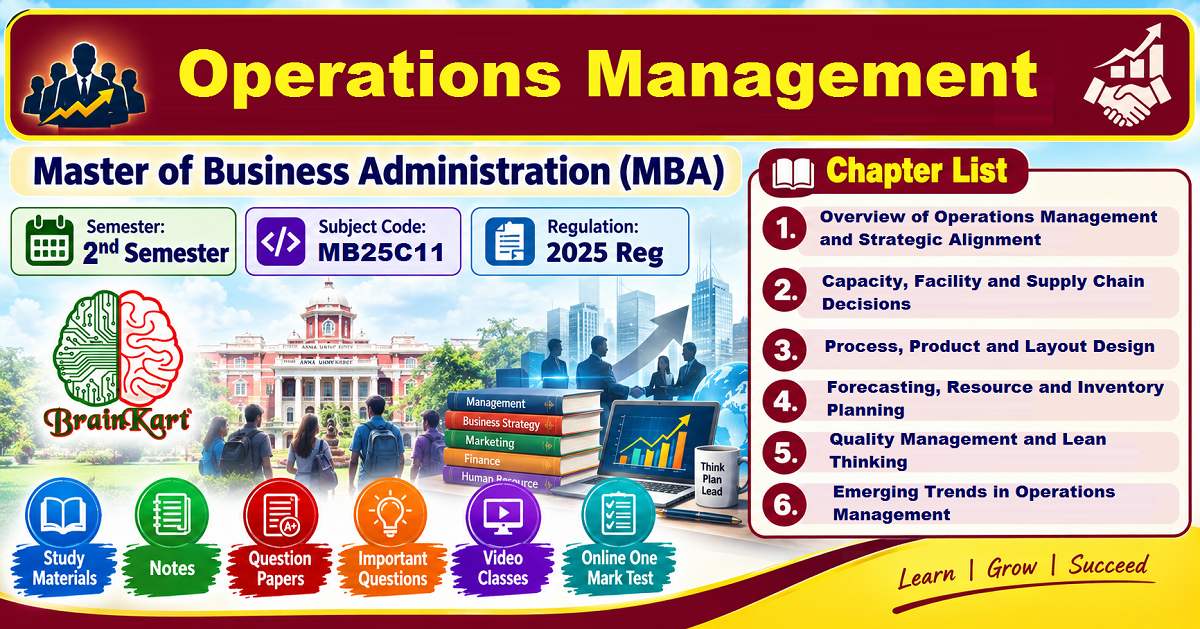
Operations Management - MB25C11
[ 2nd Semester - MBA - Master of Business Administration ]
Under Class: | 2nd Semester [MBA Dept Anna University 2025 Regulation] |
Operations Management - MB25C11 - Study Materials, Notes, Important Questions, Anna University Semester Question Paper PDF Download
Mba - Operations Management - MB25C11 Subject (under Anna University 2nd Semester - MBA - Master of Business Administration Regulation 2025) - Study Materials, Written and lecture Notes, Important Questions, Semester Question Paper PDF Download
MB25C11:
Operations
Management
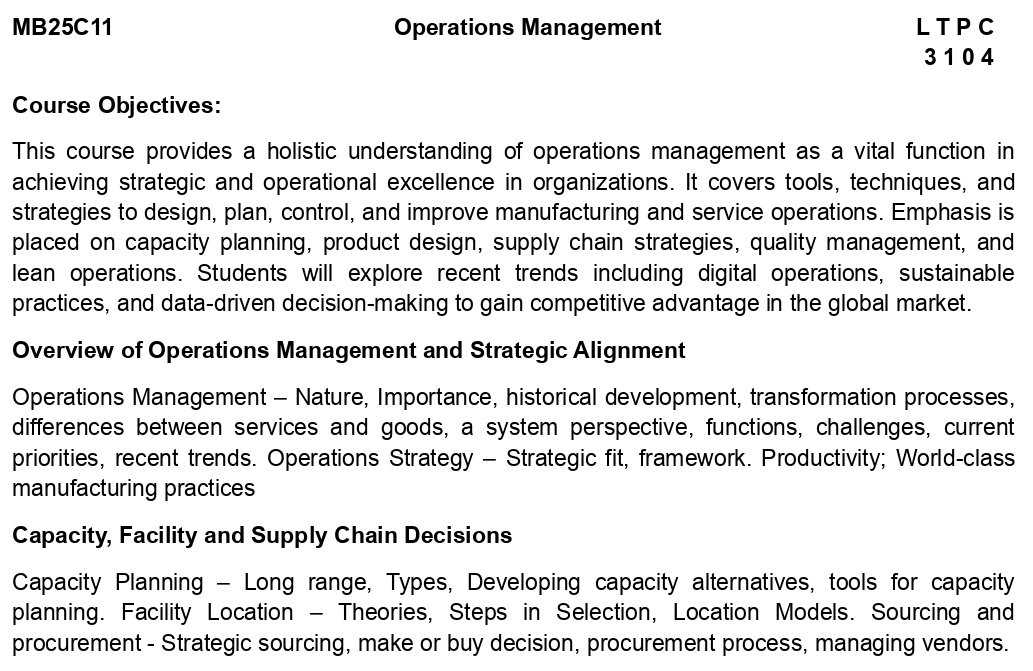
Course Objectives:
This
course provides a holistic understanding of operations management as a vital
function in achieving strategic and operational excellence in organizations. It
covers tools, techniques, and strategies to design, plan, control, and improve
manufacturing and service operations. Emphasis is placed on capacity planning,
product design, supply chain strategies, quality management, and lean
operations. Students will explore recent trends including digital operations,
sustainable practices, and data-driven decision-making to gain competitive
advantage in the global market.
Overview
of Operations Management and Strategic Alignment
Operations
Management – Nature, Importance, historical development, transformation
processes, differences between services and goods, a system perspective,
functions, challenges, current priorities, recent trends. Operations Strategy –
Strategic fit, framework. Productivity; World-class manufacturing practices
Capacity,
Facility and Supply Chain Decisions
Capacity
Planning – Long range, Types, Developing capacity alternatives, tools for
capacity planning. Facility Location – Theories, Steps in Selection, Location
Models. Sourcing and procurement - Strategic sourcing, make or buy decision,
procurement process, managing vendors.
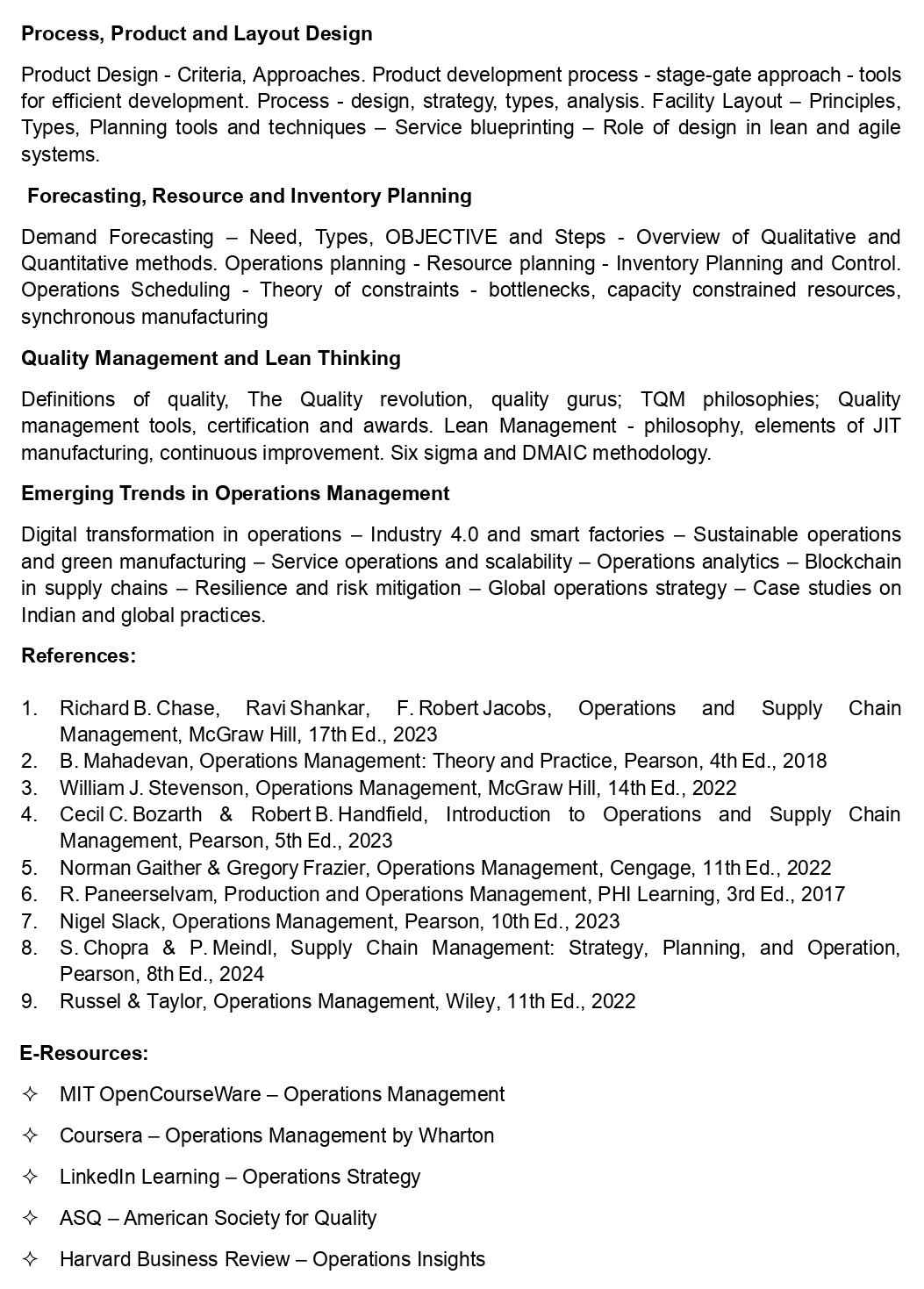
Process,
Product and Layout Design
Product
Design - Criteria, Approaches. Product development process - stage-gate
approach - tools for efficient development. Process - design, strategy, types,
analysis. Facility Layout – Principles, Types, Planning tools and techniques –
Service blueprinting – Role of design in lean and agile systems.
Forecasting,
Resource and Inventory Planning
Demand
Forecasting – Need, Types, OBJECTIVE and Steps - Overview of Qualitative and
Quantitative methods. Operations planning - Resource planning - Inventory
Planning and Control. Operations Scheduling - Theory of constraints -
bottlenecks, capacity constrained resources, synchronous manufacturing
Quality
Management and Lean Thinking
Definitions
of quality, The Quality revolution, quality gurus; TQM philosophies; Quality
management tools, certification and awards. Lean Management - philosophy,
elements of JIT manufacturing, continuous improvement. Six sigma and DMAIC
methodology.
Emerging
Trends in Operations Management
Digital
transformation in operations – Industry 4.0 and smart factories – Sustainable
operations and green manufacturing – Service operations and scalability –
Operations analytics – Blockchain in supply chains – Resilience and risk
mitigation – Global operations strategy – Case studies on Indian and global
practices.
References:
1.
Richard B. Chase,Ravi Shankar,F. Robert Jacobs,OperationsandSupplyChain
Management, McGraw Hill, 17th Ed., 2023
2.
B. Mahadevan, Operations Management: Theory and Practice, Pearson, 4th Ed.,
2018
3.
William J. Stevenson, Operations Management, McGraw Hill, 14th Ed., 2022
4.
Cecil C. Bozarth & Robert B. Handfield, Introduction to Operations and
Supply Chain Management, Pearson, 5th Ed., 2023
5.
Norman Gaither & Gregory Frazier, Operations Management, Cengage, 11th Ed.,
2022
6.
R. Paneerselvam, Production and Operations Management, PHI Learning, 3rd Ed.,
2017
7.
Nigel Slack, Operations Management, Pearson, 10th Ed., 2023
8.
S. Chopra & P. Meindl, Supply Chain Management: Strategy, Planning, and
Operation, Pearson, 8th Ed., 2024
9.
Russel & Taylor, Operations Management, Wiley, 11th Ed., 2022
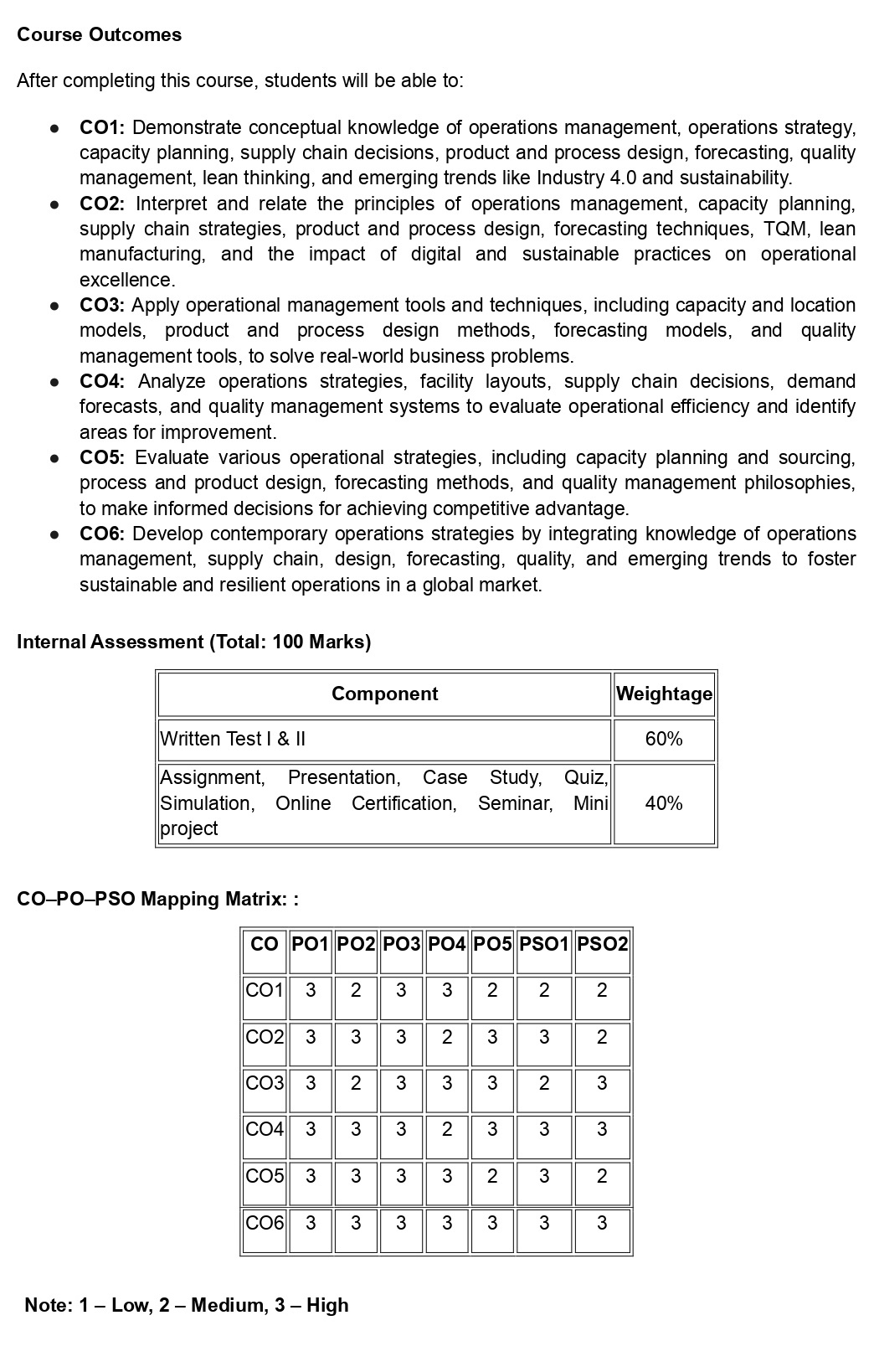
Course Outcomes
After completing this course, students will be able to:
● CO1:
Demonstrate conceptual knowledge of operations management, operations strategy,
capacity planning, supply chain decisions, product and process design,
forecasting, quality management, lean thinking, and emerging trends like
Industry 4.0 and sustainability.
● CO2:
Interpret and relate the principles of operations management, capacity
planning, supply chain strategies, product and process design, forecasting
techniques, TQM, lean manufacturing, and the impact of digital and sustainable
practices on operational excellence.
● CO3:
Apply operational management tools and techniques, including capacity and
location models, product and process design methods, forecasting models, and
quality management tools, to solve real-world business problems.
● CO4:
Analyze operations strategies, facility layouts, supply chain decisions, demand
forecasts, and quality management systems to evaluate operational efficiency
and identify areas for improvement.
● CO5:
Evaluate various operational strategies, including capacity planning and
sourcing, process and product design, forecasting methods, and quality
management philosophies, to make informed decisions for achieving competitive
advantage.
● CO6:
Develop contemporary operations strategies by integrating knowledge of operations
management, supply chain, design, forecasting, quality, and emerging trends to
foster sustainable and resilient operations in a global market.