Operating Systems - CS25C11
[ 3rd Semester - CSE, CSE(CY), AIDS, IT Engineering Departments ]
Under Class: | 3rd Semester [CSE Dept Anna University 2025 Regulation] | | 3rd Semester [CSE(CY) Dept Anna University 2025 Regulation] | | 3rd Semester [AIDS Dept Anna University 2025 Regulation] | | 4th Semester [IT Dept Anna University 2025 Regulation] |
Operating Systems - CS25C11 - Study Materials, Notes, Important Questions, Anna University Semester Question Paper PDF Download
Engineering - Operating Systems - CS25C11 Subject (under Anna University 3rd Semester - CSE, CSE(CY), AIDS, IT Engineering Departments Regulation 2025) - Study Materials, Written and lecture Notes, Important Questions, Semester Question Paper PDF Download
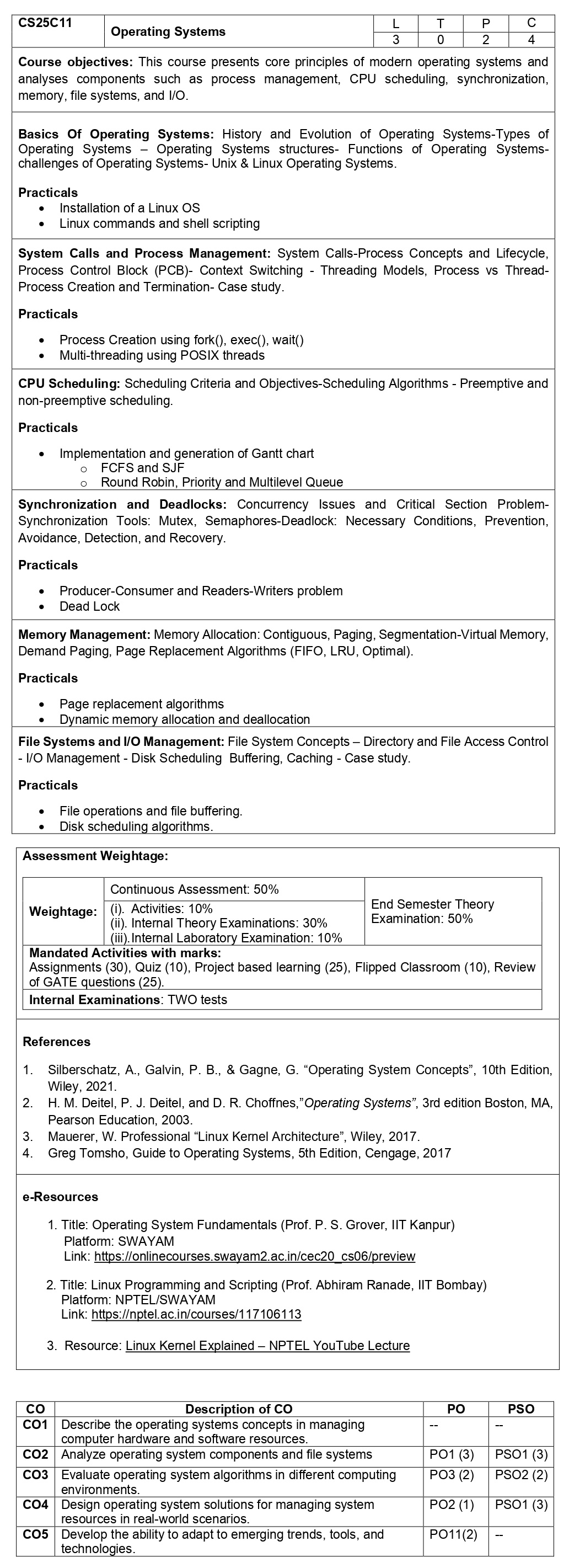
CS25C11:
Operating Systems
Course
objectives: This course presents core principles of
modern operating systems and analyses components such as process management,
CPU scheduling, synchronization, memory, file systems, and I/O.
Basics Of
Operating Systems: History and Evolution of Operating
Systems-Types of Operating Systems – Operating Systems structures- Functions of
Operating Systems-challenges of Operating Systems- Unix & Linux Operating
Systems
Practicals
•
Installation of a Linux OS
•
Linux commands and shell scripting
System
Calls and Process Management: System Calls-Process
Concepts and Lifecycle, Process Control Block (PCB)- Context Switching -
Threading Models, Process vs Thread-Process Creation and Termination- Case
study.
Practicals
•
Process Creation using fork(), exec(), wait()
•
Multi-threading using POSIX threads
CPU
Scheduling: Scheduling Criteria and
Objectives-Scheduling Algorithms - Preemptive and non-preemptive scheduling
Practicals
•
Implementation and generation of Gantt chart
o
FCFS and SJF
o
Round Robin, Priority and Multilevel Queue
Synchronization
and Deadlocks: Concurrency Issues and Critical Section
Problem-Synchronization Tools: Mutex, Semaphores-Deadlock: Necessary
Conditions, Prevention, Avoidance, Detection, and Recovery
Practicals
•
Producer-Consumer and Readers-Writers problem
•
Dead Lock
Memory
Management: Memory Allocation: Contiguous, Paging,
Segmentation-Virtual Memory, Demand Paging, Page Replacement Algorithms (FIFO,
LRU, Optimal)
Practicals
•
Page replacement algorithms
•
Dynamic memory allocation and deallocation
File
Systems and I/O Management: File System Concepts –
Directory and File Access Control -I/O Management - Disk Scheduling Buffering,
Caching - Case study.
Practicals
•
File operations and file buffering.
•
Disk scheduling algorithms
Assessment
Weightage:
Weightage:
Continuous
Assessment: 50%
(i) . Activities: 10%
(ii)
. Internal Theory Examinations: 30%
(iii)
.Internal Laboratory Examination: 10%
End
Semester Theory Examination: 50%
Mandated
Activities with marks:
Assignments
(30), Quiz (10), Virtual demonstration (25), Flipped Classroom (10), Review of
GATE & IES questions (25).
Internal
Examinations: TWO tests
References:
1.
Silberschatz, A., Galvin, P. B., & Gagne, G. “Operating System Concepts”,
10th Edition, Wiley, 2021.
2.
H. M. Deitel, P. J. Deitel, and D. R. Choffnes,”Operating Systems”, 3rd edition
Boston, MA, Pearson Education, 2003.
3.
Mauerer, W. Professional “Linux Kernel Architecture”, Wiley, 2017.
4.
Greg Tomsho, Guide to Operating Systems, 5th Edition, Cengage, 2017.