Object Oriented Software Engineering - CS25C10
[ 3rd Semester - CSE Computer Science and Engineering, Cyber Security Engineering Departments ]
Under Class: | 3rd Semester [CSE Dept Anna University 2025 Regulation] | | 3rd Semester [CSE(CY) Dept Anna University 2025 Regulation] |
Object Oriented Software Engineering - CS25C10 - Study Materials, Notes, Important Questions, Anna University Semester Question Paper PDF Download
Engineering - Object Oriented Software Engineering - CS25C10 Subject (under Anna University 3rd Semester - CSE Computer Science and Engineering, Cyber Security Engineering Departments Regulation 2025) - Study Materials, Written and lecture Notes, Important Questions, Semester Question Paper PDF Download
CS25C10:
Object
oriented software Engineering
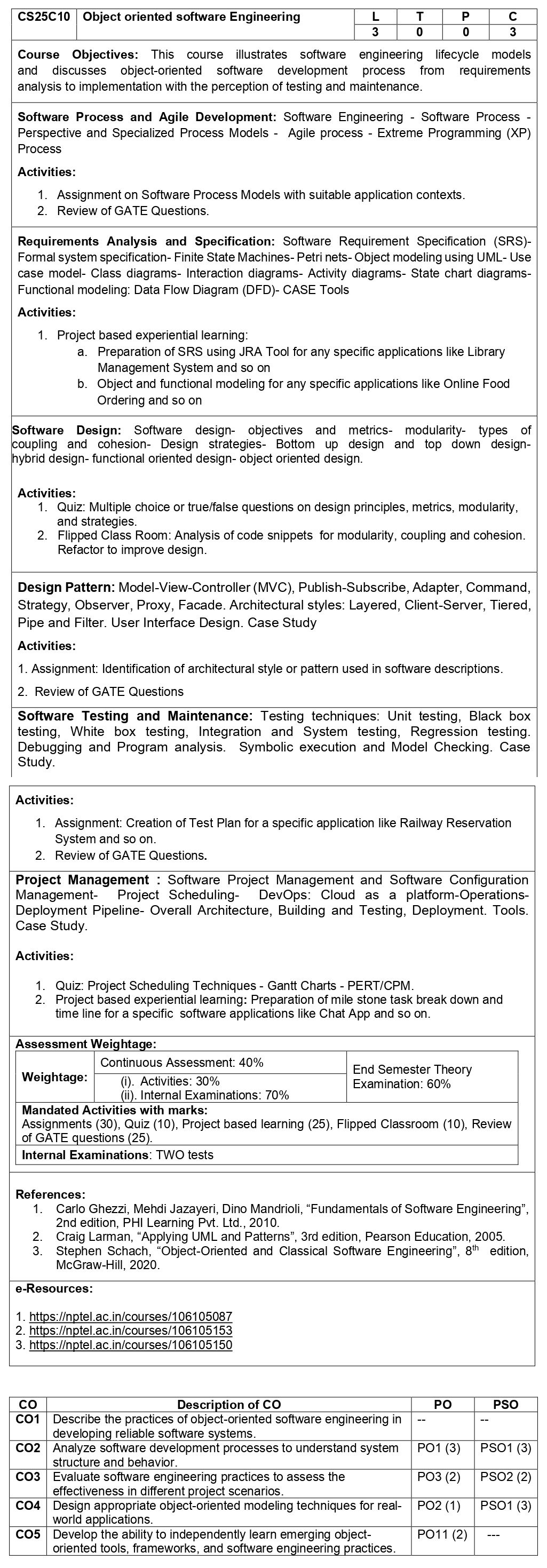
Course
Objectives: This course illustrates software
engineering lifecycle models and discusses object-oriented software development
process from requirements analysis to implementation with the perception of
testing and maintenance.
Software
Process and Agile Development: Software Engineering -
Software Process - Perspective and Specialized Process Models - Agile process -
Extreme Programming (XP) Process
Activities:
1.
Assignment on Software Process Models with suitable application contexts.
2.
Review of GATE Questions.
Requirements
Analysis and Specification: Software Requirement
Specification (SRS)-Formal system specification- Finite State Machines- Petri
nets- Object modeling using UML- Use case model- Class diagrams- Interaction
diagrams- Activity diagrams- State chart diagrams-Functional modeling: Data
Flow Diagram (DFD)- CASE Tools
Activities:
1.
Project based experiential learning:
a.
Preparation of SRS using JRA Tool for any specific applications like Library
Management System and so on
b.
Object and functional modeling for any specific applications like Online Food
Ordering and so on
Software
Design: Software design- objectives and metrics-
modularity- types of coupling and cohesion- Design strategies- Bottom up design
and top down design-hybrid design- functional oriented design- object oriented
design.
Activities:
1.
Quiz: Multiple choice or true/false questions on design principles, metrics,
modularity, and strategies.
2.
Flipped Class Room: Analysis of code snippets for modularity, coupling and cohesion.
Refactor to improve design.
Design
Pattern: Model-View-Controller (MVC),
Publish-Subscribe, Adapter, Command, Strategy, Observer, Proxy, Facade.
Architectural styles: Layered, Client-Server, Tiered, Pipe and Filter. User
Interface Design. Case Study
Activities:
1.
Assignment: Identification of architectural style or pattern used in software
descriptions.
2.
Review of GATE Questions
Software
Testing and Maintenance: Testing techniques:
Unit testing, Black box testing, White box testing, Integration and System
testing, Regression testing. Debugging and Program analysis. Symbolic execution
and Model Checking. Case Study.
Activities:
1.
Assignment: Creation of Test Plan for a specific application like Railway
Reservation System and so on.
2.
Review of GATE Questions.
Project
Management : Software Project Management and
Software Configuration Management- Project Scheduling- DevOps: Cloud as a
platform-Operations-Deployment Pipeline- Overall Architecture, Building and
Testing, Deployment. Tools. Case Study.
Activities:
1.
Quiz: Project Scheduling Techniques - Gantt Charts - PERT/CPM.
2.
Project based experiential learning: Preparation of mile stone task break down
and time line for a specific software applications like Chat App and so on.
Assessment
Weightage:
Weightage:
Continuous Assessment: 40%,
•
Activities: 30%
•
Internal Examinations: 70%
End
Semester Theory Examinations: 60%
Mandated Activites With
Mark: Assignments (30),Quitz (10), Project based
learning(25), Flipped classroom (10), Review of GATE questions (25)
Internal Examinations
: TWO tests
References:
1.
Carlo Ghezzi, Mehdi Jazayeri, Dino Mandrioli, “Fundamentals of Software
Engineering”, 2nd edition, PHI Learning Pvt. Ltd., 2010.
2.
Craig Larman, “Applying UML and Patterns”, 3rd edition, Pearson Education, 2005.
3.
Stephen Schach, “Object-Oriented and Classical Software Engineering”, 8th
edition, McGraw-Hill, 2020.