Object Oriented Programming - CS25C07
[ 3rd Semester - IT - Information Technology Department ]
Under Class: | 3rd Semester [IT Dept Anna University 2025 Regulation] |
Object Oriented Programming - CS25C07 - Study Materials, Notes, Important Questions, Anna University Semester Question Paper PDF Download
Engineering - Object Oriented Programming - CS25C07 Subject (under Anna University 3rd Semester - IT - Information Technology Department Regulation 2025) - Study Materials, Written and lecture Notes, Important Questions, Semester Question Paper PDF Download
CS25C07:
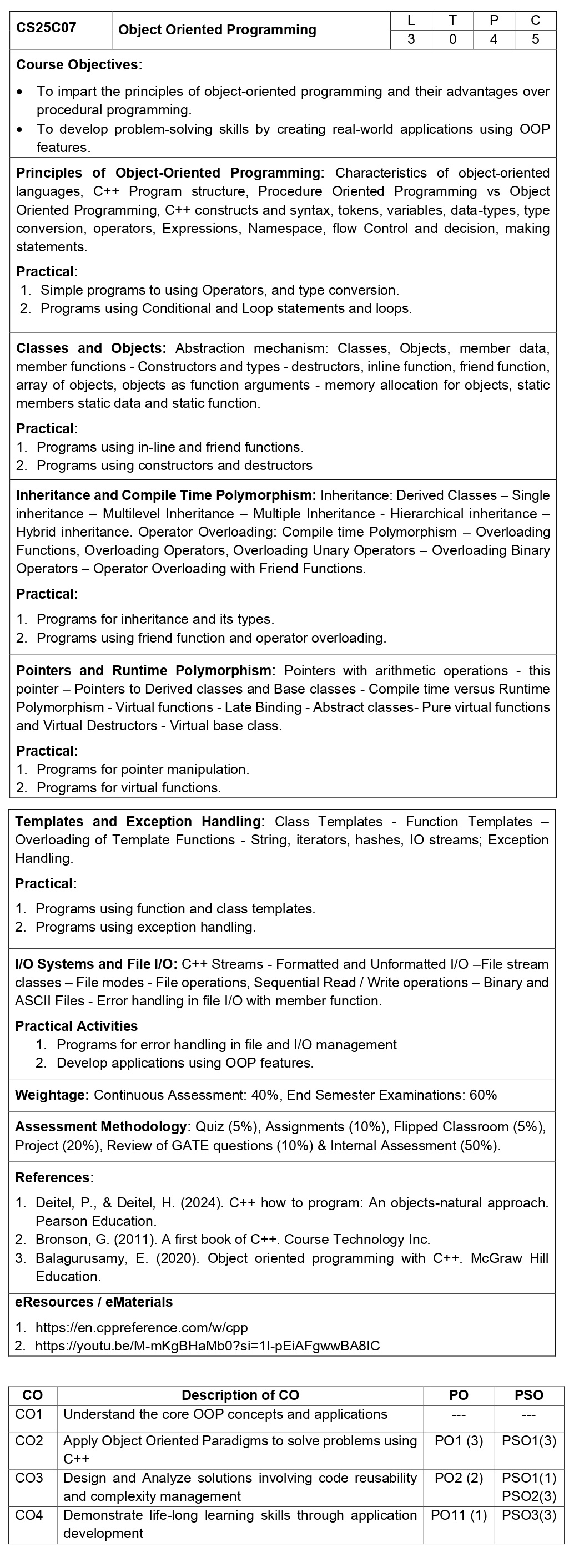
Object Oriented Programming
Course Objectives:
•
To impart the principles of object-oriented programming and their advantages
over procedural programming.
•
To develop problem-solving skills by creating real-world applications using OOP
features.
Principles
of Object-Oriented Programming: Characteristics of
object-oriented languages, C++ Program structure, Procedure Oriented
Programming vs Object Oriented Programming, C++ constructs and syntax, tokens,
variables, data-types, type conversion, operators, Expressions, Namespace, flow
Control and decision, making statements.
Practical:
1.
Simple programs to using Operators, and type conversion.
2.
Programs using Conditional and Loop statements and loops.
Classes
and Objects: Abstraction mechanism: Classes,
Objects, member data, member functions - Constructors and types - destructors,
inline function, friend function, array of objects, objects as function
arguments - memory allocation for objects, static members static data and
static function.
Practical:
1.
Programs using in-line and friend functions.
2.
Programs using constructors and destructors
Inheritance
and Compile Time Polymorphism: Inheritance:
Derived Classes – Single inheritance – Multilevel Inheritance – Multiple
Inheritance - Hierarchical inheritance – Hybrid inheritance. Operator
Overloading: Compile time Polymorphism – Overloading Functions, Overloading
Operators, Overloading Unary Operators – Overloading Binary Operators –
Operator Overloading with Friend Functions.
Practical:
1.
Programs for inheritance and its types.
2.
Programs using friend function and operator overloading.
Pointers
and Runtime Polymorphism: Pointers with
arithmetic operations - this pointer – Pointers to Derived classes and Base
classes - Compile time versus Runtime Polymorphism - Virtual functions - Late
Binding - Abstract classes- Pure virtual functions and Virtual Destructors -
Virtual base class.
Practical:
1.
Programs for pointer manipulation.
2.
Programs for virtual functions.
Templates and Exception
Handling: Class Templates - Function Templates –
Overloading of Template Functions - String, iterators, hashes, IO streams;
Exception Handling.
Practical:
1.
Programs using function and class templates.
2.
Programs using exception handling.
I/O
Systems and File I/O: C++ Streams - Formatted and Unformatted
I/O –File stream classes – File modes - File operations, Sequential Read /
Write operations – Binary and ASCII Files - Error handling in file I/O with
member function.
Practical Activities
1.
Programs for error handling in file and I/O management
2.
Develop applications using OOP features.
Weightage:
Continuous Assessment: 40%, End Semester Examinations: 60%
Assessment Methodology:
Quiz (5%), Assignments (10%), Flipped Classroom (5%), Project (20%), Review of
GATE questions (10%) & Internal Assessment (50%).
References:
1.
Deitel, P., & Deitel, H. (2024). C++ how to program: An objects-natural
approach. Pearson Education.
2.
Bronson, G. (2011). A first book of C++. Course Technology Inc.
3.
Balagurusamy, E. (2020). Object oriented programming with C++. McGraw Hill
Education.
eResources / eMaterials
1.
https://en.cppreference.com/w/cpp
2.
https://youtu.be/M-mKgBHaMb0?si=1I-pEiAFgwwBA8IC