Matrices for Engineers - MA25C10
[ 3rd Semester - EEE - Electrical and Electronics Engineering Department ]
Under Class: | 3rd Semester [EEE Dept Anna University 2025 Regulation] |
Matrices for Engineers - MA25C10 - Study Materials, Notes, Important Questions, Anna University Semester Question Paper PDF Download
Engineering - Matrices for Engineers - MA25C10 Subject (under Anna University 3rd Semester - EEE - Electrical and Electronics Engineering Department Regulation 2025) - Study Materials, Written and lecture Notes, Important Questions, Semester Question Paper PDF Download
MA25C10:
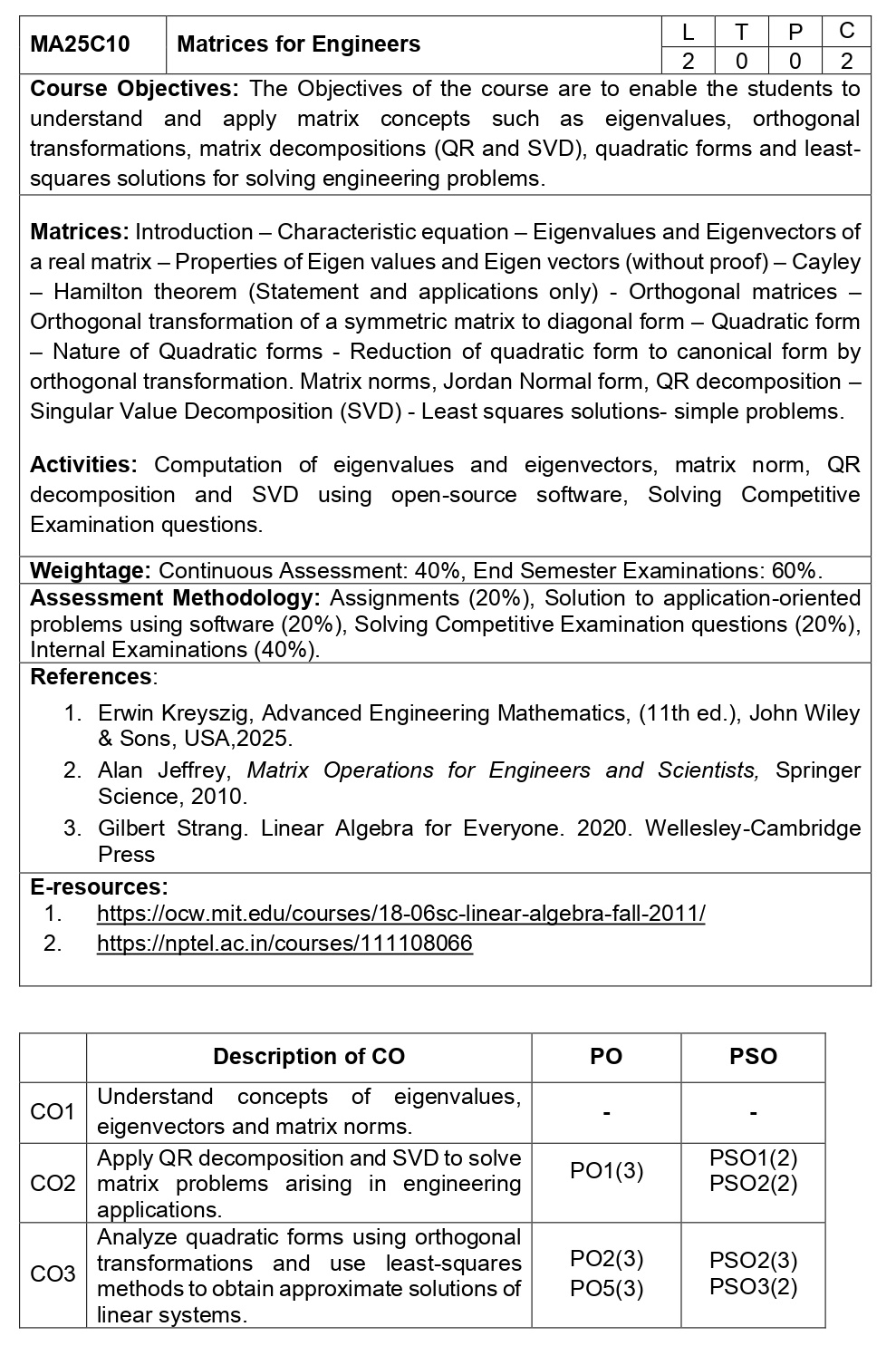
Matrices for Engineers
Course Objectives: The Objectives of the course are to enable the students to understand and apply matrix concepts such as eigenvalues, orthogonal transformations, matrix decompositions (QR and SVD), quadratic forms and least- squares solutions for solving engineering problems.
Matrices:
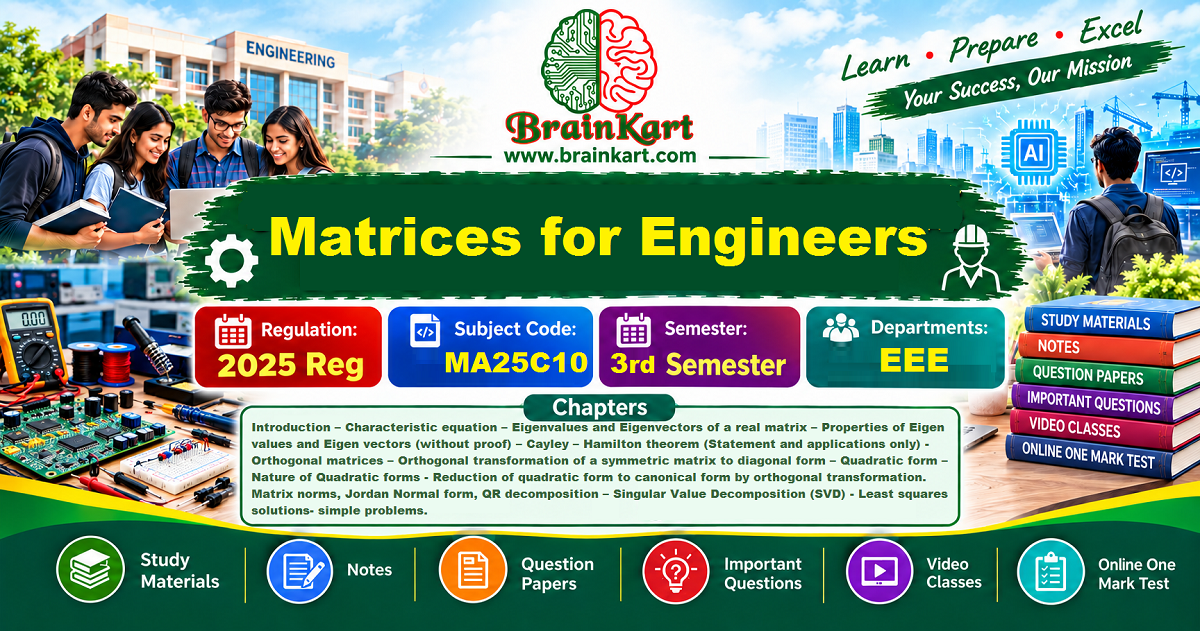
Introduction – Characteristic equation – Eigenvalues and Eigenvectors of a real
matrix – Properties of Eigen values and Eigen vectors (without proof) – Cayley
– Hamilton theorem (Statement and applications only) - Orthogonal matrices –
Orthogonal transformation of a symmetric matrix to diagonal form – Quadratic
form – Nature of Quadratic forms - Reduction of quadratic form to canonical
form by orthogonal transformation. Matrix norms, Jordan Normal form, QR
decomposition – Singular Value Decomposition (SVD) - Least squares solutions-
simple problems.
Activities:
Computation of eigenvalues and eigenvectors, matrix norm, QR decomposition and
SVD using open-source software, Solving Competitive Examination questions.
Weightage:
Continuous Assessment: 40%, End Semester Examinations: 60%.
Assessment Methodology:
Assignments (20%), Solution to application-oriented
problems
using software (20%), Solving Competitive Examination questions (20%), Internal
Examinations (40%).
References:
1.
Erwin Kreyszig, Advanced Engineering Mathematics, (11th ed.), John Wiley &
Sons, USA,2025.
2.
Alan Jeffrey, Matrix Operations for Engineers and Scientists, Springer Science,
2010.
3.
Gilbert Strang. Linear Algebra for Everyone. 2020. Wellesley-Cambridge Press