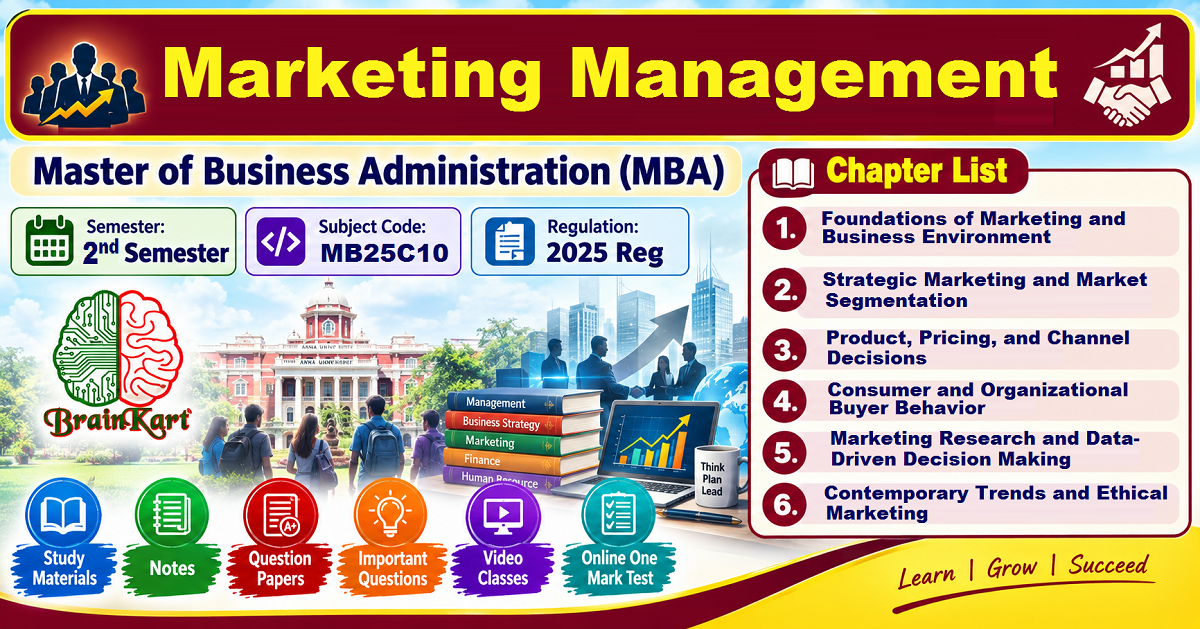
Marketing Management - MB25C10
[ 2nd Semester - MBA - Master of Business Administration ]
Under Class: | 2nd Semester [MBA Dept Anna University 2025 Regulation] |
Marketing Management - MB25C10 - Study Materials, Notes, Important Questions, Anna University Semester Question Paper PDF Download
Mba - Marketing Management - MB25C10 Subject (under Anna University 2nd Semester - MBA - Master of Business Administration Regulation 2025) - Study Materials, Written and lecture Notes, Important Questions, Semester Question Paper PDF Download
MB25C10:
Marketing
Management
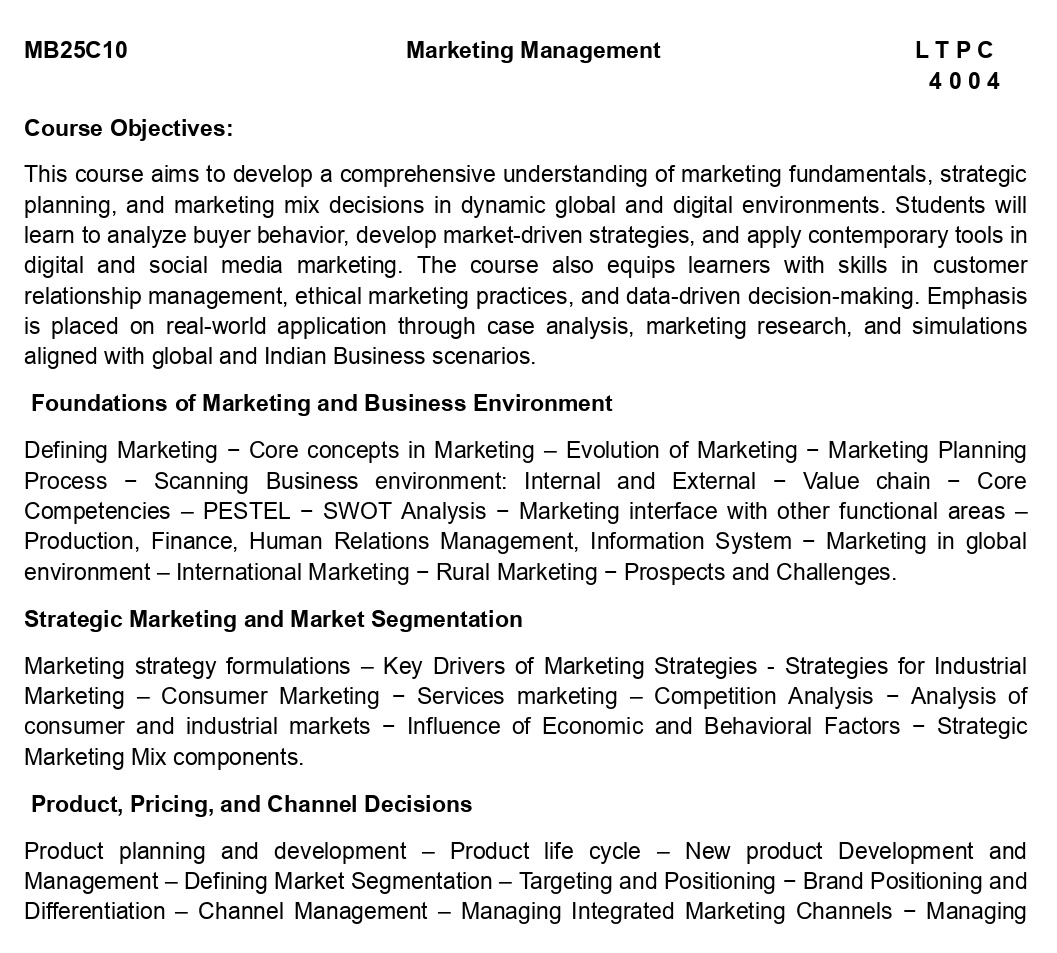
Course Objectives:
This
course aims to develop a comprehensive understanding of marketing fundamentals,
strategic planning, and marketing mix decisions in dynamic global and digital
environments. Students will learn to analyze buyer behavior, develop
market-driven strategies, and apply contemporary tools in digital and social
media marketing. The course also equips learners with skills in customer
relationship management, ethical marketing practices, and data-driven
decision-making. Emphasis is placed on real-world application through case
analysis, marketing research, and simulations aligned with global and Indian
Business scenarios.
Foundations
of Marketing and Business Environment
Defining
Marketing − Core concepts in Marketing – Evolution of Marketing − Marketing
Planning Process − Scanning Business environment: Internal and External − Value
chain − Core Competencies – PESTEL − SWOT Analysis − Marketing interface with
other functional areas – Production, Finance, Human Relations Management,
Information System − Marketing in global environment – International Marketing
− Rural Marketing − Prospects and Challenges.
Strategic
Marketing and Market Segmentation
Marketing
strategy formulations – Key Drivers of Marketing Strategies - Strategies for
Industrial Marketing – Consumer Marketing − Services marketing – Competition
Analysis − Analysis of consumer and industrial markets − Influence of Economic
and Behavioral Factors − Strategic Marketing Mix components.
Product,
Pricing, and Channel Decisions
Product
planning and development – Product life cycle – New product Development and
Management – Defining Market Segmentation – Targeting and Positioning − Brand
Positioning and Differentiation – Channel Management – Managing Integrated
Marketing Channels – Managing Retailing, Wholesaling and Logistics −
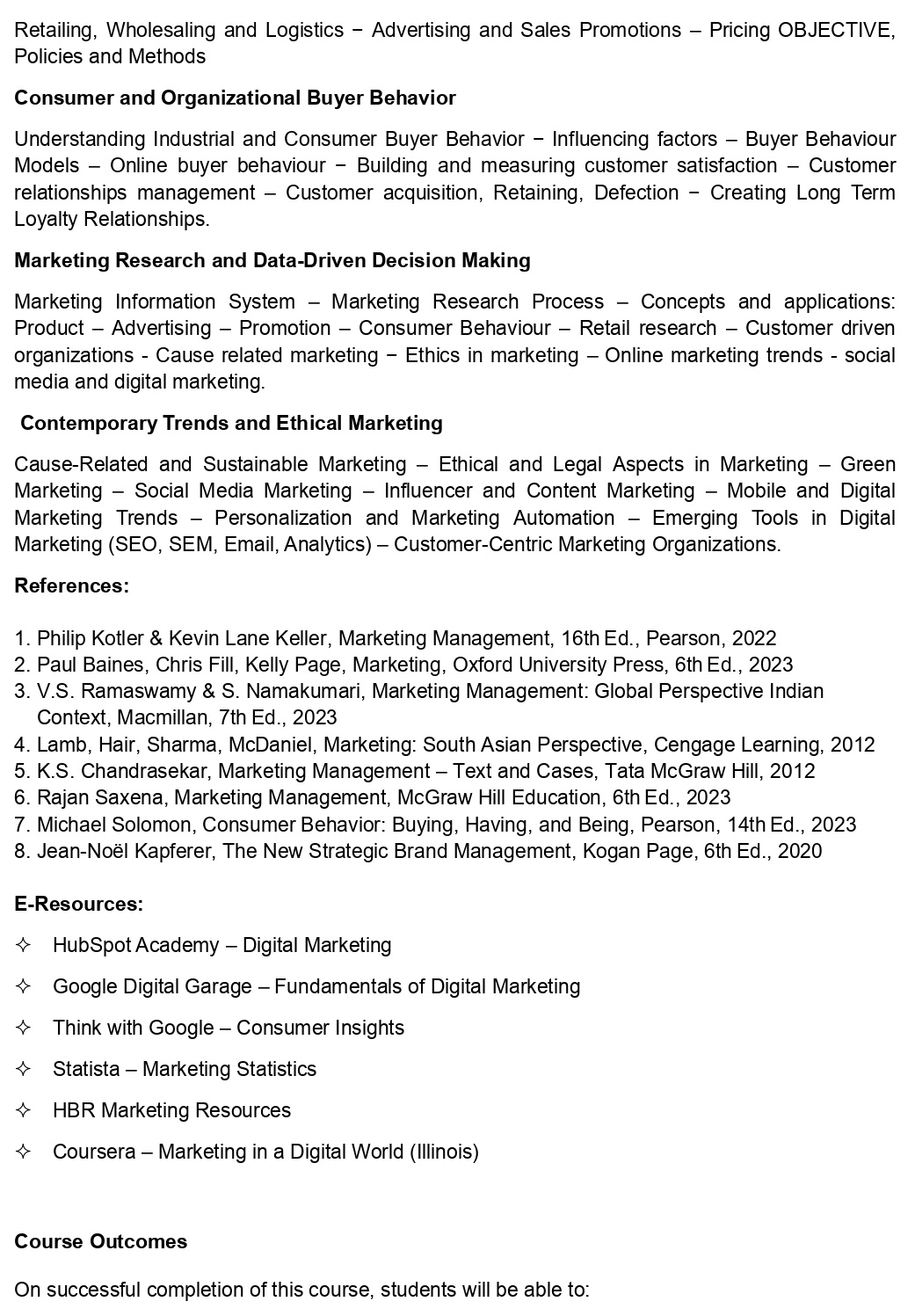
Advertising and Sales Promotions – Pricing OBJECTIVE, Policies and Methods
Consumer
and Organizational Buyer Behavior
Understanding
Industrial and Consumer Buyer Behavior − Influencing factors – Buyer Behaviour
Models – Online buyer behaviour − Building and measuring customer satisfaction
– Customer relationships management – Customer acquisition, Retaining,
Defection − Creating Long Term Loyalty Relationships.
Marketing
Research and Data-Driven Decision Making
Marketing
Information System – Marketing Research Process – Concepts and applications:
Product – Advertising – Promotion – Consumer Behaviour – Retail research –
Customer driven organizations - Cause related marketing − Ethics in marketing –
Online marketing trends - social media and digital marketing.
Contemporary
Trends and Ethical Marketing
Cause-Related
and Sustainable Marketing – Ethical and Legal Aspects in Marketing – Green
Marketing – Social Media Marketing – Influencer and Content Marketing – Mobile
and Digital Marketing Trends – Personalization and Marketing Automation –
Emerging Tools in Digital Marketing (SEO, SEM, Email, Analytics) –
Customer-Centric Marketing Organizations.
References:
1.
Philip Kotler & Kevin Lane Keller, Marketing Management, 16th Ed., Pearson,
2022
2.
Paul Baines, Chris Fill, Kelly Page, Marketing, Oxford University Press, 6th
Ed., 2023
3.
V.S. Ramaswamy & S. Namakumari, Marketing Management: Global Perspective
Indian Context, Macmillan, 7th Ed., 2023
4.
Lamb, Hair, Sharma, McDaniel, Marketing: South Asian Perspective, Cengage
Learning, 2012
5.
K.S. Chandrasekar, Marketing Management – Text and Cases, Tata McGraw Hill,
2012
6.
Rajan Saxena, Marketing Management, McGraw Hill Education, 6th Ed., 2023
7.
Michael Solomon, Consumer Behavior: Buying, Having, and Being, Pearson, 14th
Ed., 2023
8.
Jean-Noël Kapferer, The New Strategic Brand Management, Kogan Page, 6th Ed.,
2020
Course
Outcomes
On successful completion of this course, students will be able to:
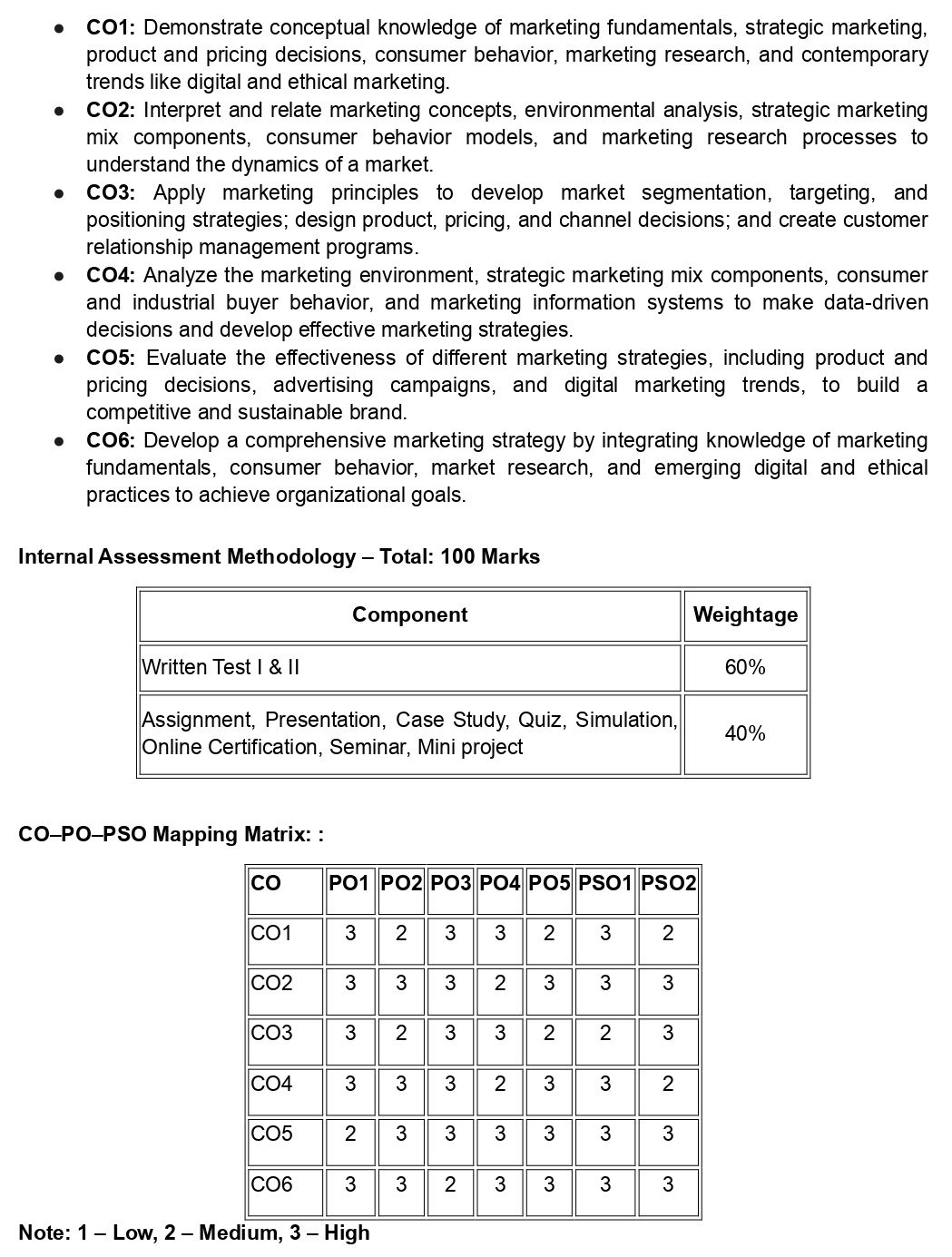
● CO1:
Demonstrate conceptual knowledge of marketing fundamentals, strategic
marketing, product and pricing decisions, consumer behavior, marketing
research, and contemporary trends like digital and ethical marketing.
● CO2:
Interpret and relate marketing concepts, environmental analysis, strategic
marketing mix components, consumer behavior models, and marketing research
processes to understand the dynamics of a market.
● CO3:
Apply marketing principles to develop market segmentation, targeting, and
positioning strategies; design product, pricing, and channel decisions; and
create customer relationship management programs.
●
CO4: Analyze the marketing
environment, strategic marketing mix components, consumer and industrial buyer
behavior, and marketing information systems to make data-driven decisions and
develop effective marketing strategies.
●
CO5: Evaluate the effectiveness of
different marketing strategies, including product and pricing decisions,
advertising campaigns, and digital marketing trends, to build a competitive and
sustainable brand.
● CO6:
Develop a comprehensive marketing strategy by integrating knowledge of
marketing fundamentals, consumer behavior, market research, and emerging
digital and ethical practices to achieve organizational goals.