Manufacturing Processes I - ME25402
[ 4th Semester - Mechanical Engineering Department ]
Under Class: | 4th Semester [Mechanical Dept Anna University 2025 Regulation] |
Manufacturing Processes I - ME25402 - Study Materials, Notes, Important Questions, Anna University Semester Question Paper PDF Download
Engineering - Manufacturing Processes I - ME25402 Subject (under Anna University 4th Semester - Mechanical Engineering Department Regulation 2025) - Study Materials, Written and lecture Notes, Important Questions, Semester Question Paper PDF Download
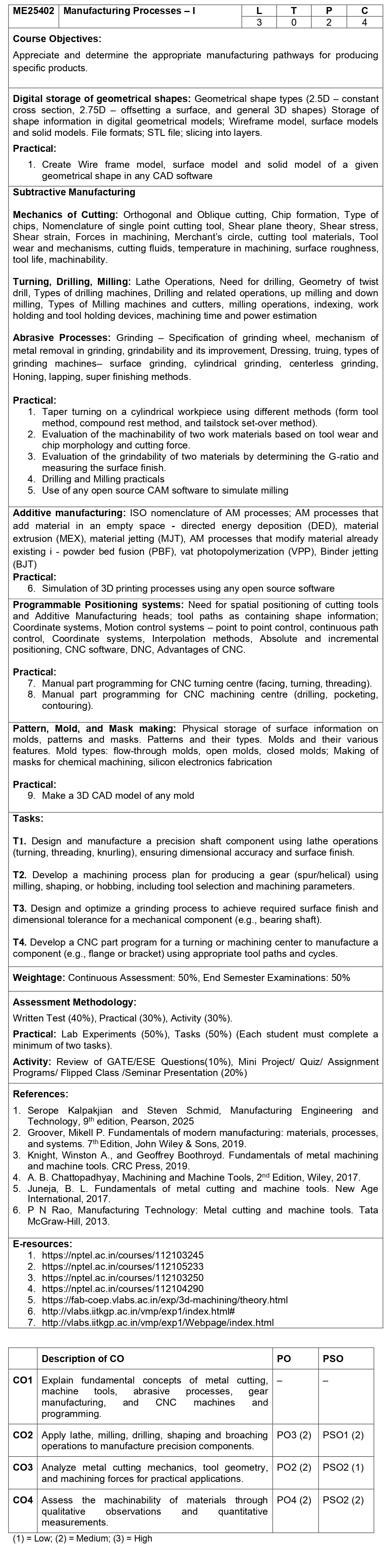
ME25402:
Manufacturing
Processes – I
Course
Objectives:
Appreciate
and determine the appropriate manufacturing pathways for producing specific
products.
Digital
storage of geometrical shapes: Geometrical shape
types (2. 5D – constant cross section, 2. 75D – offsetting a surface, and
general 3D shapes) Storage of shape information in digital geometrical models;
Wireframe model, surface models and solid models. File formats; STL file;
slicing into layers.
Practical:
1.
Create Wire frame model, surface model and solid model of a given geometrical
shape in any CAD software
Subtractive
Manufacturing
Mechanics of Cutting: Orthogonal and Oblique cutting, Chip formation, Type of chips, Nomenclature of single point cutting tool, Shear plane theory, Shear stress, Shear strain, Forces in machining, Merchant’s circle, cutting tool materials, Tool wear and mechanisms, cutting fluids, temperature in machining, surface roughness, tool life, machinability.
Turning,
Drilling, Milling: Lathe Operations, Need for drilling,
Geometry of twist drill, Types of drilling machines, Drilling and related
operations, up milling and down milling, Types of Milling machines and cutters,
milling operations, indexing, work holding and tool holding devices, machining
time and power estimation
Abrasive
Processes: Grinding – Specification of grinding wheel,
mechanism of metal removal in grinding, grindability and its improvement,
Dressing, truing, types of grinding machines– surface grinding, cylindrical
grinding, centerless grinding, Honing, lapping, super finishing methods.
Practical:
1.
Taper turning on a cylindrical workpiece using different methods (form tool
method, compound rest method, and tailstock set-over method).
2.
Evaluation of the machinability of two work materials based on tool wear and
chip morphology and cutting force.
3.
Evaluation of the grindability of two materials by determining the G-ratio and
measuring the surface finish.
4.
Drilling and Milling practicals
5.
Use of any open source CAM software to simulate milling
Additive
manufacturing: ISO nomenclature of AM processes; AM
processes that add material in an empty space - directed energy deposition
(DED), material extrusion (MEX), material jetting (MJT), AM processes that
modify material already existing i - powder bed fusion (PBF), vat
photopolymerization (VPP), Binder jetting (BJT)
Practical:
6.
Simulation of 3D printing processes using any open source software
Programmable
Positioning systems: Need for spatial positioning of
cutting tools and Additive Manufacturing heads; tool paths as containing shape
information; Coordinate systems, Motion control systems – point to point
control, continuous path control, Coordinate systems, Interpolation methods,
Absolute and incremental positioning, CNC software, DNC, Advantages of CNC.
Practical:
7.
Manual part programming for CNC turning centre (facing, turning, threading).
8.
Manual part programming for CNC machining centre (drilling, pocketing, contouring).
Pattern,
Mold, and Mask making: Physical storage of surface
information on molds, patterns and masks. Patterns and their types. Molds and
their various features. Mold types: flow-through molds, open molds, closed
molds; Making of masks for chemical machining, silicon electronics fabrication
Practical:
9.
Make a 3D CAD model of any mold
Tasks:
T1. Design
and manufacture a precision shaft component using lathe operations (turning,
threading, knurling), ensuring dimensional accuracy and surface finish.
T2. Develop
a machining process plan for producing a gear (spur/helical) using milling,
shaping, or hobbing, including tool selection and machining parameters.
T3. Design
and optimize a grinding process to achieve required surface finish and
dimensional tolerance for a mechanical component (e.g., bearing shaft).
T4. Develop
a CNC part program for a turning or machining center to manufacture a component
(e.g., flange or bracket) using appropriate tool paths and cycles.
Weightage:
Continuous Assessment: 50%, End Semester Examinations: 50%
Assessment Methodology:
Written
Test (40%), Practical (30%), Activity (30%).
Practical:
Lab Experiments (50%), Tasks (50%) (Each student must complete a minimum of two
tasks).
Activity:
Review of GATE/ESE Questions(10%), Mini Project/ Quiz/ Assignment Programs/
Flipped Class /Seminar Presentation (20%)
References:
1.
SeropeKalpakjianandStevenSchmid,ManufacturingEngineeringand Technology, 9th
edition, Pearson, 2025
2.
Groover, Mikell P. Fundamentals of modern manufacturing: materials, processes,
and systems. 7th Edition, John Wiley & Sons, 2019.
3.
Knight, Winston A., and Geoffrey Boothroyd. Fundamentals of metal machining and
machine tools. CRC Press, 2019.
4.
A. B. Chattopadhyay, Machining and Machine Tools, 2nd Edition, Wiley, 2017.
5.
Juneja, B. L. Fundamentals of metal cutting and machine tools. New Age
International,
2017.
6.
P N Rao, Manufacturing Technology: Metal cutting and machine tools. Tata
McGraw-Hill, 2013.