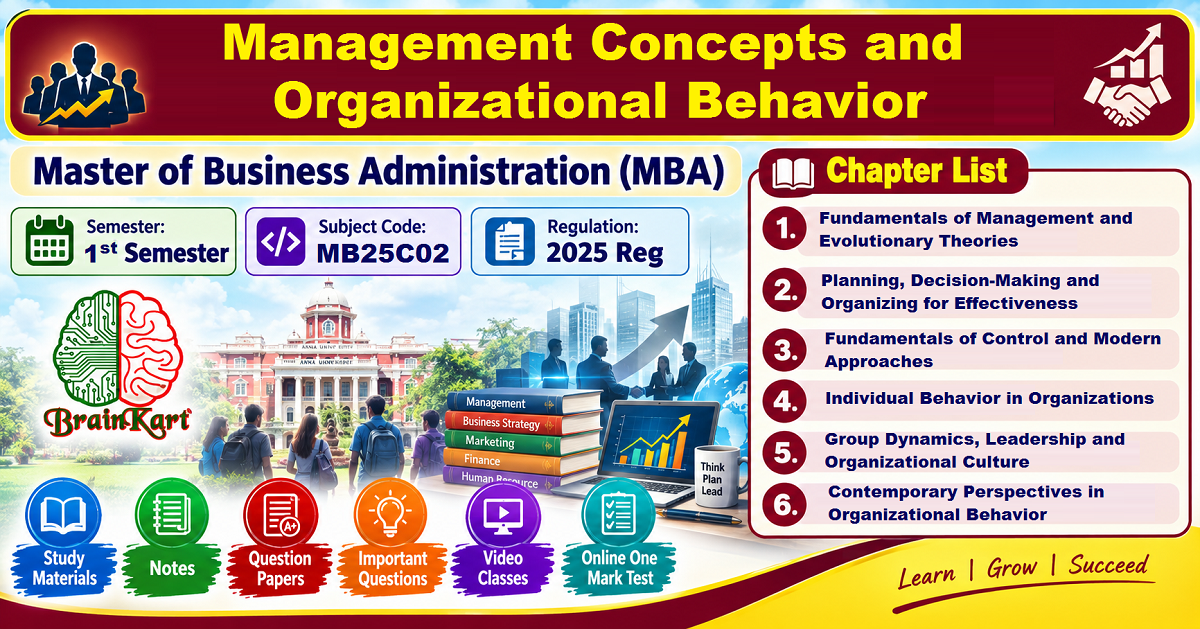
Management Concepts and Organizational Behavior - MB25C02
[ 1st Semester - MBA - Master of Business Administration ]
Under Class: | 1st Semester [MBA Dept Anna University 2025 Regulation] |
Management Concepts and Organizational Behavior - MB25C02 - Study Materials, Notes, Important Questions, Anna University Semester Question Paper PDF Download
Mba - Management Concepts and Organizational Behavior - MB25C02 Subject (under Anna University 1st Semester - MBA - Master of Business Administration Regulation 2025) - Study Materials, Written and lecture Notes, Important Questions, Semester Question Paper PDF Download
MB25C02 :
Management Concepts and Organizational Behavior
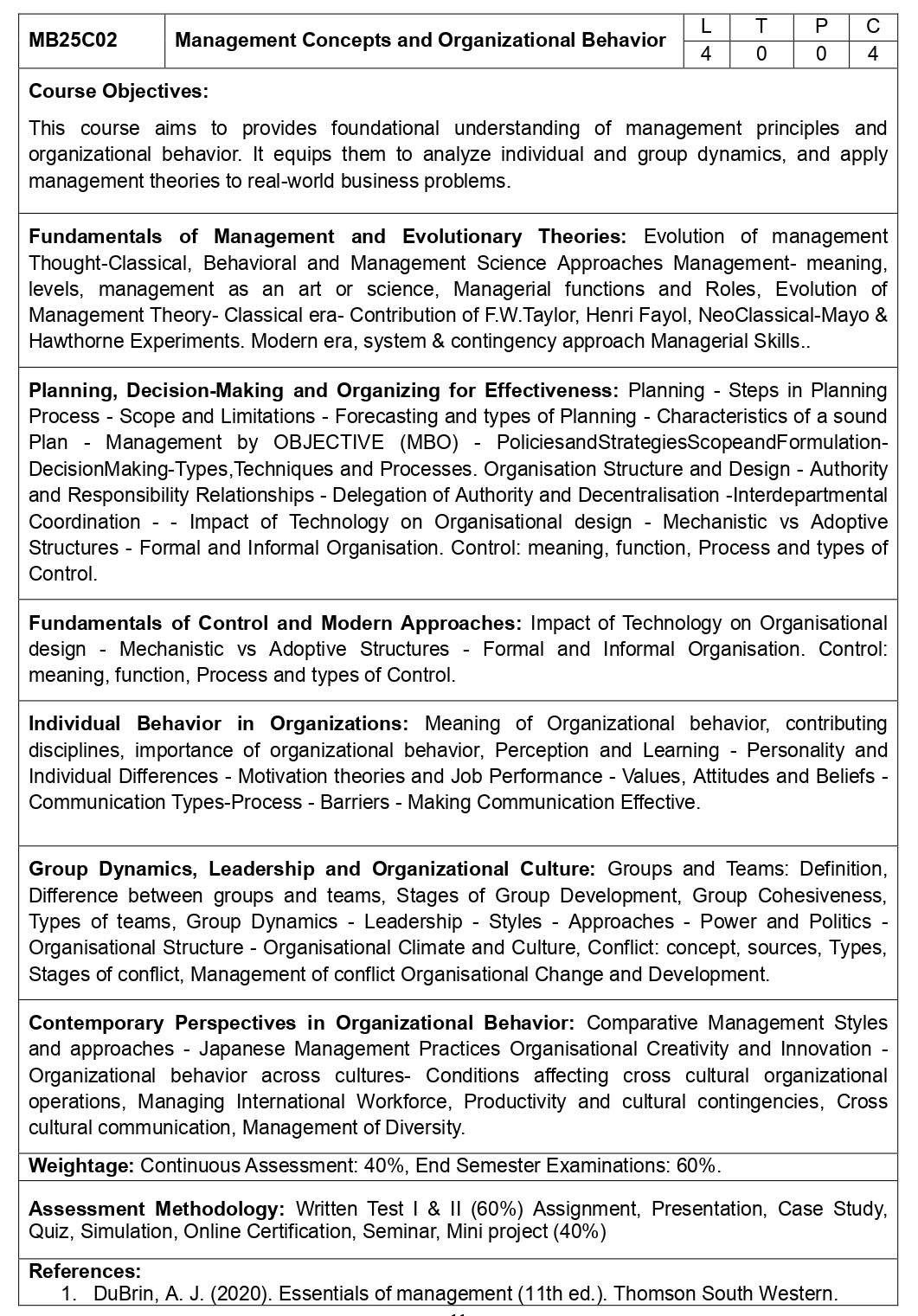
Course Objectives:
This
course aims to provides foundational understanding of management principles and
organizational behavior. It equips them to analyze individual and group
dynamics, and apply management theories to real-world business problems.
Fundamentals
of Management and Evolutionary Theories: Evolution of
management Thought-Classical, Behavioral and Management Science Approaches
Management- meaning, levels, management as an art or science, Managerial
functions and Roles, Evolution of Management Theory- Classical era-
Contribution of F.W.Taylor, Henri Fayol, NeoClassical-Mayo & Hawthorne
Experiments. Modern era, system & contingency approach Managerial Skills..
Planning,
Decision-Making and Organizing for Effectiveness:
Planning - Steps in Planning Process - Scope and Limitations - Forecasting and
types of Planning - Characteristics of a sound Plan - Management by OBJECTIVE
(MBO) -
PoliciesandStrategiesScopeandFormulation-DecisionMaking-Types,Techniques and
Processes. Organisation Structure and Design - Authority and Responsibility
Relationships - Delegation of Authority and Decentralisation -Interdepartmental
Coordination - - Impact of Technology on Organisational design - Mechanistic vs
Adoptive Structures - Formal and Informal Organisation. Control: meaning,
function, Process and types of Control.
Fundamentals
of Control and Modern Approaches: Impact of Technology
on Organisational design - Mechanistic vs Adoptive Structures - Formal and
Informal Organisation. Control: meaning, function, Process and types of
Control.
Individual
Behavior in Organizations: Meaning of
Organizational behavior, contributing disciplines, importance of organizational
behavior, Perception and
Learning
- Personality and Individual Differences - Motivation theories and Job
Performance - Values, Attitudes and Beliefs - Communication Types-Process -
Barriers - Making Communication Effective.
Group
Dynamics, Leadership and Organizational Culture:
Groups and Teams: Definition, Difference between groups and teams, Stages of
Group Development, Group Cohesiveness, Types of teams, Group Dynamics -
Leadership - Styles - Approaches - Power and Politics - Organisational
Structure - Organisational Climate and Culture, Conflict: concept, sources,
Types, Stages of conflict, Management of conflict Organisational Change and
Development.
Contemporary
Perspectives in Organizational Behavior: Comparative
Management Styles and approaches - Japanese Management Practices Organisational
Creativity and Innovation - Organizational behavior across cultures- Conditions
affecting cross cultural organizational operations, Managing International
Workforce, Productivity and cultural contingencies, Cross cultural communication,
Management of Diversity.
Weightage:
Continuous Assessment: 40%, End Semester Examinations: 60%.
Assessment Methodology:
Written Test I & II (60%) Assignment, Presentation, Case Study, Quiz,
Simulation, Online Certification, Seminar, Mini project (40%)
References:
1.
DuBrin, A. J. (2020). Essentials of management (11th ed.). Thomson South
Western.
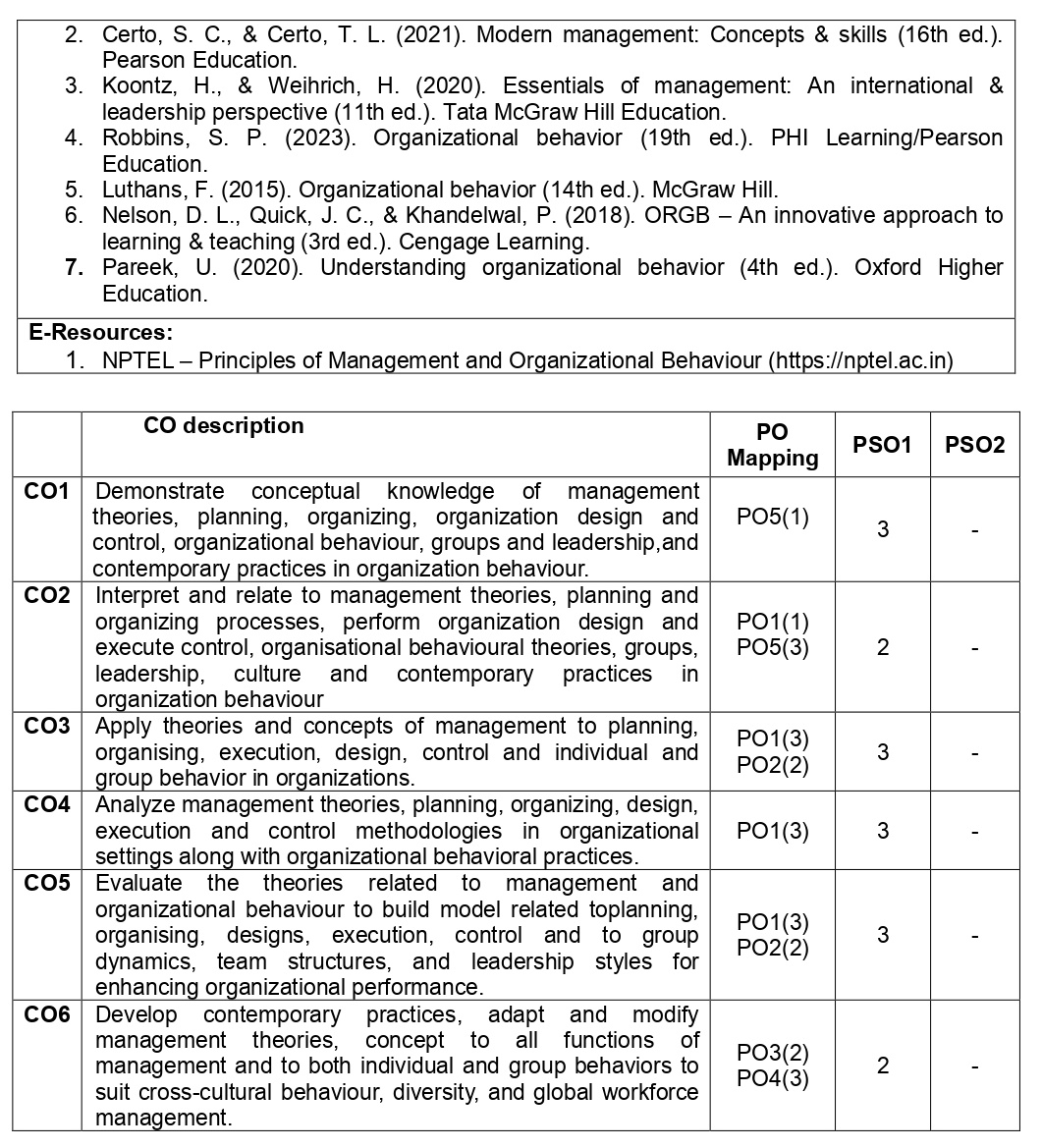
2.
Certo, S. C., & Certo, T. L. (2021). Modern management: Concepts &
skills (16th ed.). Pearson Education.
3.
Koontz, H., & Weihrich, H. (2020). Essentials of management: An
international & leadership perspective (11th ed.). Tata McGraw Hill
Education.
4.
Robbins, S. P. (2023). Organizational behavior (19th ed.). PHI Learning/Pearson
Education.
5.
Luthans, F. (2015). Organizational behavior (14th ed.). McGraw Hill.
6.
Nelson, D. L., Quick, J. C., & Khandelwal, P. (2018). ORGB – An innovative
approach to learning & teaching (3rd ed.). Cengage Learning.
7.
Pareek, U. (2020). Understanding organizational behavior (4th ed.). Oxford
Higher Education.