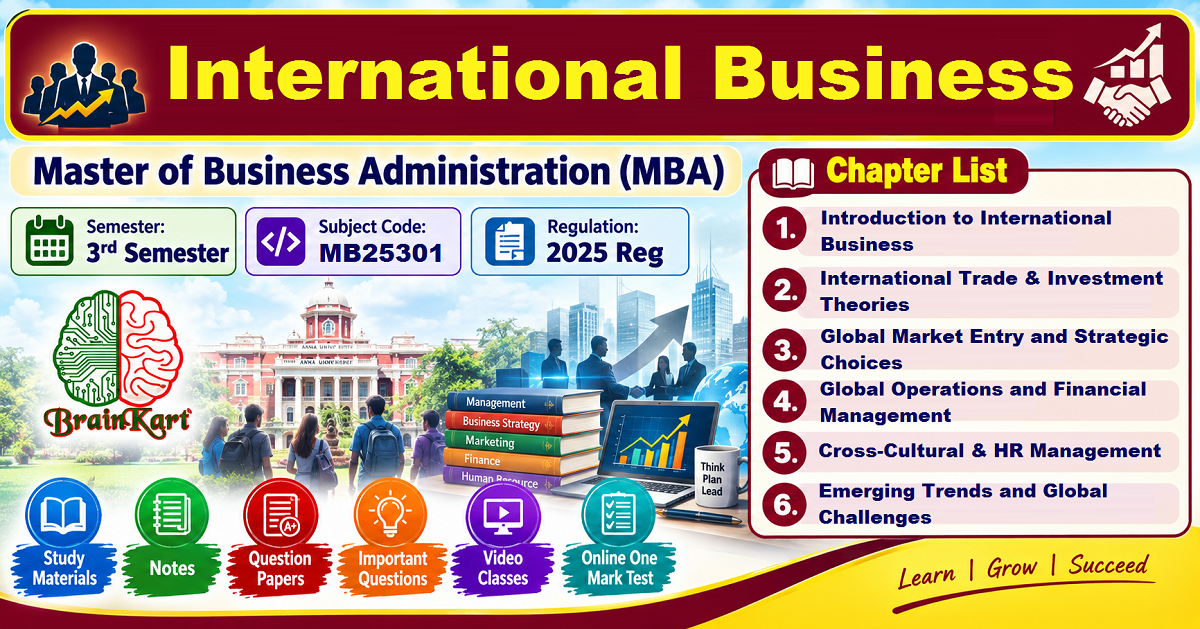
International Business - MB25301
[ 3rd Semester - MBA - Master of Business Administration ]
Under Class: | 3rd Semester [MBA Dept Anna University 2025 Regulation] |
International Business - MB25301 - Study Materials, Notes, Important Questions, Anna University Semester Question Paper PDF Download
Mba - International Business - MB25301 Subject (under Anna University 3rd Semester - MBA - Master of Business Administration Regulation 2025) - Study Materials, Written and lecture Notes, Important Questions, Semester Question Paper PDF Download
MB25301:
International
Business
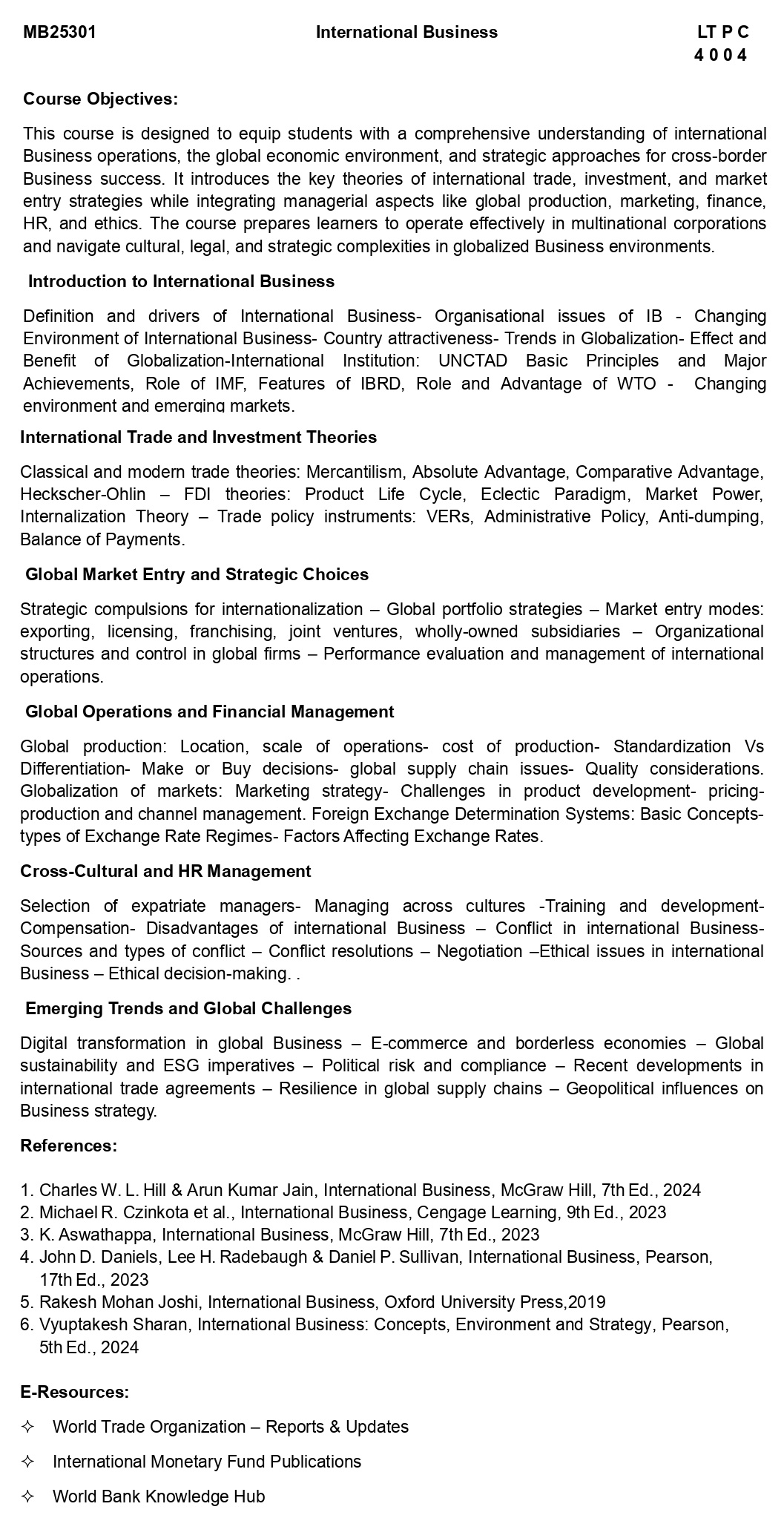
Course Objectives:
This
course is designed to equip students with a comprehensive understanding of
international Business operations, the global economic environment, and
strategic approaches for cross-border Business success. It introduces the key
theories of international trade, investment, and market entry strategies while
integrating managerial aspects like global production, marketing, finance, HR,
and ethics. The course prepares learners to operate effectively in
multinational corporations and navigate cultural, legal, and strategic
complexities in globalized Business environments.
Introduction
to International Business
Definition
and drivers of International Business- Organisational issues of IB - Changing
Environment of International Business- Country attractiveness- Trends in
Globalization- Effect and Benefit of Globalization-International Institution:
UNCTAD Basic Principles and Major Achievements, Role of IMF, Features of IBRD,
Role and Advantage of WTO - Changing environment and emerging markets.
International
Trade and Investment Theories
Classical
and modern trade theories: Mercantilism, Absolute Advantage, Comparative
Advantage, Heckscher-Ohlin – FDI theories: Product Life Cycle, Eclectic
Paradigm, Market Power, Internalization Theory – Trade policy instruments:
VERs, Administrative Policy, Anti-dumping, Balance of Payments.
Global
Market Entry and Strategic Choices
Strategic
compulsions for internationalization – Global portfolio strategies – Market
entry modes: exporting, licensing, franchising, joint ventures, wholly-owned
subsidiaries – Organizational structures and control in global firms –
Performance evaluation and management of international operations.
Global
Operations and Financial Management
Global
production: Location, scale of operations- cost of production- Standardization
Vs Differentiation- Make or Buy decisions- global supply chain issues- Quality
considerations. Globalization of markets: Marketing strategy- Challenges in
product development- pricing-production and channel management. Foreign
Exchange Determination Systems: Basic Concepts-types of Exchange Rate Regimes-
Factors Affecting Exchange Rates.
Cross-Cultural
and HR Management
Selection
of expatriate managers- Managing across cultures -Training and
development-Compensation- Disadvantages of international Business – Conflict in
international Business-Sources and types of conflict – Conflict resolutions –
Negotiation –Ethical issues in international Business – Ethical
decision-making. .
Emerging
Trends and Global Challenges
Digital
transformation in global Business – E-commerce and borderless economies –
Global sustainability and ESG imperatives – Political risk and compliance –
Recent developments in international trade agreements – Resilience in global
supply chains – Geopolitical influences on Business strategy.
References:
1. Charles W. L. Hill & Arun Kumar Jain,
International Business, McGraw Hill, 7th Ed., 2024
2.
Michael R. Czinkota et al., International Business, Cengage Learning, 9th Ed.,
2023
3.
K. Aswathappa, International Business, McGraw Hill, 7th Ed., 2023
4.
John D. Daniels, Lee H. Radebaugh & Daniel P. Sullivan, International
Business, Pearson, 17th Ed., 2023
5.
Rakesh Mohan Joshi, International Business, Oxford University Press,2019
6.
Vyuptakesh Sharan, International Business: Concepts, Environment and Strategy,
Pearson, 5th Ed., 2024
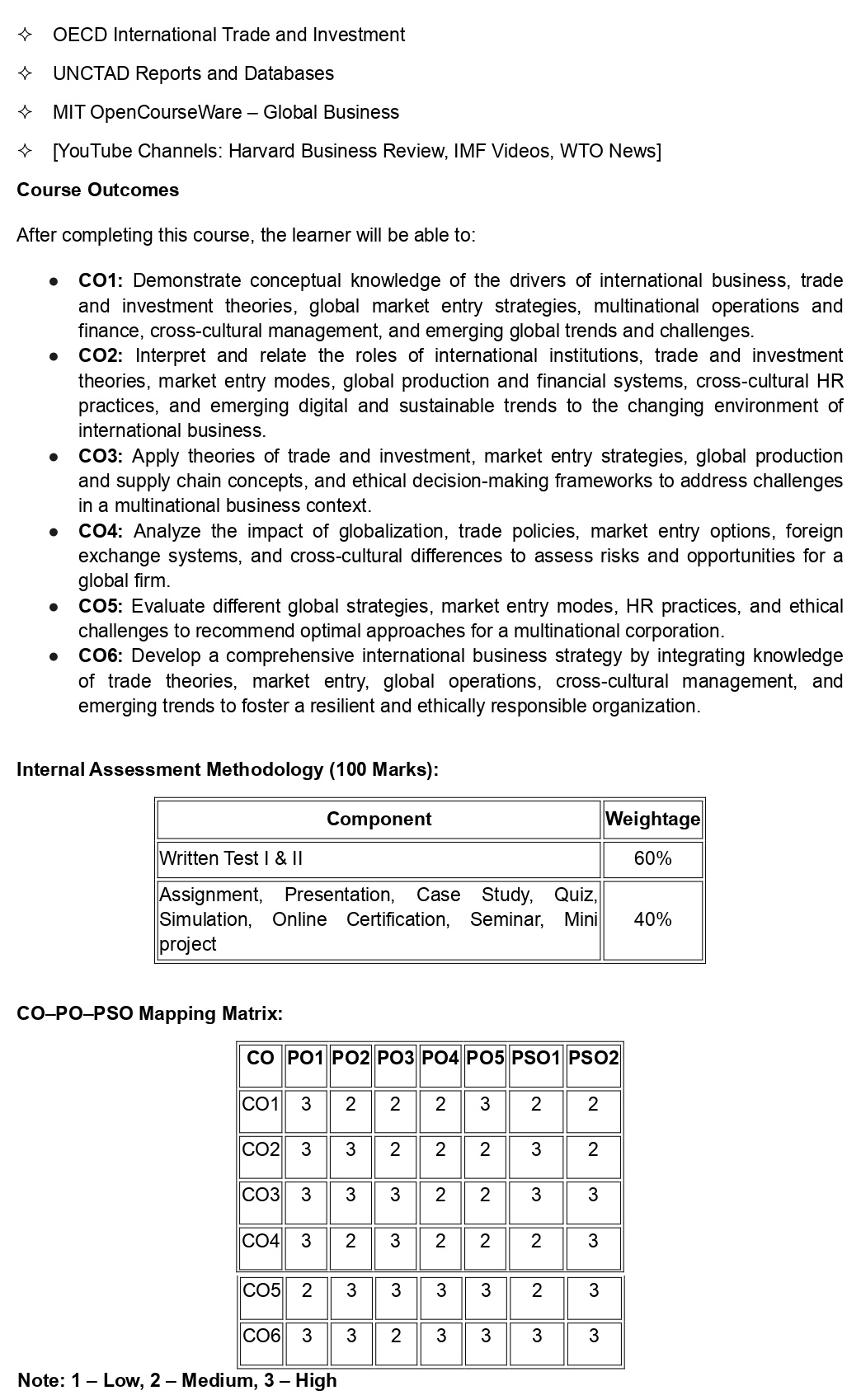
Course Outcomes
After completing this course, the learner will be able to:
● CO1:
Demonstrate conceptual knowledge of the drivers of international business,
trade and investment theories, global market entry strategies, multinational
operations and finance, cross-cultural management, and emerging global trends
and challenges.
● CO2:
Interpret and relate the roles of international institutions, trade and
investment theories, market entry modes, global production and financial
systems, cross-cultural HR practices, and emerging digital and sustainable
trends to the changing environment of international business.
● CO3:
Apply theories of trade and investment, market entry strategies, global
production and supply chain concepts, and ethical decision-making frameworks to
address challenges in a multinational business context.
● CO4:
Analyze the impact of globalization, trade policies, market entry options,
foreign exchange systems, and cross-cultural differences to assess risks and
opportunities for a global firm.
● CO5:
Evaluate different global strategies, market entry modes, HR practices, and
ethical challenges to recommend optimal approaches for a multinational
corporation.
● CO6:
Develop a comprehensive international business strategy by integrating
knowledge of trade theories, market entry, global operations, cross-cultural
management, and emerging trends to foster a resilient and ethically responsible
organization.