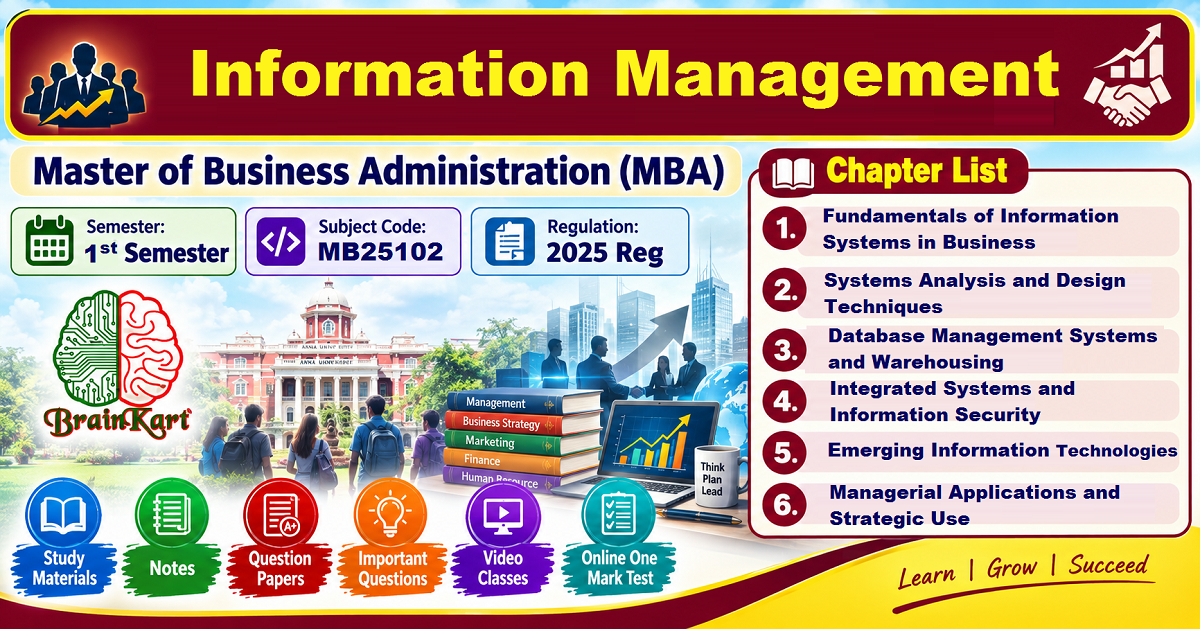
Information Management - MB25102
[ 1st Semester - MBA - Master of Business Administration ]
Under Class: | 1st Semester [MBA Dept Anna University 2025 Regulation] |
Information Management - MB25102 - Study Materials, Notes, Important Questions, Anna University Semester Question Paper PDF Download
Mba - Information Management - MB25102 Subject (under Anna University 1st Semester - MBA - Master of Business Administration Regulation 2025) - Study Materials, Written and lecture Notes, Important Questions, Semester Question Paper PDF Download
MB25102:
Information
Management
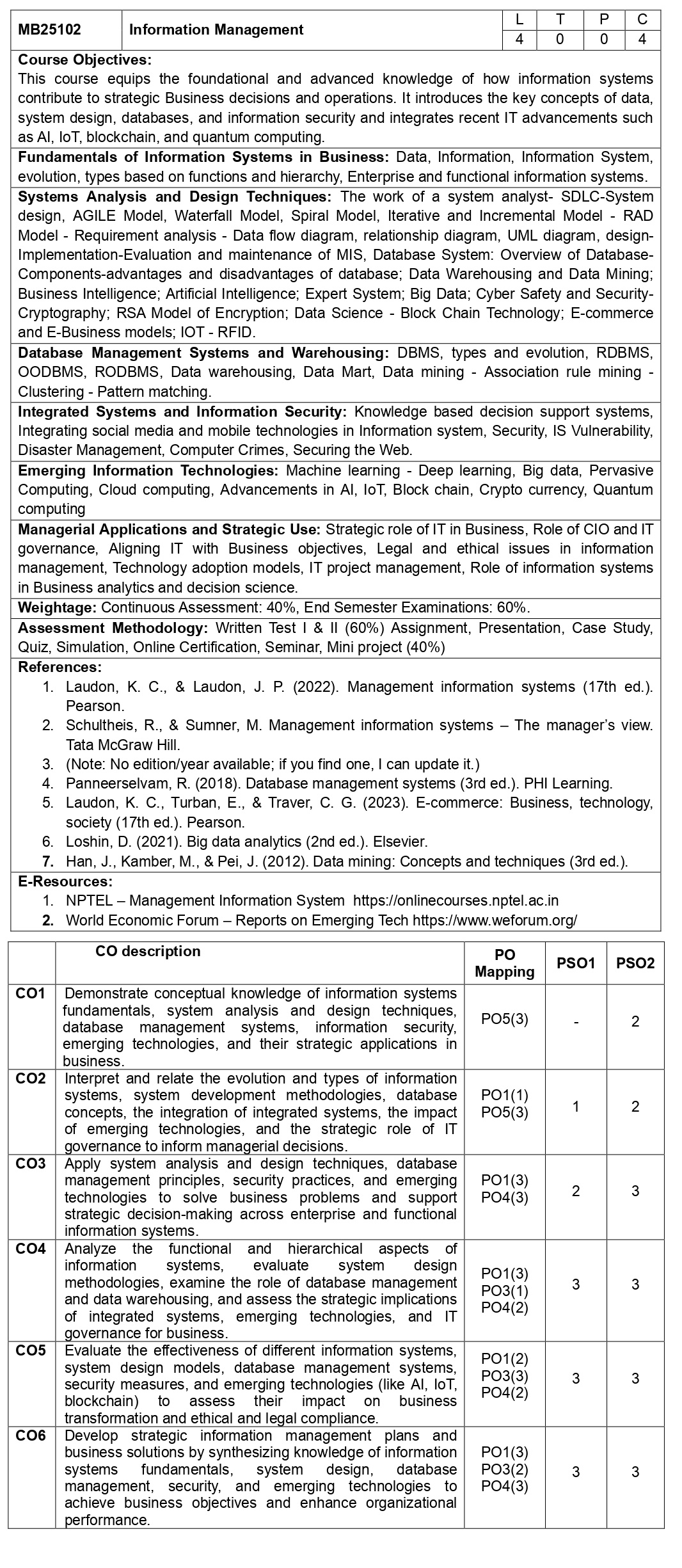
Course Objectives:
This
course equips the foundational and advanced knowledge of how information
systems contribute to strategic Business decisions and operations. It
introduces the key concepts of data, system design, databases, and information
security and integrates recent IT advancements such as AI, IoT, blockchain, and
quantum computing.
Fundamentals
of Information Systems in Business: Data, Information,
Information System, evolution, types based on functions and hierarchy,
Enterprise and functional information systems.
Systems
Analysis and Design Techniques: The work of a system
analyst- SDLC-System design, AGILE Model, Waterfall Model, Spiral Model,
Iterative and Incremental Model - RAD Model - Requirement analysis - Data flow
diagram, relationship diagram, UML diagram, design-Implementation-Evaluation
and maintenance of MIS, Database System: Overview of
Database-Components-advantages and disadvantages of database; Data Warehousing
and Data Mining; Business Intelligence; Artificial Intelligence; Expert System;
Big Data; Cyber Safety and Security-Cryptography; RSA Model of Encryption; Data
Science - Block Chain Technology; E-commerce and E-Business models; IOT - RFID.
Database
Management Systems and Warehousing: DBMS, types and
evolution, RDBMS, OODBMS, RODBMS, Data warehousing, Data Mart, Data mining -
Association rule mining - Clustering - Pattern matching.
Integrated
Systems and Information Security: Knowledge based
decision support systems, Integrating social media and mobile technologies in
Information system, Security, IS Vulnerability, Disaster Management, Computer
Crimes, Securing the Web.
Emerging
Information Technologies: Machine learning -
Deep learning, Big data, Pervasive Computing, Cloud computing, Advancements in
AI, IoT, Block chain, Crypto currency, Quantum computing
Managerial
Applications and Strategic Use: Strategic role of IT
in Business, Role of CIO and IT governance, Aligning IT with Business
objectives, Legal and ethical issues in information management, Technology
adoption models, IT project management, Role of information systems in Business
analytics and decision science.
Weightage:
Continuous Assessment: 40%, End Semester Examinations: 60%.
Assessment Methodology:
Written Test I & II (60%) Assignment, Presentation, Case Study, Quiz,
Simulation, Online Certification, Seminar, Mini project (40%)
References:
1.
Laudon, K. C., & Laudon, J. P. (2022). Management information systems (17th
ed.). Pearson.
2.
Schultheis, R., & Sumner, M. Management information systems – The manager’s
view. Tata McGraw Hill.
3.
(Note: No edition/year available; if you find one, I can update it.)
4.
Panneerselvam, R. (2018). Database management systems (3rd ed.). PHI Learning.
5.
Laudon, K. C., Turban, E., & Traver, C. G. (2023). E-commerce: Business,
technology, society (17th ed.). Pearson.
6.
Loshin, D. (2021). Big data analytics (2nd ed.). Elsevier.
7.
Han, J., Kamber, M., & Pei, J. (2012). Data mining: Concepts and techniques
(3rd ed.).