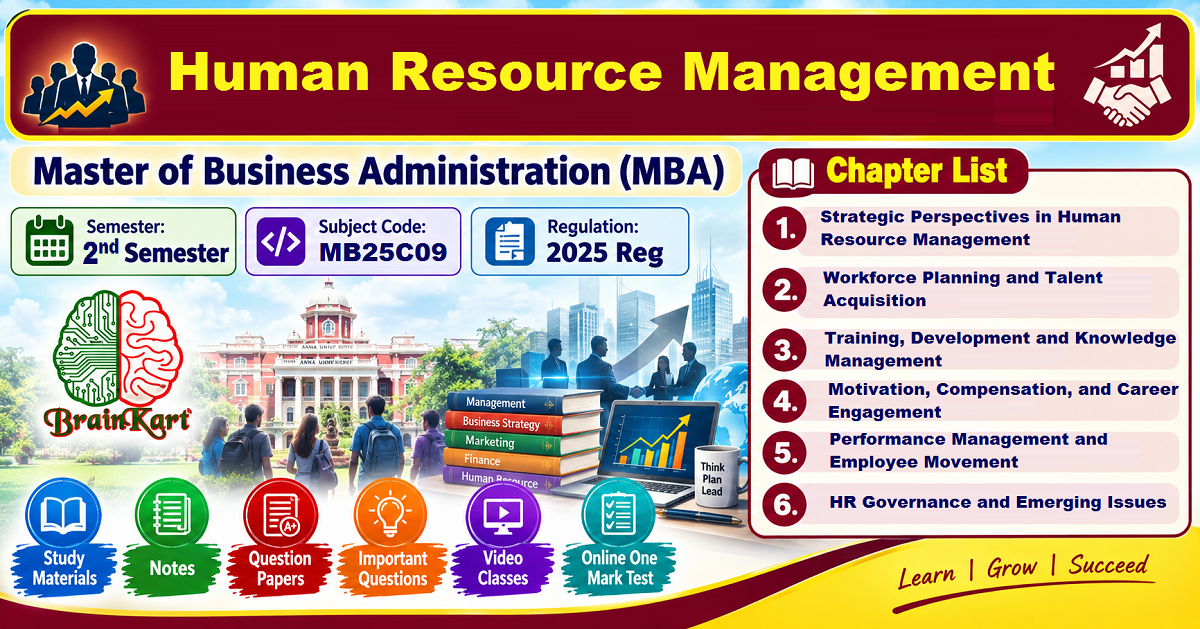
Human Resource Management - MB25C09
[ 2nd Semester - MBA - Master of Business Administration ]
Under Class: | 2nd Semester [MBA Dept Anna University 2025 Regulation] |
Human Resource Management - MB25C09 - Study Materials, Notes, Important Questions, Anna University Semester Question Paper PDF Download
Mba - Human Resource Management - MB25C09 Subject (under Anna University 2nd Semester - MBA - Master of Business Administration Regulation 2025) - Study Materials, Written and lecture Notes, Important Questions, Semester Question Paper PDF Download
MB25C09:
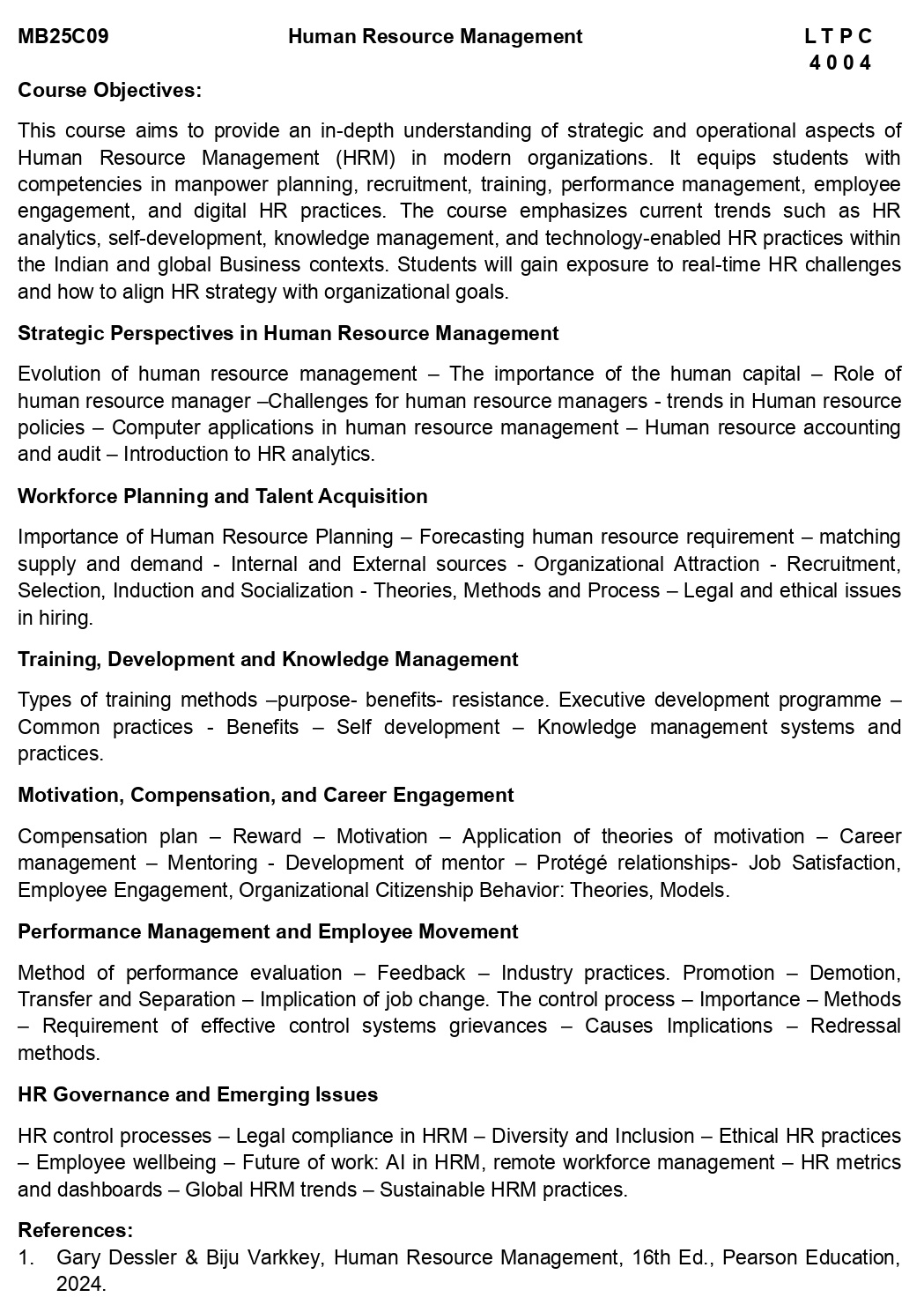
Human Resource
Management
Course Objectives:
This
course aims to provide an in-depth understanding of strategic and operational
aspects of Human Resource Management (HRM) in modern organizations. It equips
students with competencies in manpower planning, recruitment, training,
performance management, employee engagement, and digital HR practices. The
course emphasizes current trends such as HR analytics, self-development,
knowledge management, and technology-enabled HR practices within the Indian and
global Business contexts. Students will gain exposure to real-time HR
challenges and how to align HR strategy with organizational goals.
Strategic
Perspectives in Human Resource Management
Evolution
of human resource management – The importance of the human capital – Role of
human resource manager –Challenges for human resource managers - trends in
Human resource policies – Computer applications in human resource management – Human
resource accounting and audit – Introduction to HR analytics.
Workforce
Planning and Talent Acquisition
Importance
of Human Resource Planning – Forecasting human resource requirement – matching
supply and demand - Internal and External sources - Organizational Attraction -
Recruitment, Selection, Induction and Socialization - Theories, Methods and
Process – Legal and ethical issues in hiring.
Training,
Development and Knowledge Management
Types
of training methods –purpose- benefits- resistance. Executive development
programme – Common practices - Benefits – Self development – Knowledge
management systems and practices.
Motivation,
Compensation, and Career Engagement
Compensation
plan – Reward – Motivation – Application of theories of motivation – Career
management – Mentoring - Development of mentor – Protégé relationships- Job
Satisfaction, Employee Engagement, Organizational Citizenship Behavior:
Theories, Models.
Performance
Management and Employee Movement
Method
of performance evaluation – Feedback – Industry practices. Promotion –
Demotion, Transfer and Separation – Implication of job change. The control
process – Importance – Methods – Requirement of effective control systems
grievances – Causes Implications – Redressal methods.
HR
Governance and Emerging Issues
HR
control processes – Legal compliance in HRM – Diversity and Inclusion – Ethical
HR practices – Employee wellbeing – Future of work: AI in HRM, remote workforce
management – HR metrics and dashboards – Global HRM trends – Sustainable HRM
practices.
References:
1.
Gary Dessler & Biju Varkkey, Human Resource Management, 16th Ed., Pearson
Education, 2024.
2.
David A. DeCenzo, Stephen P. Robbins, Susan L. Verhulst, Fundamentals of Human
Resource Management, Wiley, 13th Ed., 2024
3.
Uday Kumar Haldar, Juthika Sarkar, Human Resource Management, Oxford University
Press, 2nd Ed., 2023.
4.
Wayne F. Cascio, Managing Human Resources: Productivity, Quality of Work Life,
Profits, McGraw Hill, 12th Ed., 2024.
5.
Michael Armstrong, Armstrong’s Handbook of Strategic Human Resource Management,
Kogan Page, 8th Ed., 2023.
6.
Luis R. Gomez-Mejia et al., Managing Human Resources, Pearson, 8th Ed., 2023.
7.
Dipak Kumar Bhattacharyya, HR Analytics: Understanding Theories and
Applications, Sage Publications, 2nd Ed., 2022.
8.
Ivancevich, Human Resource Management, McGraw Hill, 14th Ed., 2023.
9.
Bernardin, Human Resource Management, Tata McGraw Hill, 11th Ed., 2022.
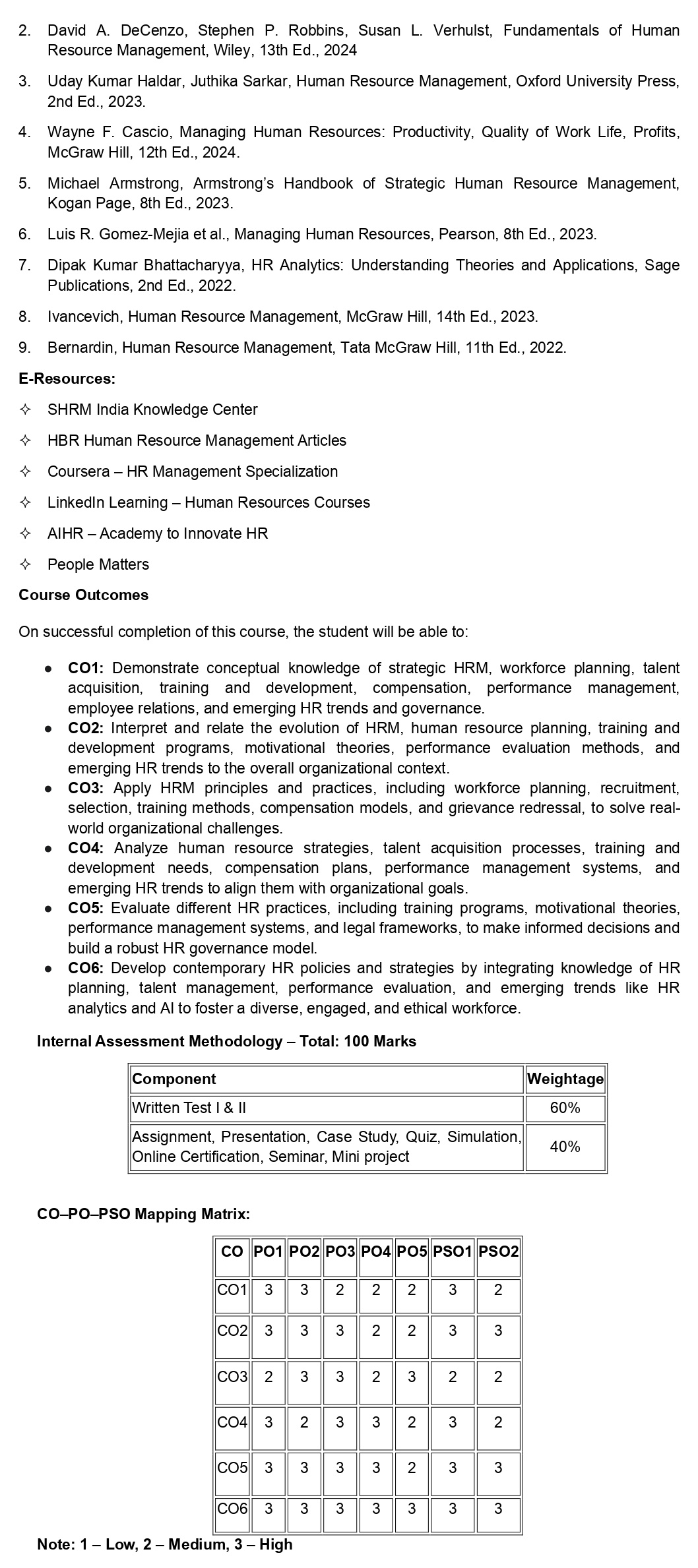
Course
Outcomes
On successful completion of this course, the student will be able to:
● CO1:
Demonstrate conceptual knowledge of strategic HRM, workforce planning, talent
acquisition, training and development, compensation, performance management,
employee relations, and emerging HR trends and governance.
● CO2:
Interpret and relate the evolution of HRM, human resource planning, training
and development programs, motivational theories, performance evaluation
methods, and emerging HR trends to the overall organizational context.
● CO3:
Apply HRM principles and practices, including workforce planning, recruitment,
selection, training methods, compensation models, and grievance redressal, to
solve real-world organizational challenges.
● CO4:
Analyze human resource strategies, talent acquisition processes, training and
development needs, compensation plans, performance management systems, and
emerging HR trends to align them with organizational goals.
● CO5:
Evaluate different HR practices, including training programs, motivational
theories, performance management systems, and legal frameworks, to make informed
decisions and build a robust HR governance model.
● CO6:
Develop contemporary HR policies and strategies by integrating knowledge of HR
planning, talent management, performance evaluation, and emerging trends like
HR analytics and AI to foster a diverse, engaged, and ethical workforce.