Fluid Mechanics and Machinery - CE25C12
[ 4th Semester - Mechanical Engineering Department ]
Under Class: | 4th Semester [Mechanical Dept Anna University 2025 Regulation] |
Fluid Mechanics and Machinery - CE25C12 - Study Materials, Notes, Important Questions, Anna University Semester Question Paper PDF Download
Engineering - Fluid Mechanics and Machinery - CE25C12 Subject (under Anna University 4th Semester - Mechanical Engineering Department Regulation 2025) - Study Materials, Written and lecture Notes, Important Questions, Semester Question Paper PDF Download
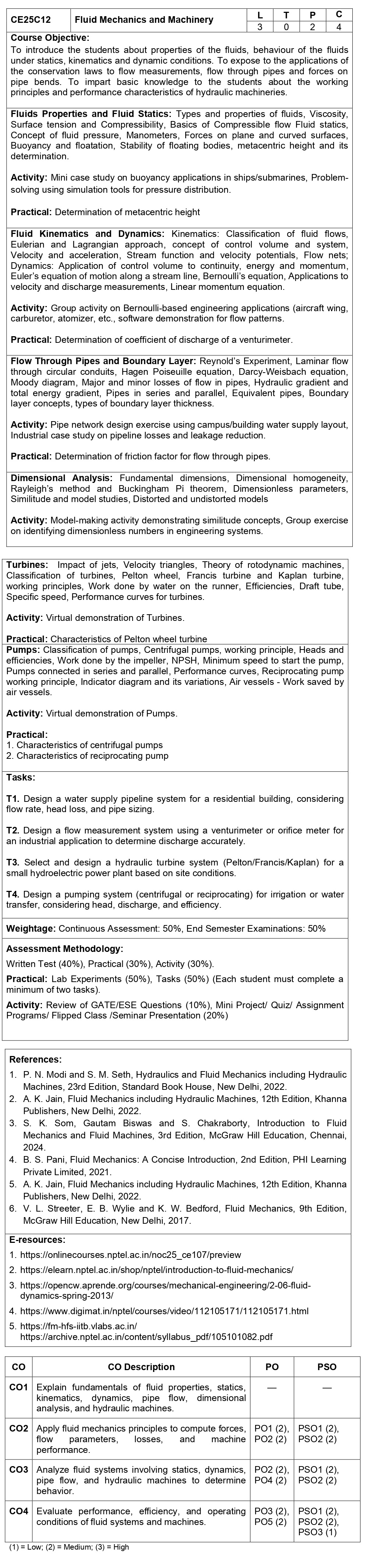
CE25C12:
Fluid Mechanics and Machinery
Course Objective:
To
introduce the students about properties of the fluids, behaviour of the fluids
under statics, kinematics and dynamic conditions. To expose to the applications
of the conservation laws to flow measurements, flow through pipes and forces on
pipe bends. To impart basic knowledge to the students about the working
principles and performance characteristics of hydraulic machineries.
Fluids
Properties and Fluid Statics: Types and properties
of fluids, Viscosity, Surface tension and Compressibility, Basics of Compressible
flow Fluid statics, Concept of fluid pressure, Manometers, Forces on plane and
curved surfaces, Buoyancy and floatation, Stability of floating bodies,
metacentric height and its determination.
Activity:
Mini case study on buoyancy applications in ships/submarines, Problem-solving
using simulation tools for pressure distribution.
Practical:
Determination of metacentric height
Fluid
Kinematics and Dynamics: Kinematics: Classification of
fluid flows, Eulerian and Lagrangian approach, concept of control volume and
system, Velocity and acceleration, Stream function and velocity potentials,
Flow nets; Dynamics: Application of control volume to continuity, energy and
momentum, Euler’s equation of motion along a stream line, Bernoulli’s equation,
Applications to velocity and discharge measurements, Linear momentum equation.
Activity:
Group activity on Bernoulli-based engineering applications (aircraft wing,
carburetor, atomizer, etc., software demonstration for flow patterns.
Practical:
Determination of coefficient of discharge of a venturimeter.
Flow
Through Pipes and Boundary Layer: Reynold’s Experiment,
Laminar flow through circular conduits, Hagen Poiseuille equation,
Darcy-Weisbach equation, Moody diagram, Major and minor losses of flow in
pipes, Hydraulic gradient and total energy gradient, Pipes in series and
parallel, Equivalent pipes, Boundary layer concepts, types of boundary layer
thickness.
Activity:
Pipe network design exercise using campus/building water supply layout, Industrial
case study on pipeline losses and leakage reduction.
Practical:
Determination of friction factor for flow through pipes.
Dimensional
Analysis: Fundamental dimensions, Dimensional
homogeneity, Rayleigh’s method and Buckingham Pi theorem, Dimensionless
parameters, Similitude and model studies, Distorted and undistorted models
Activity:
Model-making activity demonstrating similitude concepts, Group exercise on
identifying dimensionless numbers in engineering systems.
Turbines:
Impact of jets, Velocity triangles, Theory of rotodynamic machines,
Classification of turbines, Pelton wheel, Francis turbine and Kaplan turbine,
working principles, Work done by water on the runner, Efficiencies, Draft tube,
Specific speed, Performance curves for turbines.
Activity: Virtual
demonstration of Turbines.
Practical:
Characteristics of Pelton wheel turbine
Pumps:
Classification of pumps, Centrifugal pumps, working principle, Heads and
efficiencies, Work done by the impeller, NPSH, Minimum speed to start the pump,
Pumps connected in series and parallel, Performance curves, Reciprocating pump
working principle, Indicator diagram and its variations, Air vessels - Work
saved by air vessels.
Activity:
Virtual demonstration of Pumps.
Practical:
1.
Characteristics of centrifugal pumps
2.
Characteristics of reciprocating pump
Tasks:
T1.
Design a water supply pipeline system for a residential building, considering
flow rate, head loss, and pipe sizing.
T2.
Design a flow measurement system using a venturimeter or orifice meter for an
industrial application to determine discharge accurately.
T3.
Select and design a hydraulic turbine system (Pelton/Francis/Kaplan) for a
small hydroelectric power plant based on site conditions.
T4.
Design a pumping system (centrifugal or reciprocating) for irrigation or water
transfer, considering head, discharge, and efficiency.
Weightage:
Continuous Assessment: 50%, End Semester Examinations: 50%
Assessment Methodology:
Written Test (40%), Practical (30%), Activity (30%).
Practical:
Lab Experiments (50%), Tasks (50%) (Each student must complete a minimum of two
tasks).
Activity:
Review of GATE/ESE Questions (10%), Mini Project/ Quiz/ Assignment Programs/
Flipped Class /Seminar Presentation (20%)
References:
1.
P. N. Modi and S. M. Seth, Hydraulics and Fluid Mechanics including Hydraulic
Machines, 23rd Edition, Standard Book House, New Delhi, 2022.
2.
A. K. Jain, Fluid Mechanics including Hydraulic Machines, 12th Edition, Khanna
Publishers, New Delhi, 2022.
3.
S. K. Som, Gautam Biswas and S. Chakraborty, Introduction to Fluid Mechanics
and Fluid Machines, 3rd Edition, McGraw Hill Education, Chennai, 2024.
4.
B. S. Pani, Fluid Mechanics: A Concise Introduction, 2nd Edition, PHI Learning
Private Limited, 2021.
5.
A. K. Jain, Fluid Mechanics including Hydraulic Machines, 12th Edition, Khanna
Publishers, New Delhi, 2022.
6.
V. L. Streeter, E. B. Wylie and K. W. Bedford, Fluid Mechanics, 9th Edition,
McGraw Hill Education, New Delhi, 2017.
E-resources:
1.
https://onlinecourses.nptel.ac.in/noc25_ce107/preview
2.
https://elearn.nptel.ac.in/shop/nptel/introduction-to-fluid-mechanics/
3.
https://opencw.aprende.org/courses/mechanical-engineering/2-06-fluid-dynamics-spring-2013/
4.
https://www.digimat.in/nptel/courses/video/112105171/112105171.html
5.
https://fm-hfs-iitb.vlabs.ac.in/
https://archive.nptel.ac.in/content/syllabus_pdf/105101082.pdf