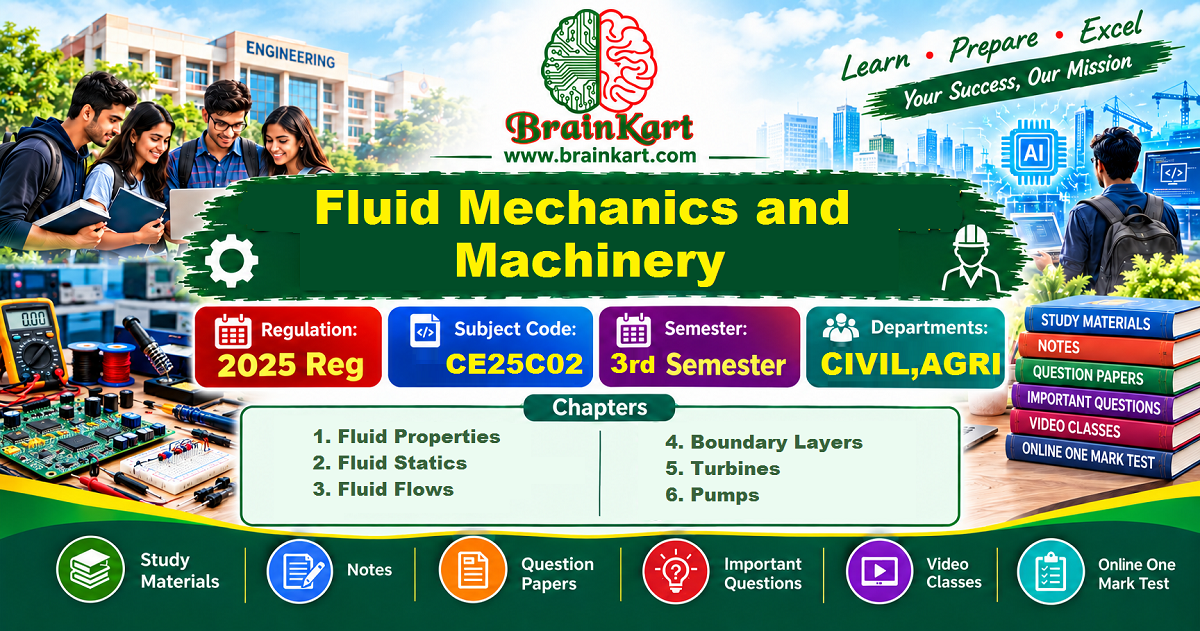
Fluid Mechanics and Machinery - CE25C02
[ 3rd Semester - Civil, Agriculture Engineering Departments ]
Under Class: | 3rd Semester [Civil Dept Anna University 2025 Regulation] | | 3rd Semester [Agricultural Dept Anna University 2025 Regulation] |
Fluid Mechanics and Machinery - CE25C02 - Study Materials, Notes, Important Questions, Anna University Semester Question Paper PDF Download
Engineering - Fluid Mechanics and Machinery - CE25C02 Subject (under Anna University 3rd Semester - Civil, Agriculture Engineering Departments Regulation 2025) - Study Materials, Written and lecture Notes, Important Questions, Semester Question Paper PDF Download
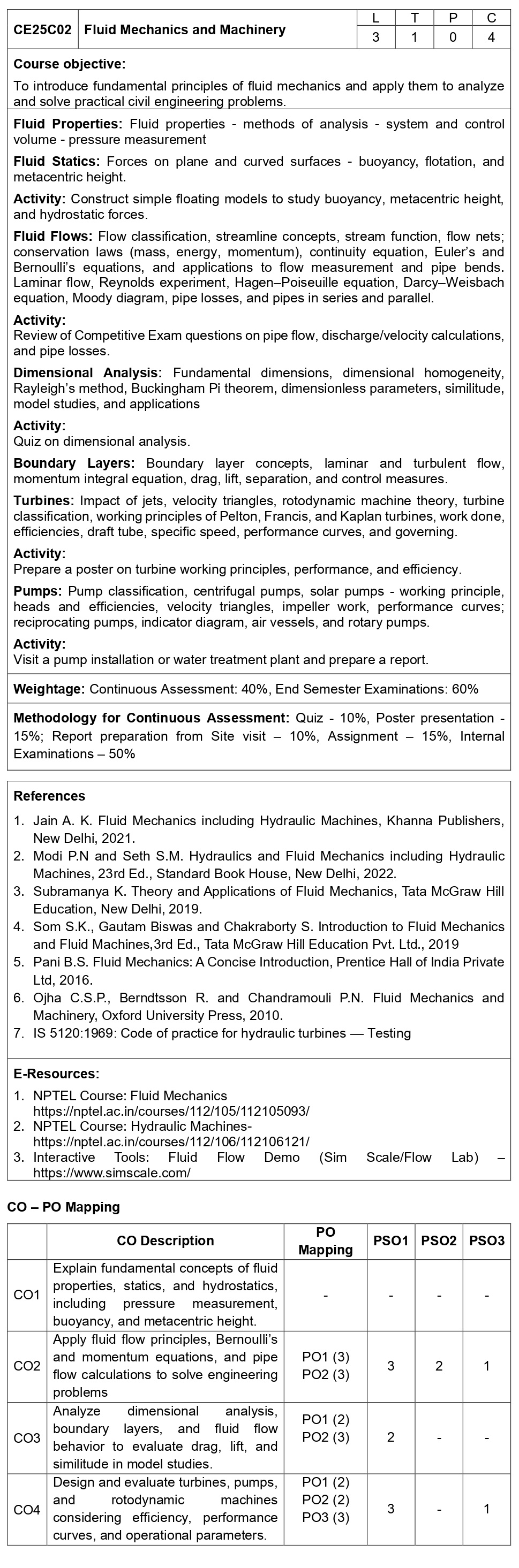
CE25C02:
Fluid
Mechanics and Machinery
Course
objective:
To
introduce fundamental principles of fluid mechanics and apply them to analyze
and solve practical civil engineering problems.
Fluid
Properties: Fluid properties - methods of analysis
- system and control volume - pressure measurement
Fluid
Statics: Forces on plane and curved surfaces -
buoyancy, flotation, and metacentric height.
Activity:
Construct simple floating models to study buoyancy, metacentric height, and
hydrostatic forces.
Fluid
Flows: Flow classification, streamline concepts, stream
function, flow nets; conservation laws (mass, energy, momentum), continuity
equation, Euler’s and Bernoulli’s equations, and applications to flow
measurement and pipe bends. Laminar flow, Reynolds experiment, Hagen–Poiseuille
equation, Darcy–Weisbach equation, Moody diagram, pipe losses, and pipes in
series and parallel.
Activity: Review
of Competitive Exam questions on pipe flow, discharge/velocity calculations,
and pipe losses.
Dimensional
Analysis: Fundamental dimensions, dimensional homogeneity, Rayleigh’s method,
Buckingham Pi theorem, dimensionless parameters, similitude, model studies, and
applications
Activity:
Quiz
on dimensional analysis.
Boundary
Layers: Boundary layer concepts, laminar and
turbulent flow, momentum integral equation, drag, lift, separation, and control
measures.
Turbines:
Impact of jets, velocity triangles, rotodynamic machine theory, turbine
classification, working principles of Pelton, Francis, and Kaplan turbines,
work done, efficiencies, draft tube, specific speed, performance curves, and
governing.
Activity:
Prepare
a poster on turbine working principles, performance, and efficiency.
Pumps: Pump
classification, centrifugal pumps, solar pumps - working principle, heads and
efficiencies, velocity triangles, impeller work, performance curves;
reciprocating pumps, indicator diagram, air vessels, and rotary pumps.
Activity:
Visit
a pump installation or water treatment plant and prepare a report.
Weightage:
Continuous Assessment: 40%, End Semester Examinations: 60%
Methodology for
Continuous Assessment: Quiz - 10%, Poster presentation -
15%; Report preparation from Site visit – 10%, Assignment – 15%, Internal
Examinations – 50%
References
1.
Jain A. K. Fluid Mechanics including Hydraulic Machines, Khanna Publishers, New
Delhi, 2021.
2.
Modi P.N and Seth S.M. Hydraulics and Fluid Mechanics including Hydraulic
Machines, 23rd Ed., Standard Book House, New Delhi, 2022.
3.
Subramanya K. Theory and Applications of Fluid Mechanics, Tata McGraw Hill
Education, New Delhi, 2019.
4.
Som S.K., Gautam Biswas and Chakraborty S. Introduction to Fluid Mechanics and
Fluid Machines,3rd Ed., Tata McGraw Hill Education Pvt. Ltd., 2019
5.
Pani B.S. Fluid Mechanics: A Concise Introduction, Prentice Hall of India
Private Ltd, 2016.
6.
Ojha C.S.P., Berndtsson R. and Chandramouli P.N. Fluid Mechanics and Machinery,
Oxford University Press, 2010.
7.
IS 5120:1969: Code of practice for hydraulic turbines — Testing