Financial Management - MB25201
[ 2nd Semester - MBA - Master of Business Administration ]
Under Class: | 2nd Semester [MBA Dept Anna University 2025 Regulation] |
Financial Management - MB25201 - Study Materials, Notes, Important Questions, Anna University Semester Question Paper PDF Download
Mba - Financial Management - MB25201 Subject (under Anna University 2nd Semester - MBA - Master of Business Administration Regulation 2025) - Study Materials, Written and lecture Notes, Important Questions, Semester Question Paper PDF Download
MB25201:
Financial
Management
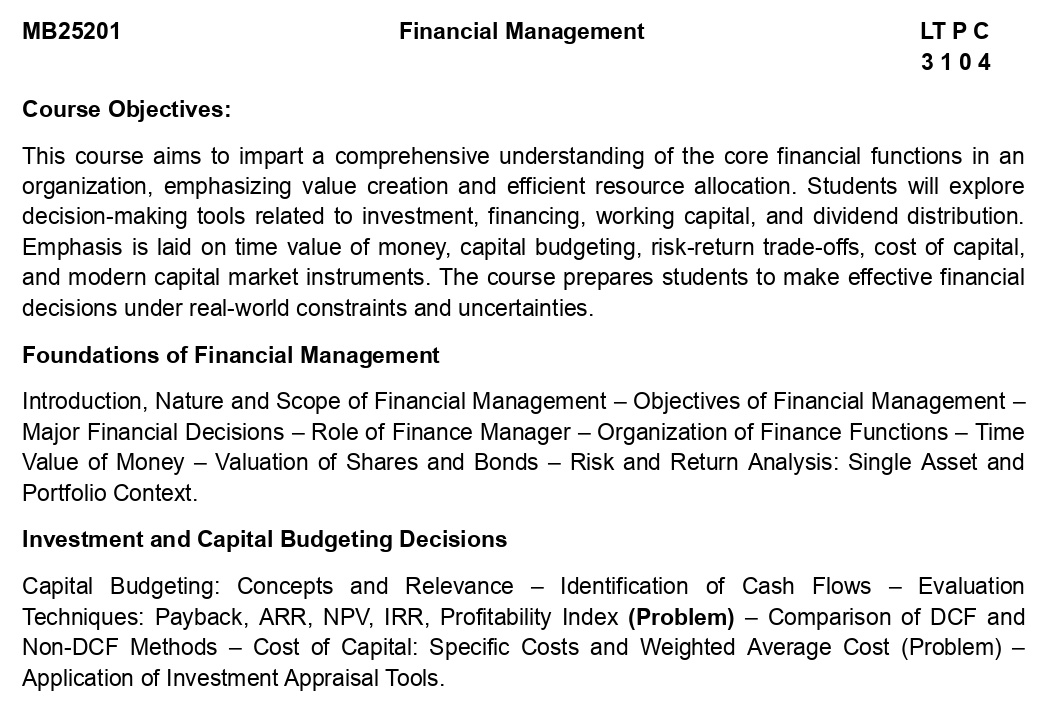
Course Objectives:
This
course aims to impart a comprehensive understanding of the core financial
functions in an organization, emphasizing value creation and efficient resource
allocation. Students will explore decision-making tools related to investment,
financing, working capital, and dividend distribution. Emphasis is laid on time
value of money, capital budgeting, risk-return trade-offs, cost of capital, and
modern capital market instruments. The course prepares students to make
effective financial decisions under real-world constraints and uncertainties.
Foundations
of Financial Management
Introduction,
Nature and Scope of Financial Management – Objectives of Financial Management –
Major Financial Decisions – Role of Finance Manager – Organization of Finance
Functions – Time Value of Money – Valuation of Shares and Bonds – Risk and
Return Analysis: Single Asset and Portfolio Context.
Investment
and Capital Budgeting Decisions
Capital
Budgeting: Concepts and Relevance – Identification of Cash Flows – Evaluation
Techniques: Payback, ARR, NPV, IRR, Profitability Index (Problem) – Comparison of DCF and Non-DCF Methods – Cost of
Capital: Specific Costs and Weighted Average Cost (Problem) – Application of
Investment Appraisal Tools.
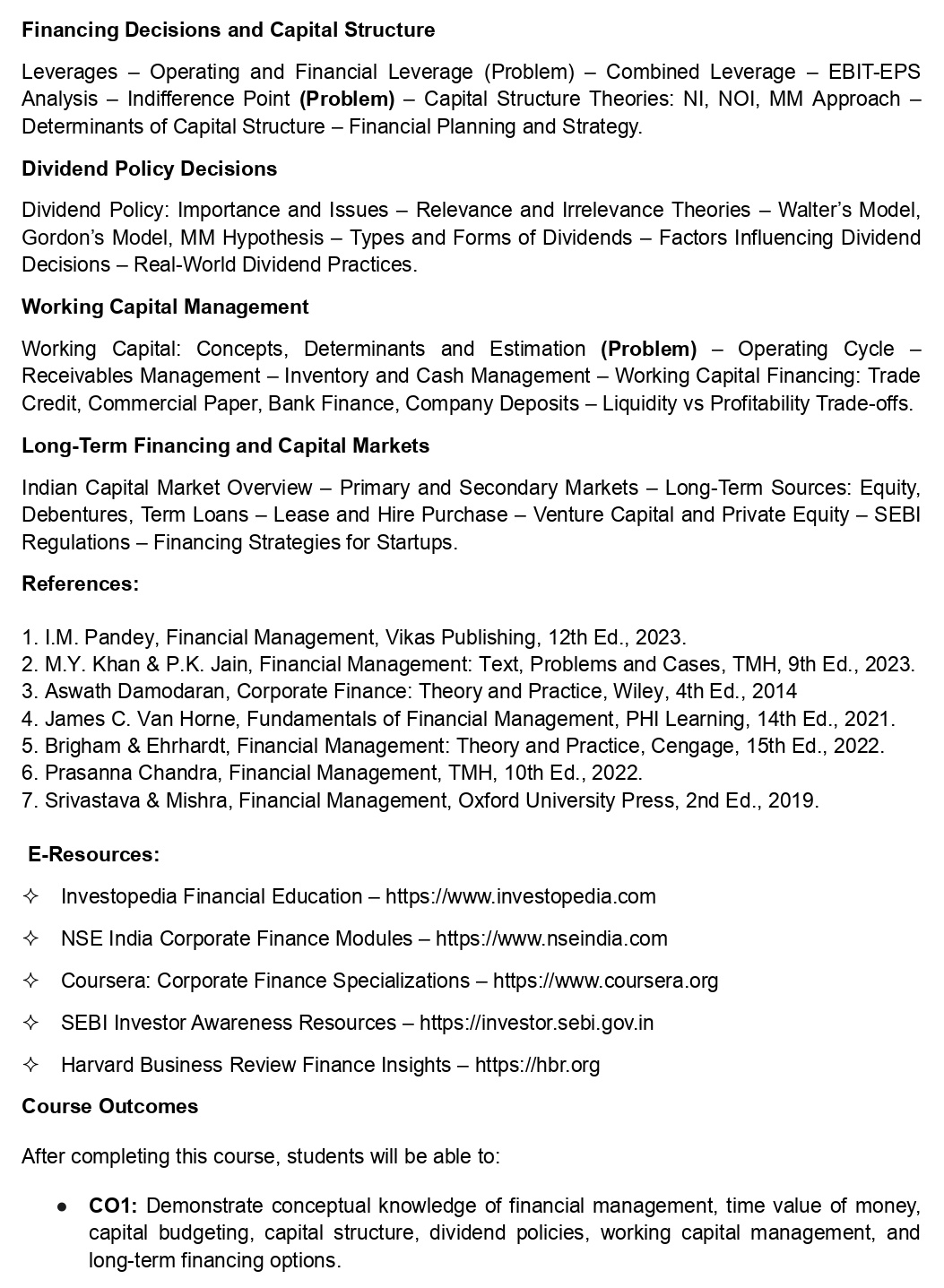
Financing
Decisions and Capital Structure
Leverages
– Operating and Financial Leverage (Problem) – Combined Leverage – EBIT-EPS
Analysis – Indifference Point (Problem)
– Capital Structure Theories: NI, NOI, MM Approach – Determinants of Capital
Structure – Financial Planning and Strategy.
Dividend
Policy Decisions
Dividend
Policy: Importance and Issues – Relevance and Irrelevance Theories – Walter’s
Model, Gordon’s Model, MM Hypothesis – Types and Forms of Dividends – Factors
Influencing Dividend Decisions – Real-World Dividend Practices.
Working
Capital Management
Working
Capital: Concepts, Determinants and Estimation (Problem) – Operating Cycle – Receivables Management – Inventory
and Cash Management – Working Capital Financing: Trade Credit, Commercial
Paper, Bank Finance, Company Deposits – Liquidity vs Profitability Trade-offs.
Long-Term
Financing and Capital Markets
Indian
Capital Market Overview – Primary and Secondary Markets – Long-Term Sources:
Equity, Debentures, Term Loans – Lease and Hire Purchase – Venture Capital and
Private Equity – SEBI Regulations – Financing Strategies for Startups.
References:
1.
I.M. Pandey, Financial Management, Vikas Publishing, 12th Ed., 2023.
2.
M.Y. Khan & P.K. Jain, Financial Management: Text, Problems and Cases, TMH,
9th Ed., 2023.
3.
Aswath Damodaran, Corporate Finance: Theory and Practice, Wiley, 4th Ed., 2014
4.
James C. Van Horne, Fundamentals of Financial Management, PHI Learning, 14th
Ed., 2021.
5.
Brigham & Ehrhardt, Financial Management: Theory and Practice, Cengage,
15th Ed., 2022.
6.
Prasanna Chandra, Financial Management, TMH, 10th Ed., 2022.
7.
Srivastava & Mishra, Financial Management, Oxford University Press, 2nd
Ed., 2019.
Course
Outcomes
After
completing this course, students will be able to:
● CO1:
Demonstrate conceptual knowledge of financial management, time value of money,
capital budgeting, capital structure, dividend policies, working capital
management, and long-term financing options.
● CO2:
Interpret and relate the objectives of financial management, risk and return
analysis, capital budgeting techniques, leverage and capital structure
theories, dividend policies, and the role of capital markets in a company's
financial decisions.
● CO3:
Apply financial management principles, time value of money concepts, and
capital budgeting techniques to make informed investment, financing, and
working capital decisions.
● CO4:
Analyze financial data, including cash flows, leverage, and working capital
components, to evaluate investment proposals, capital structure, and liquidity
management strategies.
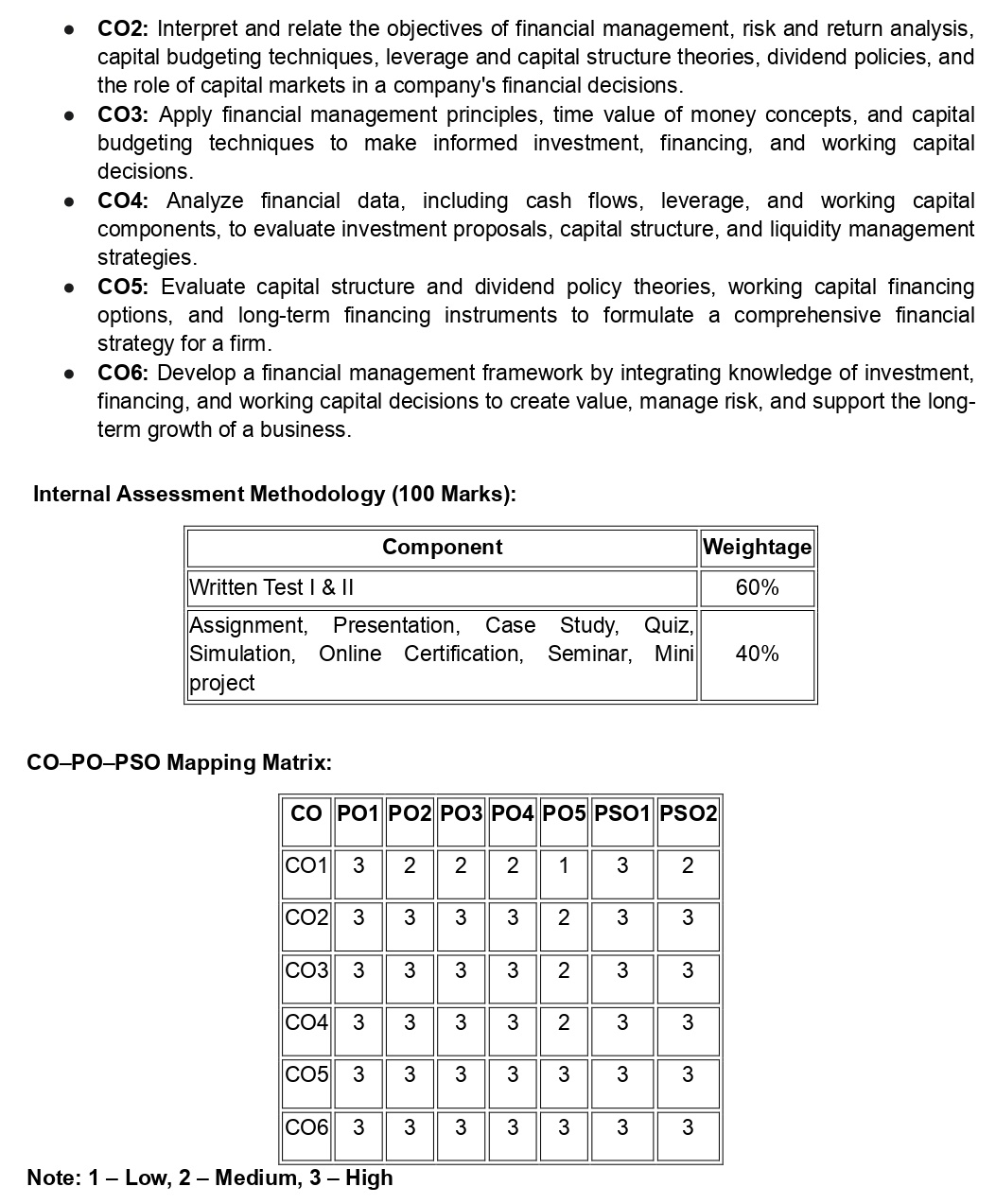
● CO5:
Evaluate capital structure and dividend policy theories, working capital
financing options, and long-term financing instruments to formulate a
comprehensive financial strategy for a firm.
● CO6:
Develop a financial management framework by integrating knowledge of
investment, financing, and working capital decisions to create value, manage
risk, and support the long-term growth of a business.