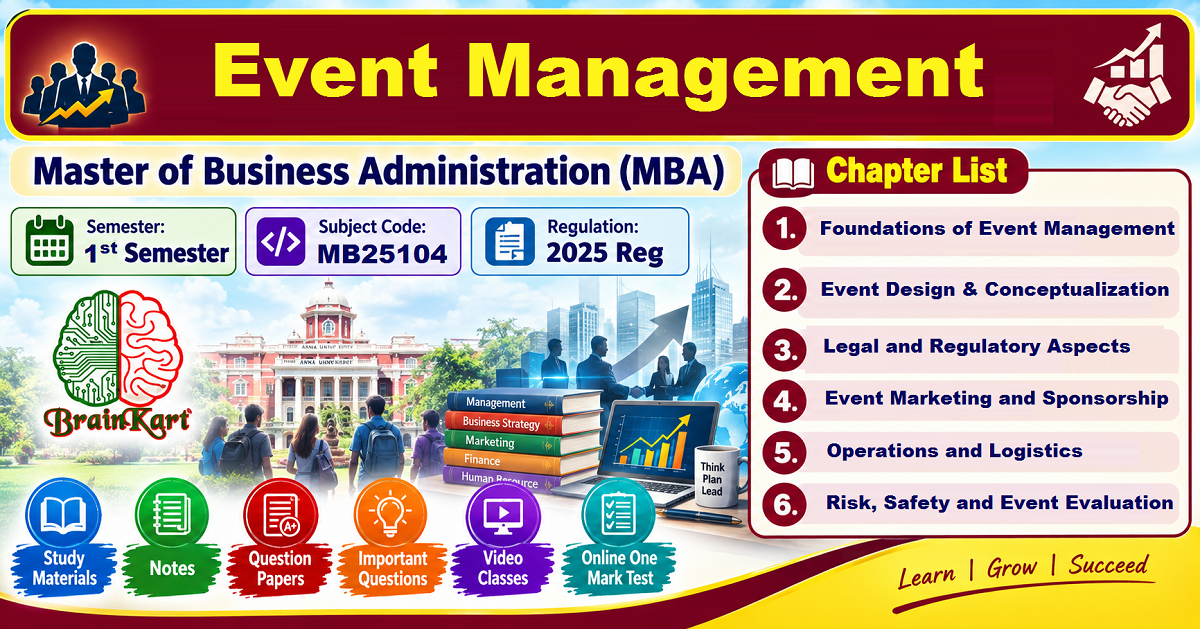
Event Management - MB25104
[ 1st Semester - MBA - Master of Business Administration ]
Under Class: | 1st Semester [MBA Dept Anna University 2025 Regulation] |
Event Management - MB25104 - Study Materials, Notes, Important Questions, Anna University Semester Question Paper PDF Download
Mba - Event Management - MB25104 Subject (under Anna University 1st Semester - MBA - Master of Business Administration Regulation 2025) - Study Materials, Written and lecture Notes, Important Questions, Semester Question Paper PDF Download
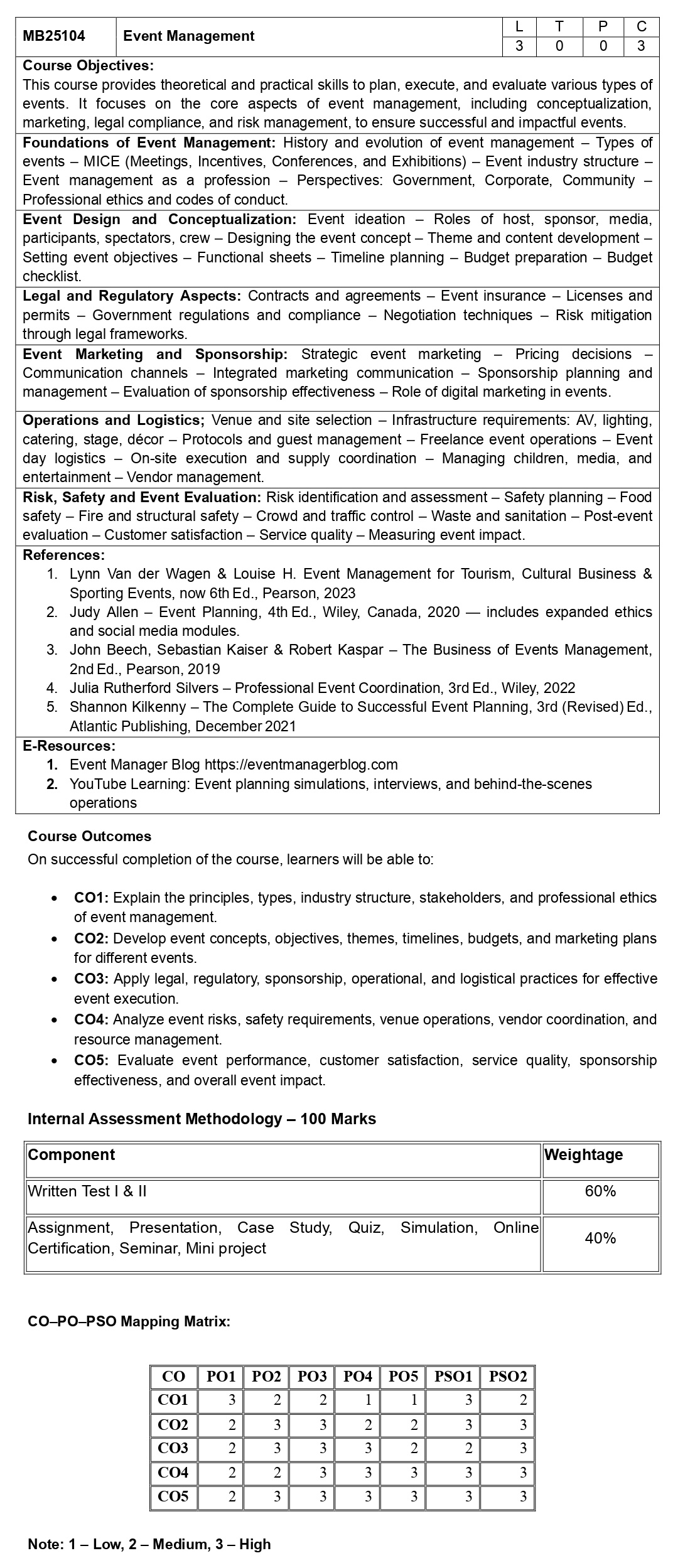
MB25104:
Event
Management
Course Objectives:
This
course provides theoretical and practical skills to plan, execute, and evaluate
various types of events. It focuses on the core aspects of event management,
including conceptualization, marketing, legal compliance, and risk management,
to ensure successful and impactful events.
Foundations
of Event Management: History and evolution of event
management – Types of events – MICE (Meetings, Incentives, Conferences, and
Exhibitions) – Event industry structure – Event management as a profession –
Perspectives: Government, Corporate, Community – Professional ethics and codes
of conduct.
Event
Design and Conceptualization: Event ideation – Roles
of host, sponsor, media, participants, spectators, crew – Designing the event
concept – Theme and content development – Setting event objectives – Functional
sheets – Timeline planning – Budget preparation – Budget checklist.
Legal and
Regulatory Aspects: Contracts and agreements – Event
insurance – Licenses and permits – Government regulations and compliance –
Negotiation techniques – Risk mitigation through legal frameworks.
Event
Marketing and Sponsorship: Strategic event
marketing – Pricing decisions – Communication channels – Integrated marketing
communication – Sponsorship planning and management – Evaluation of sponsorship
effectiveness – Role of digital marketing in events.
Operations
and Logistics; Venue and site selection –
Infrastructure requirements: AV, lighting, catering, stage, décor – Protocols
and guest management – Freelance event operations – Event day logistics –
On-site execution and supply coordination – Managing children, media, and entertainment
– Vendor management.
Risk,
Safety and Event Evaluation: Risk identification
and assessment – Safety planning – Food safety – Fire and structural safety –
Crowd and traffic control – Waste and sanitation – Post-event evaluation –
Customer satisfaction – Service quality – Measuring event impact.
References:
1.
Lynn Van der Wagen & Louise H. Event Management for Tourism, Cultural
Business & Sporting Events, now 6th Ed., Pearson, 2023
2.
Judy Allen – Event Planning, 4th Ed., Wiley, Canada, 2020 — includes expanded
ethics and social media modules.
3.
John Beech, Sebastian Kaiser & Robert Kaspar – The Business of Events
Management, 2nd Ed., Pearson, 2019
4.
Julia Rutherford Silvers – Professional Event Coordination, 3rd Ed., Wiley,
2022
5.
Shannon Kilkenny – The Complete Guide to Successful Event Planning, 3rd
(Revised) Ed., Atlantic Publishing, December 2021
Course
Outcomes
On successful completion of the course, learners will be able to:
• CO1:
Explain the principles, types, industry structure, stakeholders, and
professional ethics of event management.
• CO2:
Develop event concepts, objectives, themes, timelines, budgets, and marketing
plans for different events.
• CO3:
Apply legal, regulatory, sponsorship, operational, and logistical practices for
effective event execution.
• CO4:
Analyze event risks, safety requirements, venue operations, vendor
coordination, and resource management.
• CO5:
Evaluate event performance, customer satisfaction, service quality, sponsorship
effectiveness, and overall event impact.
Internal
Assessment Methodology
Component -
Written Test I & II
Weightage
- 60%
Assignment,Presentation,CaseStudy,Quiz,Simulation,Online
Certification, Seminar, Mini project - 40%