Essentials of Computing - CS25C03
[ 1st Semester - CSE,AIDS,IT,CY Department ]
Under Class: | 1st Semester [CSE Dept Anna University 2025 Regulation] | | 1st Semester [CSE(CY) Dept Anna University 2025 Regulation] | | 1st Semester [AIDS Dept Anna University 2025 Regulation] | | 1st Semester [IT Dept Anna University 2025 Regulation] |
Essentials of Computing - CS25C03 - Study Materials, Notes, Important Questions, Anna University Semester Question Paper PDF Download
Engineering - Essentials of Computing - CS25C03 Subject (under Anna University 1st Semester - Engineering Regulation 2025) - Study Materials, Written and lecture Notes, Important Questions, Semester Question Paper PDF Download
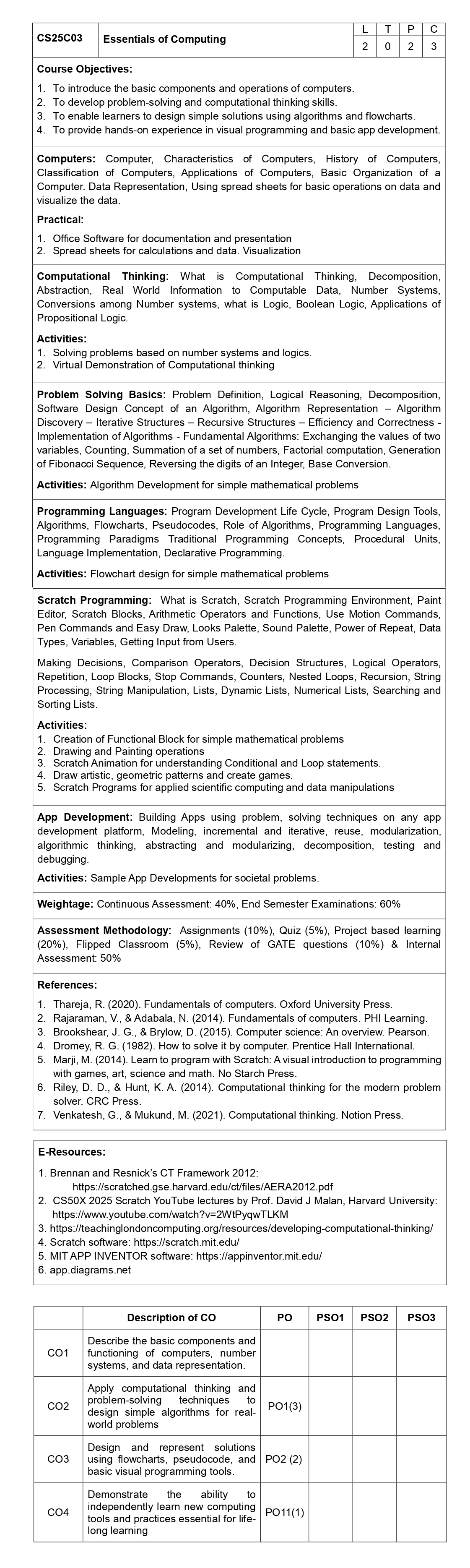
CS25C03:
Essentials of Computing
Course
Objectives:
1.To
introduce the basic components and operations of computers.
2.To
develop problem-solving and computational thinking skills.
3.To
enable learners to design simple solutions using algorithms and flowcharts.
4.To
provide hands-on experience in visual programming and basic app development.
Computers:
Computer, Characteristics of Computers, History of Computers, Classification of
Computers, Applications of Computers, Basic Organization of a Computer. Data
Representation, Using spread sheets for basic operations on data and visualize
the data.
Practical:
1.Office
Software for documentation and presentation
2.Spread
sheets for calculations and data. Visualization
Computational
Thinking: What is Computational Thinking,
Decomposition, Abstraction, Real World Information to Computable Data, Number
Systems, Conversions among Number systems, what is Logic, Boolean Logic,
Applications of Propositional Logic.
Activities:
1.Solving
problems based on number systems and logics.
2.Virtual
Demonstration of Computational thinking
Problem
Solving Basics: Problem Definition, Logical Reasoning,
Decomposition, Software Design Concept of an Algorithm, Algorithm
Representation – Algorithm Discovery – Iterative Structures – Recursive
Structures – Efficiency and Correctness - Implementation of Algorithms -
Fundamental Algorithms: Exchanging the values of two variables, Counting,
Summation of a set of numbers, Factorial computation, Generation of Fibonacci
Sequence, Reversing the digits of an Integer, Base Conversion.
Activities:
Algorithm Development for simple mathematical problems
Programming
Languages: Program Development Life Cycle, Program
Design Tools, Algorithms, Flowcharts, Pseudocodes, Role of Algorithms,
Programming Languages, Programming Paradigms Traditional Programming Concepts,
Procedural Units, Language Implementation, Declarative Programming.
Activities:
Flowchart design for simple mathematical problems
Scratch
Programming: What is Scratch, Scratch Programming
Environment, Paint Editor, Scratch Blocks, Arithmetic Operators and Functions,
Use Motion Commands, Pen Commands and Easy Draw, Looks Palette, Sound Palette,
Power of Repeat, Data Types, Variables, Getting Input from Users.
Making
Decisions, Comparison Operators, Decision Structures, Logical Operators,
Repetition, Loop Blocks, Stop Commands, Counters, Nested Loops, Recursion,
String Processing, String Manipulation, Lists, Dynamic Lists, Numerical Lists,
Searching and Sorting Lists.
Activities:
1.Creation
of Functional Block for simple mathematical problems
2.Drawing
and Painting operations
3.Scratch
Animation for understanding Conditional and Loop statements.
4.Draw
artistic, geometric patterns and create games.
5.Scratch
Programs for applied scientific computing and data manipulations
App
Development: Building Apps using problem, solving
techniques on any app development platform, Modeling, incremental and
iterative, reuse, modularization, algorithmic thinking, abstracting and modularizing,
decomposition, testing and debugging.
Activities:
Sample App Developments for societal problems.
Weightage:
Continuous Assessment: 40%, End Semester Examinations: 60%
Assessment Methodology:
Assignments (10%), Quiz (5%), Project based learning (20%), Flipped Classroom
(5%), Review of GATE questions (10%) & Internal Assessment: 50%
References:
1.Thareja,
R. (2020). Fundamentals of computers. Oxford University Press.
2.Rajaraman,
V., & Adabala, N. (2014). Fundamentals of computers. PHI Learning.
3.Brookshear,
J. G., & Brylow, D. (2015). Computer science: An overview. Pearson.
4.Dromey,
R. G. (1982). How to solve it by computer. Prentice Hall International.
5.Marji,
M. (2014). Learn to program with Scratch: A visual introduction to programming
with games, art, science and math. No Starch Press.
6.Riley,
D. D., & Hunt, K. A. (2014). Computational thinking for the modern problem
solver. CRC Press.
7.Venkatesh, G., & Mukund, M. (2021). Computational thinking. Notion Press.
E-Resources:
1.
Brennan and Resnick’s CT Framework 2012: https://scratched.gse.harvard.edu/ct/files/AERA2012.pdf
2.
CS50X 2025 Scratch YouTube lectures by Prof. David J Malan, Harvard University:
https://www.youtube.com/watch?v=2WtPyqwTLKM
3.
https://teachinglondoncomputing.org/resources/developing-computational-thinking/
4.
Scratch software: https://scratch.mit.edu/
5.
MIT APP INVENTOR software: https://appinventor.mit.edu/
6.
app.diagrams.net