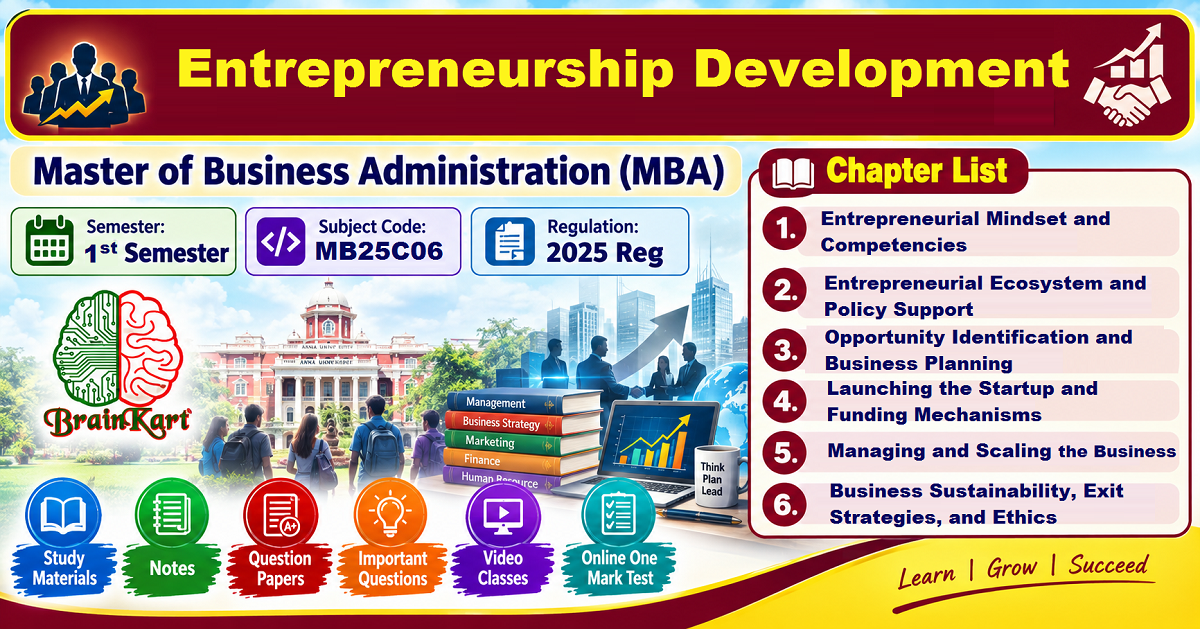
Entrepreneurship Development - MB25C06
[ 1st Semester - MBA - Master of Business Administration ]
Under Class: | 1st Semester [MBA Dept Anna University 2025 Regulation] |
Entrepreneurship Development - MB25C06 - Study Materials, Notes, Important Questions, Anna University Semester Question Paper PDF Download
Mba - Entrepreneurship Development - MB25C06 Subject (under Anna University 1st Semester - MBA - Master of Business Administration Regulation 2025) - Study Materials, Written and lecture Notes, Important Questions, Semester Question Paper PDF Download
MB25C06:
Entrepreneurship
Development
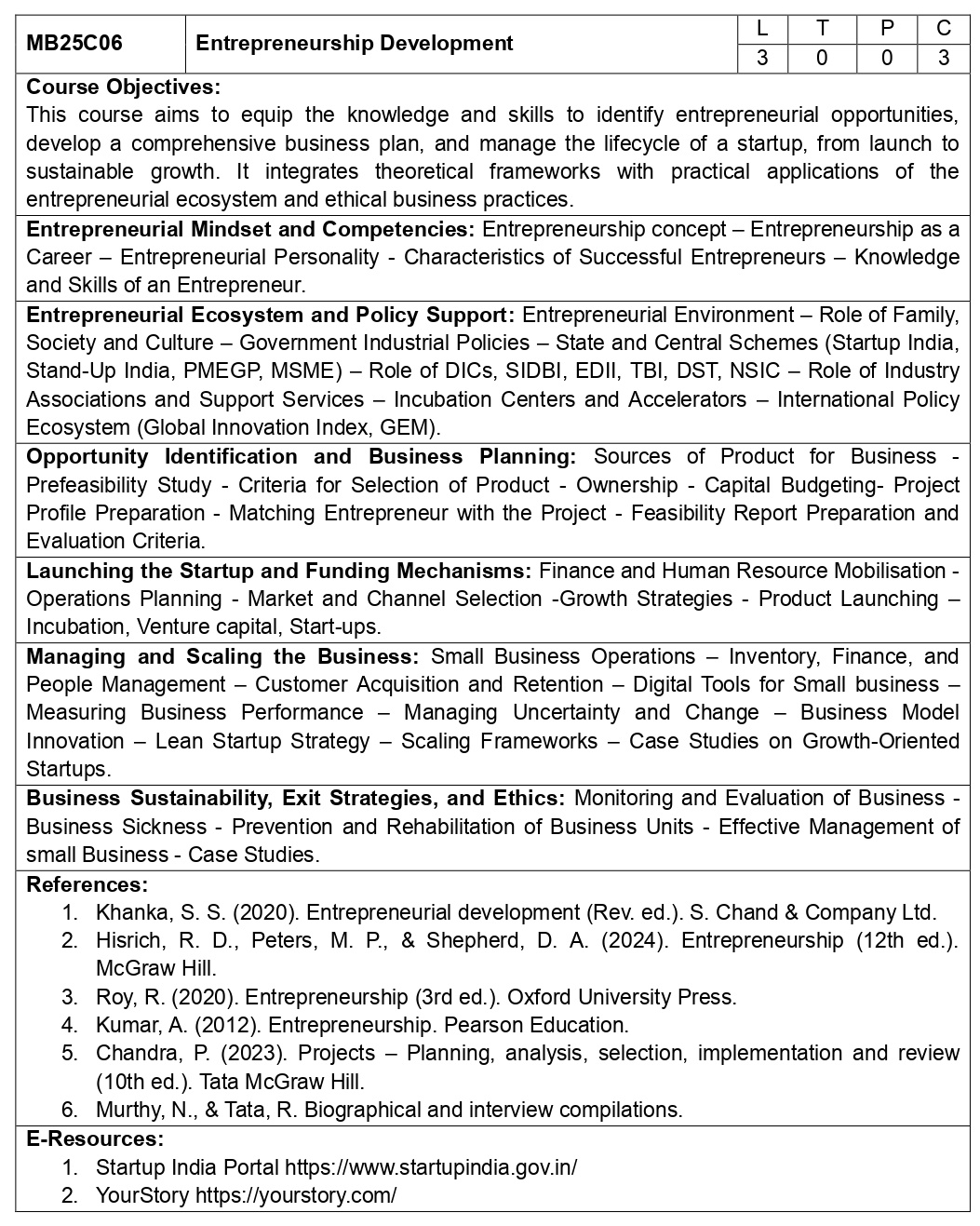
Course Objectives:
This
course aims to equip the knowledge and skills to identify entrepreneurial
opportunities, develop a comprehensive business plan, and manage the lifecycle
of a startup, from launch to sustainable growth. It integrates theoretical
frameworks with practical applications of the entrepreneurial ecosystem and
ethical business practices.
Entrepreneurial
Mindset and Competencies: Entrepreneurship
concept – Entrepreneurship as a Career – Entrepreneurial Personality -
Characteristics of Successful Entrepreneurs – Knowledge and Skills of an
Entrepreneur.
Entrepreneurial
Ecosystem and Policy Support: Entrepreneurial
Environment – Role of Family, Society and Culture – Government Industrial
Policies – State and Central Schemes (Startup India, Stand-Up India, PMEGP,
MSME) – Role of DICs, SIDBI, EDII, TBI, DST, NSIC – Role of Industry
Associations and Support Services – Incubation Centers and Accelerators –
International Policy Ecosystem (Global Innovation Index, GEM).
Opportunity
Identification and Business Planning: Sources of
Product for Business - Prefeasibility Study - Criteria for Selection of Product
- Ownership - Capital Budgeting- Project Profile Preparation - Matching
Entrepreneur with the Project - Feasibility Report Preparation and Evaluation
Criteria.
Launching
the Startup and Funding Mechanisms: Finance and Human
Resource Mobilisation - Operations Planning - Market and Channel Selection
-Growth Strategies - Product Launching – Incubation, Venture capital,
Start-ups.
Managing
and Scaling the Business: Small Business
Operations – Inventory, Finance, and People Management – Customer Acquisition
and Retention – Digital Tools for Small business – Measuring Business
Performance – Managing Uncertainty and Change – Business Model Innovation –
Lean Startup Strategy – Scaling Frameworks – Case Studies on Growth-Oriented Startups.
Business
Sustainability, Exit Strategies, and Ethics:
Monitoring and Evaluation of Business - Business Sickness - Prevention and
Rehabilitation of Business Units - Effective Management of small Business -
Case Studies.
References:
1.
Khanka, S. S. (2020). Entrepreneurial development (Rev. ed.). S. Chand &
Company Ltd.
2.
Hisrich, R. D., Peters, M. P., & Shepherd, D. A. (2024). Entrepreneurship
(12th ed.). McGraw Hill.
3.
Roy, R. (2020). Entrepreneurship (3rd ed.). Oxford University Press.
4.
Kumar, A. (2012). Entrepreneurship. Pearson Education.
5.
Chandra, P. (2023). Projects – Planning, analysis, selection, implementation
and review (10th ed.). Tata McGraw Hill.
6.
Murthy, N., & Tata, R. Biographical and interview compilations.
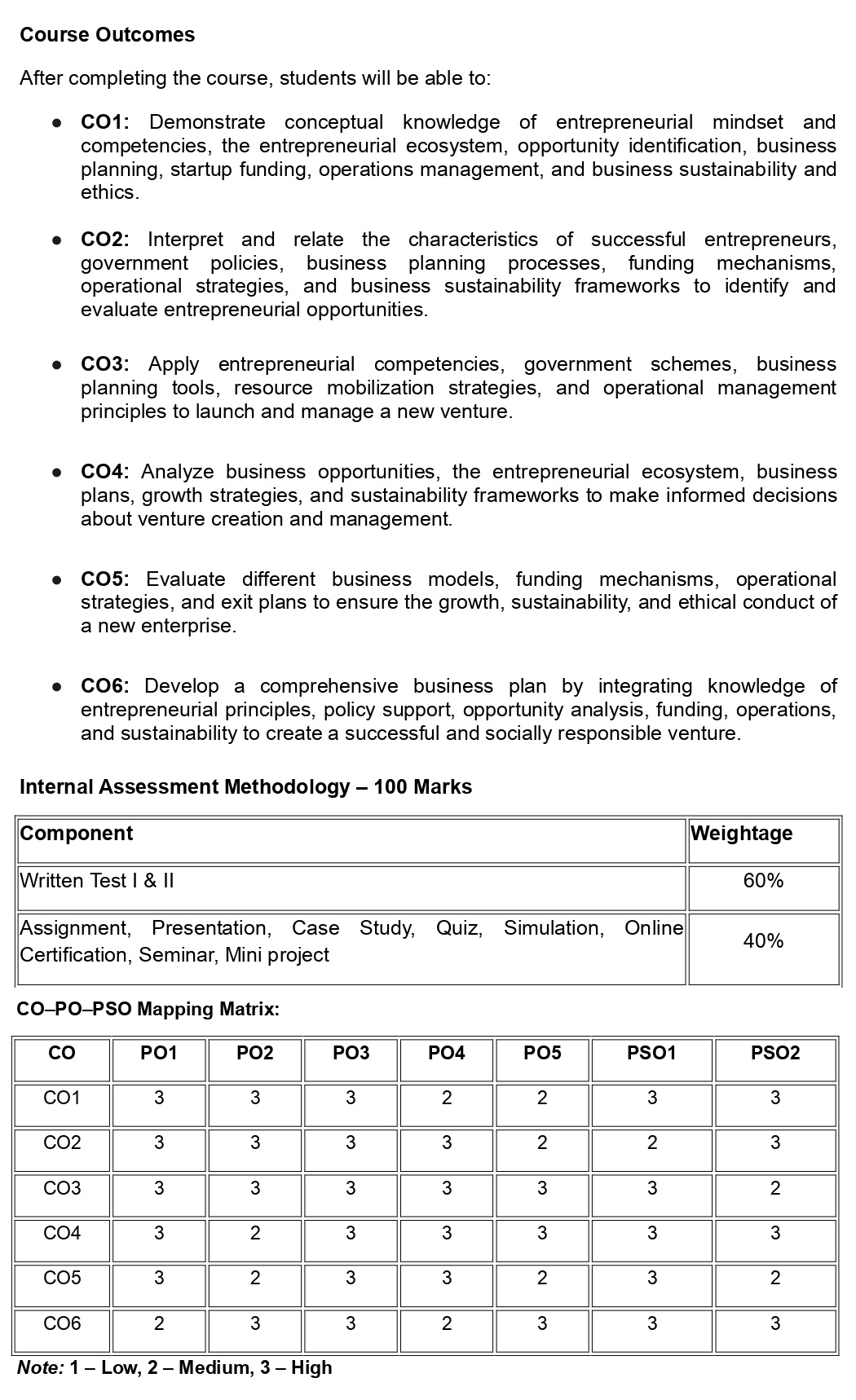
Course
Outcomes
After
completing the course, students will be able to:
● CO1:
Demonstrate conceptual knowledge of entrepreneurial mindset and competencies,
the entrepreneurial ecosystem, opportunity identification, business planning,
startup funding, operations management, and business sustainability and ethics.
● CO2:
Interpret and relate the characteristics of successful entrepreneurs,
government policies, business planning processes, funding mechanisms,
operational strategies, and business sustainability frameworks to identify and
evaluate entrepreneurial opportunities.
● CO3:
Apply entrepreneurial competencies, government schemes, business planning
tools, resource mobilization strategies, and operational management principles
to launch and manage a new venture.
● CO4:
Analyze business opportunities, the entrepreneurial ecosystem, business plans,
growth strategies, and sustainability frameworks to make informed decisions
about venture creation and management.
● CO5:
Evaluate different business models, funding mechanisms, operational strategies,
and exit plans to ensure the growth, sustainability, and ethical conduct of a
new enterprise.
● CO6:
Develop a comprehensive business plan by integrating knowledge of
entrepreneurial principles, policy support, opportunity analysis, funding,
operations, and sustainability to create a successful and socially responsible
venture.