Electronic Circuits and Analysis - EC25C05
[ 3rd Semester - ECE - Electronics and Communication Engineering Department ]
Under Class: | 3rd Semester [ECE Dept Anna University 2025 Regulation] |
Electronic Circuits and Analysis - EC25C05 - Study Materials, Notes, Important Questions, Anna University Semester Question Paper PDF Download
Engineering - Electronic Circuits and Analysis - EC25C05 Subject (under Anna University 3rd Semester - ECE - Electronics and Communication Engineering Department Regulation 2025) - Study Materials, Written and lecture Notes, Important Questions, Semester Question Paper PDF Download
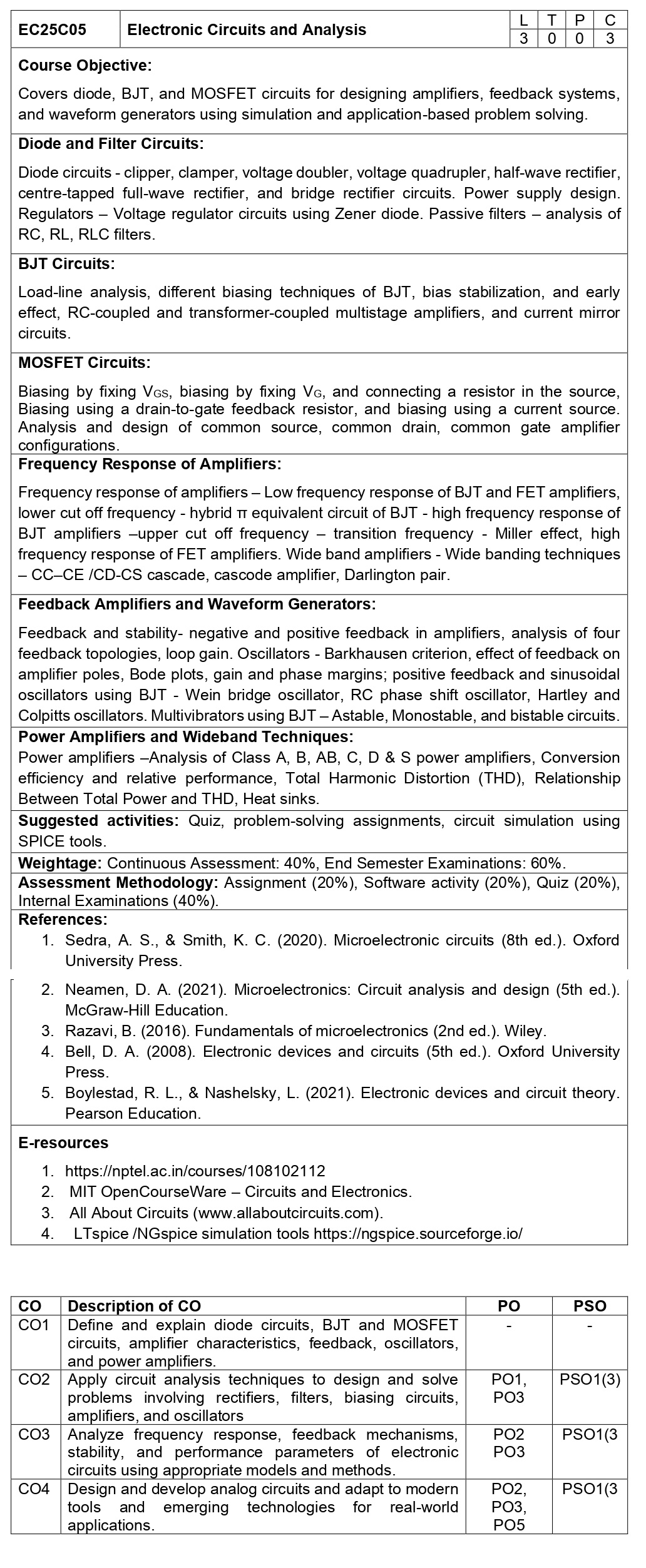
EC25C05:
Electronic Circuits and Analysis
Course
Objective:
Covers
diode, BJT, and MOSFET circuits for designing amplifiers, feedback systems, and
waveform generators using simulation and application-based problem solving.
Diode and
Filter Circuits:
Diode
circuits - clipper, clamper, voltage doubler, voltage quadrupler, half-wave
rectifier, centre-tapped full-wave rectifier, and bridge rectifier circuits.
Power supply design. Regulators – Voltage regulator circuits using Zener diode.
Passive filters – analysis of RC, RL, RLC filters.
BJT
Circuits:
Load-line
analysis, different biasing techniques of BJT, bias stabilization, and early
effect, RC-coupled and transformer-coupled multistage amplifiers, and current
mirror circuits.
MOSFET
Circuits:
Biasing
by fixing VGS, biasing by fixing VG, and connecting a resistor in the source,
Biasing using a drain-to-gate feedback resistor, and biasing using a current
source. Analysis and design of common source, common drain, common gate
amplifier configurations.
Frequency
Response of Amplifiers:
Frequency
response of amplifiers – Low frequency response of BJT and FET amplifiers,
lower cut off frequency - hybrid π equivalent circuit of BJT - high frequency
response of BJT amplifiers –upper cut off frequency – transition frequency -
Miller effect, high frequency response of FET amplifiers. Wide band amplifiers
- Wide banding techniques – CC–CE /CD-CS cascade, cascode amplifier, Darlington
pair.
Feedback
Amplifiers and Waveform Generators:
Feedback
and stability- negative and positive feedback in amplifiers, analysis of four
feedback topologies, loop gain. Oscillators - Barkhausen criterion, effect of
feedback on amplifier poles, Bode plots, gain and phase margins; positive feedback
and sinusoidal oscillators using BJT - Wein bridge oscillator, RC phase shift
oscillator, Hartley and
Colpitts
oscillators. Multivibrators using BJT – Astable, Monostable, and bistable
circuits.
Power
Amplifiers and Wideband Techniques:
Power
amplifiers –Analysis of Class A, B, AB, C, D & S power amplifiers,
Conversion efficiency and relative performance, Total Harmonic Distortion
(THD), Relationship Between Total Power and THD, Heat sinks.
Suggested activities:
Quiz, problem-solving assignments, circuit simulation using
SPICE
tools.
Weightage:
Continuous Assessment: 40%, End Semester Examinations: 60%.
Assessment Methodology:
Assignment (20%), Software activity (20%), Quiz (20%),
Internal
Examinations (40%).
References:
1.
Sedra, A. S., & Smith, K. C. (2020). Microelectronic circuits (8th ed.).
Oxford University Press.
2.
Neamen, D. A. (2021). Microelectronics: Circuit analysis and design (5th ed.).
McGraw-Hill Education.
3.
Razavi, B. (2016). Fundamentals of microelectronics (2nd ed.). Wiley.
4.
Bell, D. A. (2008). Electronic devices and circuits (5th ed.). Oxford
University Press.
5.
Boylestad, R. L., & Nashelsky, L. (2021). Electronic devices and circuit
theory.
Pearson
Education.