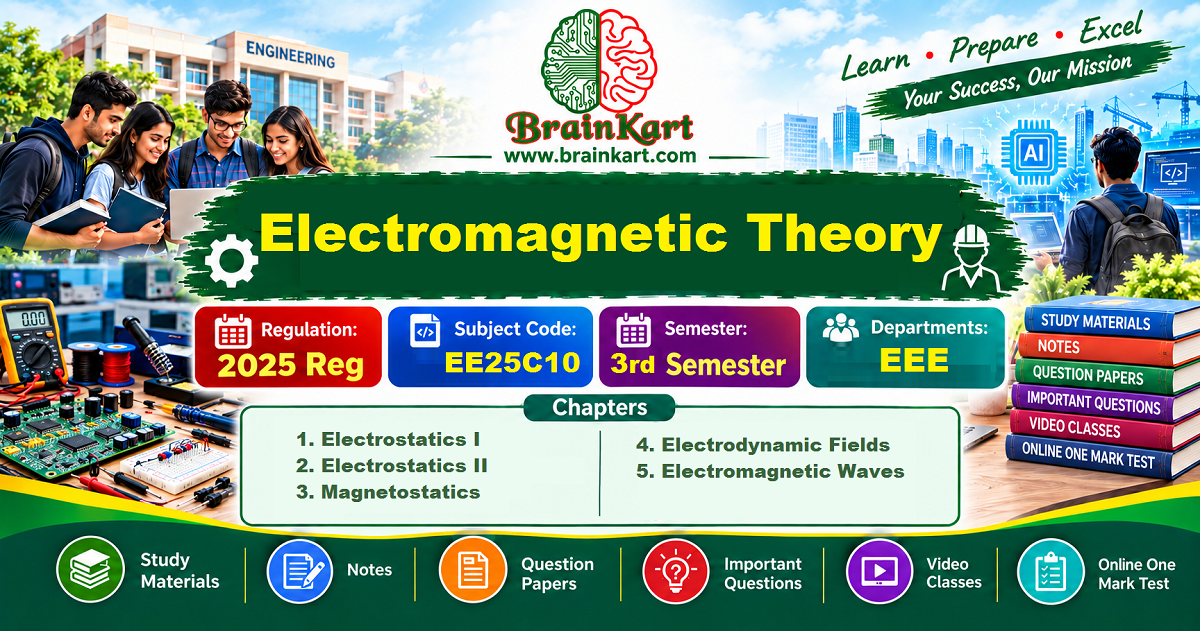
Electromagnetic Theory - EE25C10
[ 3rd Semester - EEE - Electrical and Electronics Engineering Department ]
Under Class: | 3rd Semester [EEE Dept Anna University 2025 Regulation] |
Electromagnetic Theory - EE25C10 - Study Materials, Notes, Important Questions, Anna University Semester Question Paper PDF Download
Engineering - Electromagnetic Theory - EE25C10 Subject (under Anna University 3rd Semester - EEE - Electrical and Electronics Engineering Department Regulation 2025) - Study Materials, Written and lecture Notes, Important Questions, Semester Question Paper PDF Download
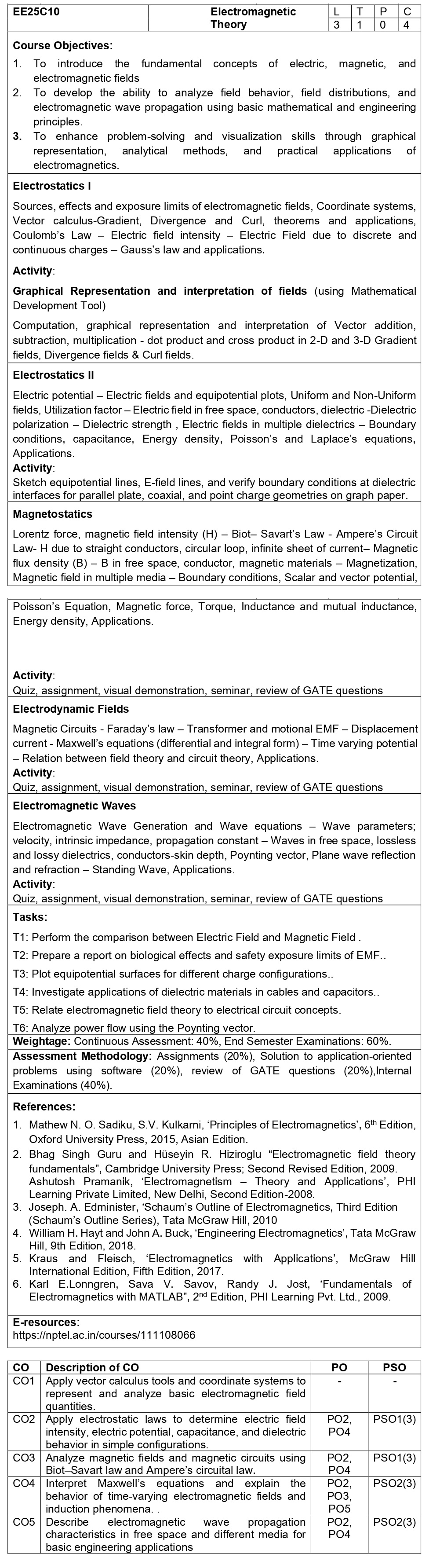
EE25C10:
Electromagnetic Theory
Course
Objectives:
1.
To introduce the fundamental concepts of electric, magnetic, and
electromagnetic fields
2.
To develop the ability to analyze field behavior, field distributions, and
electromagnetic wave propagation using basic mathematical and engineering
principles.
3.
To enhance problem-solving and visualization skills through graphical representation,
analytical methods, and practical applications of electromagnetics.
Electrostatics
I
Sources,
effects and exposure limits of electromagnetic fields, Coordinate systems,
Vector calculus-Gradient, Divergence and Curl, theorems and applications,
Coulomb’s Law – Electric field intensity – Electric Field due to discrete and
continuous charges – Gauss’s law and applications.
Activity:
Graphical
Representation and interpretation of fields (using
Mathematical Development Tool)
Computation,
graphical representation and interpretation of Vector addition,
subtraction,
multiplication - dot product and cross product in 2-D and 3-D Gradient fields,
Divergence fields & Curl fields.
Electrostatics
II
Electric
potential – Electric fields and equipotential plots, Uniform and Non-Uniform
fields, Utilization factor – Electric field in free space, conductors,
dielectric -Dielectric polarization – Dielectric strength , Electric fields in
multiple dielectrics – Boundary conditions, capacitance, Energy density,
Poisson’s and Laplace’s equations, Applications.
Activity:
Sketch
equipotential lines, E-field lines, and verify boundary conditions at
dielectric interfaces for parallel plate, coaxial, and point charge geometries
on graph paper.
Magnetostatics
Lorentz
force, magnetic field intensity (H) – Biot– Savart’s Law - Ampere’s Circuit
Law- H due to straight conductors, circular loop, infinite sheet of current–
Magnetic flux density (B) – B in free space, conductor, magnetic materials –
Magnetization,
Magnetic
field in multiple media – Boundary conditions, Scalar and vector potential,
Poisson’s
Equation, Magnetic force, Torque, Inductance and mutual inductance, Energy
density, Applications.
Activity:
Quiz,
assignment, visual demonstration, seminar, review of GATE questions
Electrodynamic
Fields
Magnetic
Circuits - Faraday’s law – Transformer and motional EMF – Displacement current
- Maxwell’s equations (differential and integral form) – Time varying potential
– Relation between field theory and circuit theory, Applications.
Activity:
Quiz,
assignment, visual demonstration, seminar, review of GATE questions
Electromagnetic
Waves
Electromagnetic
Wave Generation and Wave equations – Wave parameters; velocity, intrinsic
impedance, propagation constant – Waves in free space, lossless and lossy
dielectrics, conductors-skin depth, Poynting vector, Plane wave reflection and
refraction – Standing Wave, Applications.
Activity:
Quiz,
assignment, visual demonstration, seminar, review of GATE questions
Tasks:
T1:
Perform the comparison between Electric Field and Magnetic Field .
T2:
Prepare a report on biological effects and safety exposure limits of EMF..
T3:
Plot equipotential surfaces for different charge configurations..
T4:
Investigate applications of dielectric materials in cables and capacitors..
T5:
Relate electromagnetic field theory to electrical circuit concepts.
T6:
Analyze power flow using the Poynting vector.
Weightage:
Continuous Assessment: 40%, End Semester Examinations: 60%.
Assessment Methodology:
Assignments (20%), Solution to application-oriented problems using software(20%),review
of GATE questions (20%),Internal
Examinations
(40%).
References:
1.
Mathew N. O. Sadiku, S.V. Kulkarni, ‘Principles of Electromagnetics’, 6th
Edition, Oxford University Press, 2015, Asian Edition.
2.
Bhag Singh Guru and Hüseyin R. Hiziroglu “Electromagnetic field theory
fundamentals”,
Cambridge University Press; Second Revised Edition, 2009.