Electric Circuit Analysis - EE25302
[ 3rd Semester - EEE - Electrical and Electronics Engineering Department ]
Under Class: | 3rd Semester [EEE Dept Anna University 2025 Regulation] |
Electric Circuit Analysis - EE25302 - Study Materials, Notes, Important Questions, Anna University Semester Question Paper PDF Download
Engineering - Electric Circuit Analysis - EE25302 Subject (under Anna University 3rd Semester - EEE - Electrical and Electronics Engineering Department Regulation 2025) - Study Materials, Written and lecture Notes, Important Questions, Semester Question Paper PDF Download
EE25302:
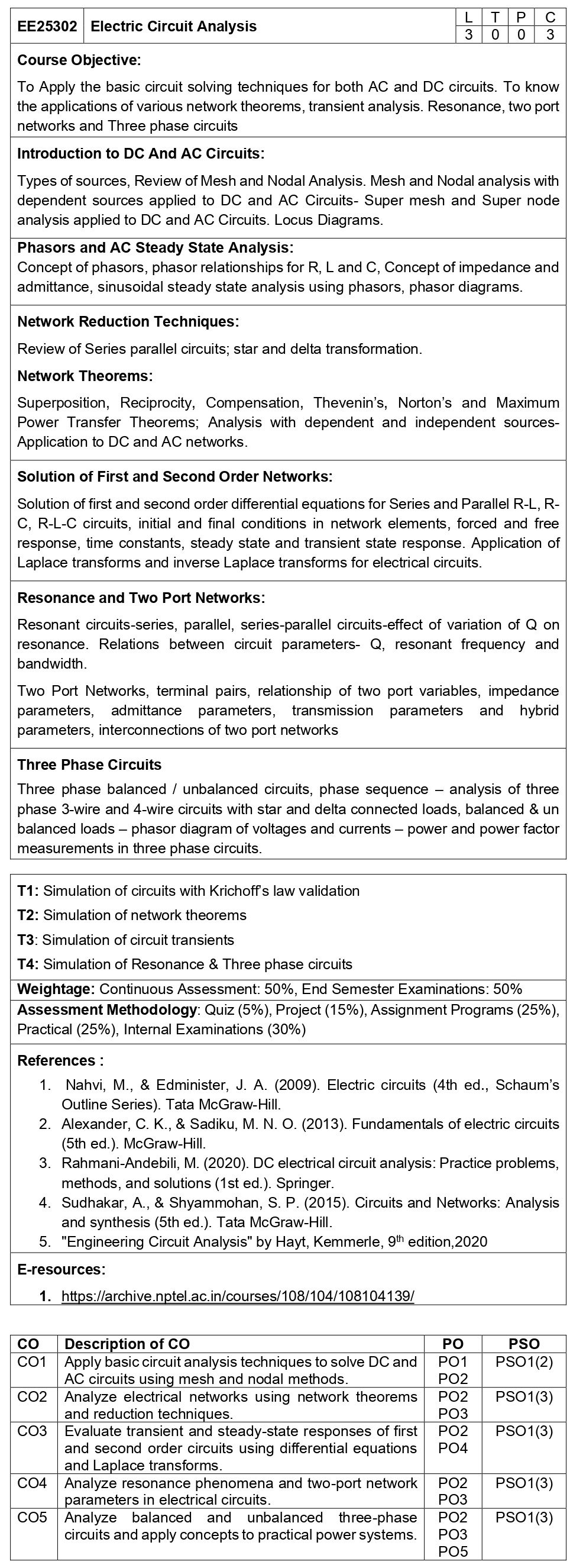
Electric Circuit Analysis
Course
Objective:
To
Apply the basic circuit solving techniques for both AC and DC circuits. To know
the applications of various network theorems, transient analysis. Resonance,
two port networks and Three phase circuits
Introduction
to DC And AC Circuits:
Types
of sources, Review of Mesh and Nodal Analysis. Mesh and Nodal analysis with
dependent sources applied to DC and AC Circuits- Super mesh and Super node
analysis applied to DC and AC Circuits. Locus Diagrams.
Phasors
and AC Steady State Analysis:
Concept
of phasors, phasor relationships for R, L and C, Concept of impedance and
admittance, sinusoidal steady state analysis using phasors, phasor diagrams.
Network
Reduction Techniques:
Review
of Series parallel circuits; star and delta transformation.
Network Theorems:
Superposition,
Reciprocity, Compensation, Thevenin’s, Norton’s and Maximum Power Transfer
Theorems; Analysis with dependent and independent sources-Application to DC and
AC networks.
Solution
of First and Second Order Networks:
Solution
of first and second order differential equations for Series and Parallel R-L,
R-C, R-L-C circuits, initial and final conditions in network elements, forced
and free response, time constants, steady state and transient state response.
Application of Laplace transforms and inverse Laplace transforms for electrical
circuits.
Resonance
and Two Port Networks:
Resonant
circuits-series, parallel, series-parallel circuits-effect of variation of Q on
resonance. Relations between circuit parameters- Q, resonant frequency and
bandwidth.
Two
Port Networks, terminal pairs, relationship of two port variables, impedance
parameters, admittance parameters, transmission parameters and hybrid
parameters, interconnections of two port networks
Three
Phase Circuits
Three
phase balanced / unbalanced circuits, phase sequence – analysis of three phase
3-wire and 4-wire circuits with star and delta connected loads, balanced &
un balanced loads – phasor diagram of voltages and currents – power and power
factor
measurements
in three phase circuits.
T1:
Simulation of circuits with Krichoff’s law validation
T2:
Simulation of network theorems
T3:
Simulation of circuit transients
T4:
Simulation of Resonance & Three phase circuits
Weightage:
Continuous Assessment: 50%, End Semester Examinations: 50%
Assessment Methodology:
Quiz (5%), Project (15%), Assignment Programs (25%),
Practical
(25%), Internal Examinations (30%)
References
:
1.
Nahvi, M., & Edminister, J. A. (2009). Electric circuits (4th ed., Schaum’s
Outline Series). Tata McGraw-Hill.
2.
Alexander, C. K., & Sadiku, M. N. O. (2013). Fundamentals of electric
circuits (5th ed.). McGraw-Hill.
3.
Rahmani-Andebili, M. (2020). DC electrical circuit analysis: Practice problems,
methods, and solutions (1st ed.). Springer.
4.
Sudhakar, A., & Shyammohan, S. P. (2015). Circuits and Networks: Analysis
and synthesis (5th ed.). Tata McGraw-Hill.
5."Engineering
Circuit Analysis" by Hayt, Kemmerle, 9th edition,2020