Discrete Mathematics - MA25C14
[ 3rd Semester - CSE, CSE(CY), AIDS, IT Engineering Departments ]
Under Class: | 3rd Semester [CSE Dept Anna University 2025 Regulation] | | 3rd Semester [CSE(CY) Dept Anna University 2025 Regulation] | | 3rd Semester [AIDS Dept Anna University 2025 Regulation] | | 3rd Semester [IT Dept Anna University 2025 Regulation] |
Discrete Mathematics - MA25C14 - Study Materials, Notes, Important Questions, Anna University Semester Question Paper PDF Download
Engineering - Discrete Mathematics - MA25C14 Subject (under Anna University 3rd Semester - CSE, CSE(CY), AIDS, IT Engineering Departments Regulation 2025) - Study Materials, Written and lecture Notes, Important Questions, Semester Question Paper PDF Download
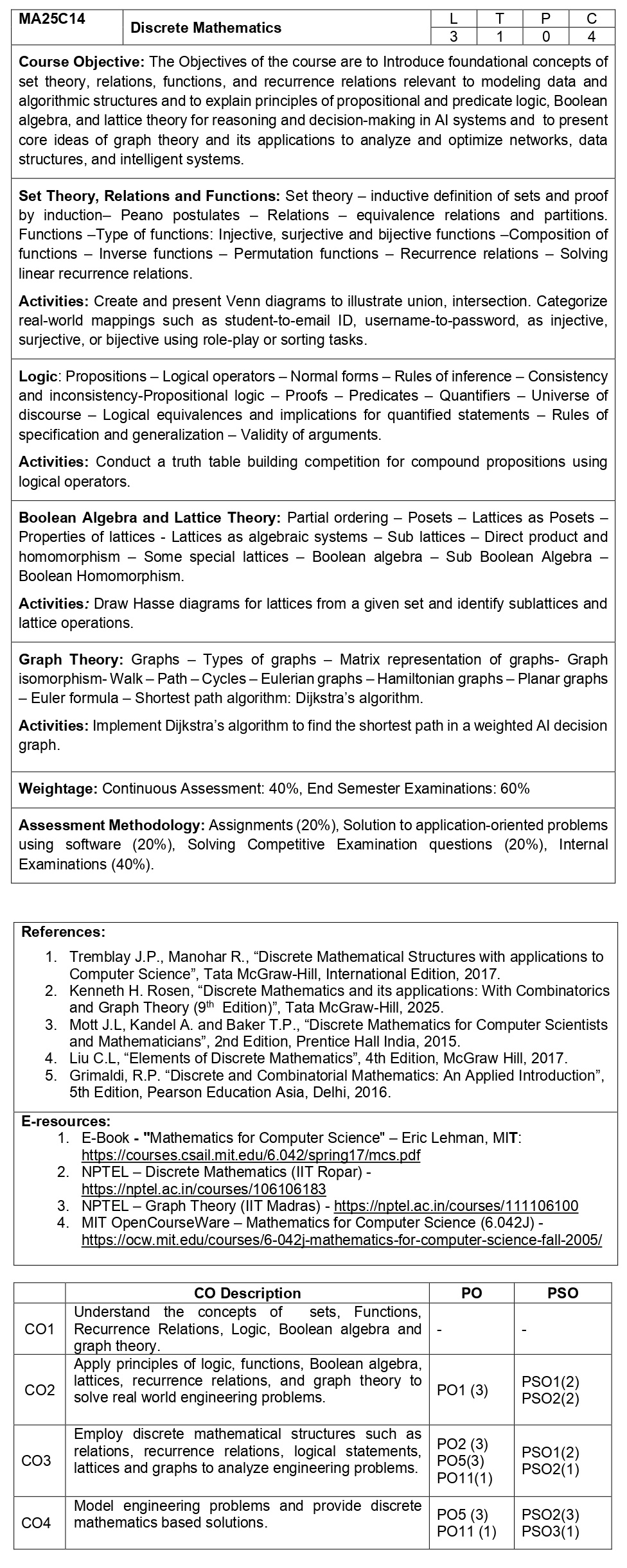
MA25C14:
Discrete Mathematics
Course
Objective:
The
Objectives of the course are to Introduce foundational concepts of set theory,
relations, functions, and recurrence relations relevant to modeling data and
algorithmic structures and to explain principles of propositional and predicate
logic, Boolean algebra, and lattice theory for reasoning and decision-making in
AI systems and to present core ideas of graph theory and its applications to
analyze and optimize networks, data structures, and intelligent systems.
Set
Theory, Relations and Functions: Set theory – inductive
definition of sets and proof by induction– Peano postulates – Relations –
equivalence relations and partitions. Functions –Type of functions: Injective,
surjective and bijective functions –Composition of functions – Inverse
functions – Permutation functions – Recurrence relations – Solving linear
recurrence relations.
Activities:
Create and present Venn diagrams to illustrate union, intersection. Categorize
real-world mappings such as student-to-email ID, username-to-password, as
injective, surjective, or bijective using role-play or sorting tasks.
Logic :
Propositions – Logical operators – Normal forms – Rules of inference –
Consistency and inconsistency-Propositional logic – Proofs – Predicates –
Quantifiers – Universe of discourse – Logical equivalences and implications for
quantified statements – Rules of specification and generalization – Validity of
arguments.
Activities:
Conduct a truth table building competition for compound propositions using
logical operators.
Boolean
Algebra and Lattice Theory: Partial ordering –
Posets – Lattices as Posets – Properties of lattices - Lattices as algebraic
systems – Sub lattices – Direct product and homomorphism – Some special
lattices – Boolean algebra – Sub Boolean Algebra – Boolean Homomorphism.
Activities:
Draw Hasse diagrams for lattices from a given set and identify sublattices and
lattice operations.
Graph
Theory: Graphs – Types of graphs – Matrix
representation of graphs- Graph isomorphism- Walk – Path – Cycles – Eulerian
graphs – Hamiltonian graphs – Planar graphs – Euler formula – Shortest path
algorithm: Dijkstra’s algorithm.
Activities:
Implement Dijkstra’s algorithm to find the shortest path in a weighted AI
decision graph.
Weightage:
Continuous Assessment: 40%, End Semester Examinations: 60%
Assessment Methodology:
Assignments (20%), Solution to application-oriented problems using software
(20%), Solving Competitive Examination questions (20%), Internal Examinations
(40%).
References:
1.
Tremblay J.P., Manohar R., “Discrete Mathematical Structures with applications
to Computer Science”, Tata McGraw-Hill, International Edition, 2017.
2.
Kenneth H. Rosen, “Discrete Mathematics and its applications: With Combinatorics
and Graph Theory (9th Edition)”, Tata McGraw-Hill, 2025.
3.
Mott J.L, Kandel A. and Baker T.P., “Discrete Mathematics for Computer
Scientists and Mathematicians”, 2nd Edition, Prentice Hall India, 2015.
4.
Liu C.L, “Elements of Discrete Mathematics”, 4th Edition, McGraw Hill, 2017.
5.
Grimaldi, R.P. “Discrete and Combinatorial Mathematics: An Applied
Introduction”, 5th Edition, Pearson Education Asia, Delhi, 2016.