Digital System Design - EC25C07
[ 3rd Semester - ECE - Electronics and Communication Engineering Department ]
Under Class: | 3rd Semester [ECE Dept Anna University 2025 Regulation] |
Digital System Design - EC25C07 - Study Materials, Notes, Important Questions, Anna University Semester Question Paper PDF Download
Engineering - Digital System Design - EC25C07 Subject (under Anna University 3rd Semester - ECE - Electronics and Communication Engineering Department Regulation 2025) - Study Materials, Written and lecture Notes, Important Questions, Semester Question Paper PDF Download
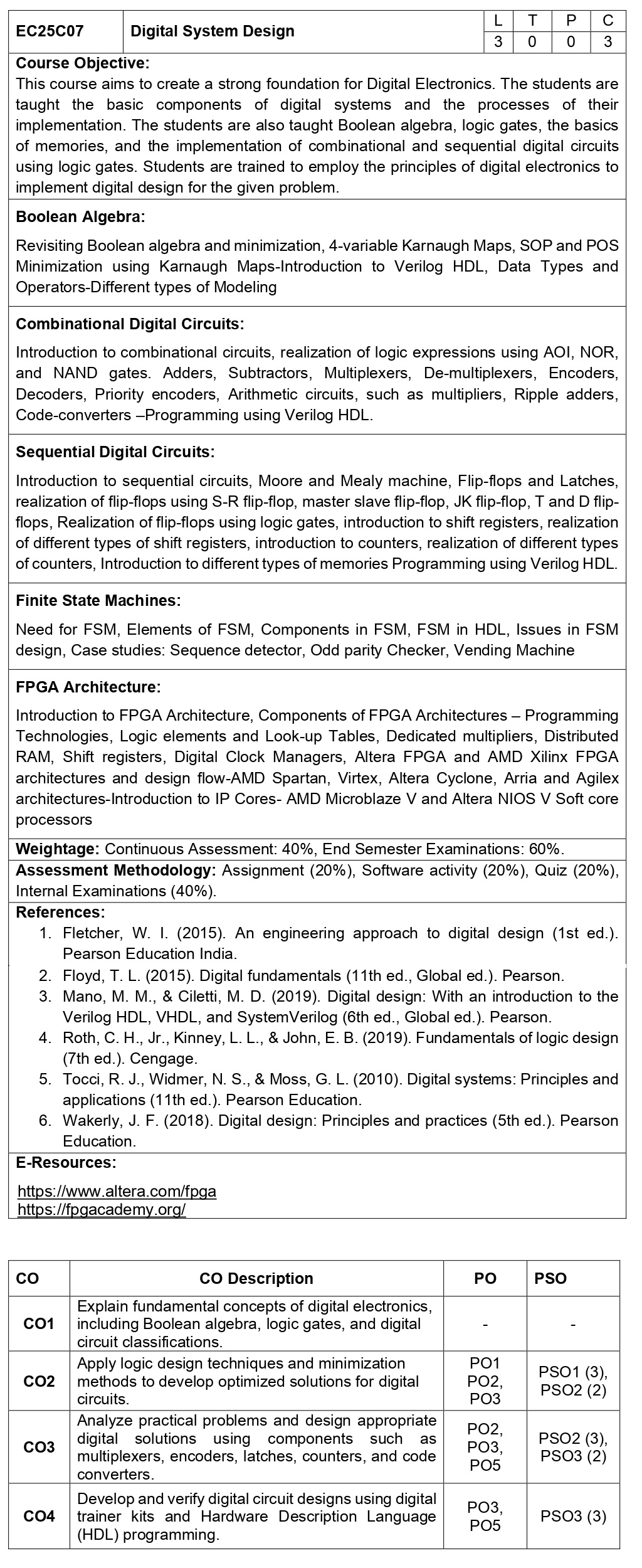
EC25C07:
Digital
System Design
Course
Objective:
This
course aims to create a strong foundation for Digital Electronics. The students
are taught the basic components of digital systems and the processes of their
implementation. The students are also taught Boolean algebra, logic gates, the
basics of memories, and the implementation of combinational and sequential
digital circuits using logic gates. Students are trained to employ the
principles of digital electronics to implement digital design for the given
problem.
Boolean
Algebra:
Revisiting
Boolean algebra and minimization, 4-variable Karnaugh Maps, SOP and POS
Minimization using Karnaugh Maps-Introduction to Verilog HDL, Data Types and
Operators-Different types of Modeling
Combinational
Digital Circuits:
Introduction
to combinational circuits, realization of logic expressions using AOI, NOR, and
NAND gates. Adders, Subtractors, Multiplexers, De-multiplexers, Encoders,
Decoders, Priority encoders, Arithmetic circuits, such as multipliers, Ripple
adders, Code-converters –Programming using Verilog HDL.
Sequential
Digital Circuits:
Introduction
to sequential circuits, Moore and Mealy machine, Flip-flops and Latches,
realization of flip-flops using S-R flip-flop, master slave flip-flop, JK
flip-flop, T and D flip-flops, Realization of flip-flops using logic gates,
introduction to shift registers, realization of different types of shift
registers, introduction to counters, realization of different types of counters,
Introduction to different types of memories Programming using Verilog HDL.
Finite
State Machines:
Need
for FSM, Elements of FSM, Components in FSM, FSM in HDL, Issues in FSM design,
Case studies: Sequence detector, Odd parity Checker, Vending Machine
FPGA
Architecture:
Introduction
to FPGA Architecture, Components of FPGA Architectures – Programming
Technologies, Logic elements and Look-up Tables, Dedicated multipliers,
Distributed RAM, Shift registers, Digital Clock Managers, Altera FPGA and AMD
Xilinx FPGA architectures and design flow-AMD Spartan, Virtex, Altera Cyclone,
Arria and Agilex architectures-Introduction to IP Cores- AMD Microblaze V and
Altera NIOS V Soft core processors
Weightage:
Continuous Assessment: 40%, End Semester Examinations: 60%.
Assessment Methodology:
Assignment (20%), Software activity (20%), Quiz (20%),
Internal
Examinations (40%).
References:
1.
Fletcher, W. I. (2015). An engineering approach to digital design (1st ed.).
Pearson Education India.
2.
Floyd, T. L. (2015). Digital fundamentals (11th ed., Global ed.). Pearson.
3.
Mano, M. M., & Ciletti, M. D. (2019). Digital design: With an introduction
to the Verilog HDL, VHDL, and SystemVerilog (6th ed., Global ed.). Pearson.
4.
Roth, C. H., Jr., Kinney, L. L., & John, E. B. (2019). Fundamentals of
logic design (7th ed.). Cengage.
5.
Tocci, R. J., Widmer, N. S., & Moss, G. L. (2010). Digital systems:
Principles and applications (11th ed.). Pearson Education.
6.
Wakerly, J. F. (2018). Digital design: Principles and practices (5th ed.).
Pearson Education.