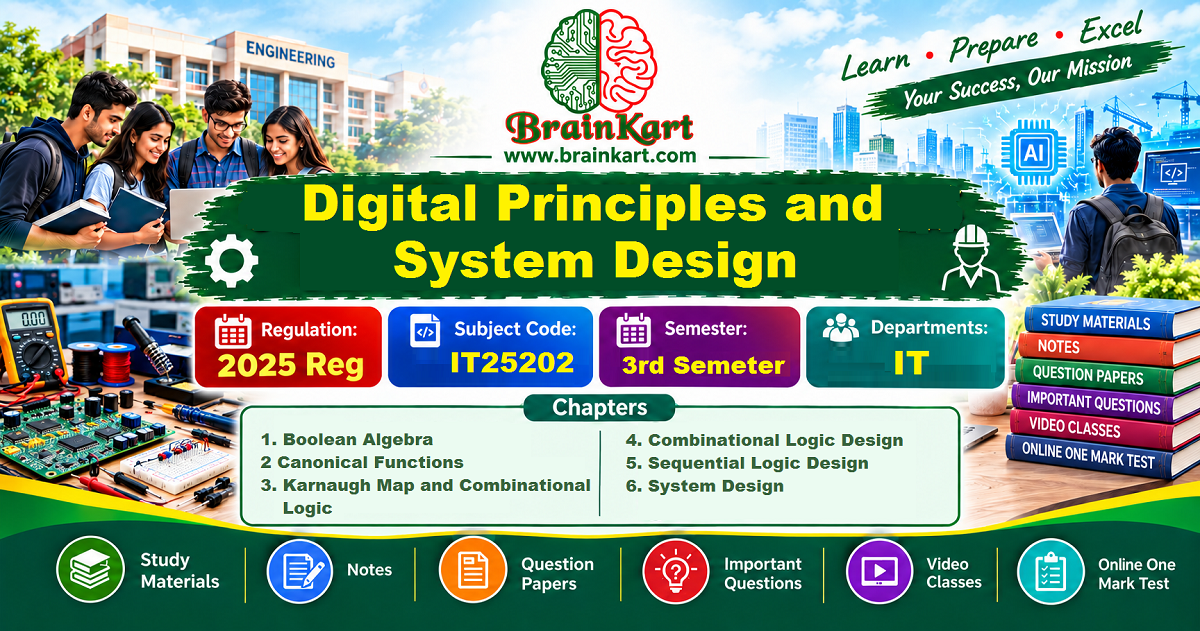
Digital Principles and System Design - IT25202
[ 2nd Semester - IT - Information Technology Department ]
Under Class: | 2nd Semester [IT Dept Anna University 2025 Regulation] |
Digital Principles and System Design - IT25202 - Study Materials, Notes, Important Questions, Anna University Semester Question Paper PDF Download
Engineering - Digital Principles and System Design - IT25202 Subject (under Anna University 2nd Semester - IT Information Technology Engineering Regulation 2025) - Study Materials, Written and lecture Notes, Important Questions, Semester Question Paper PDF Download
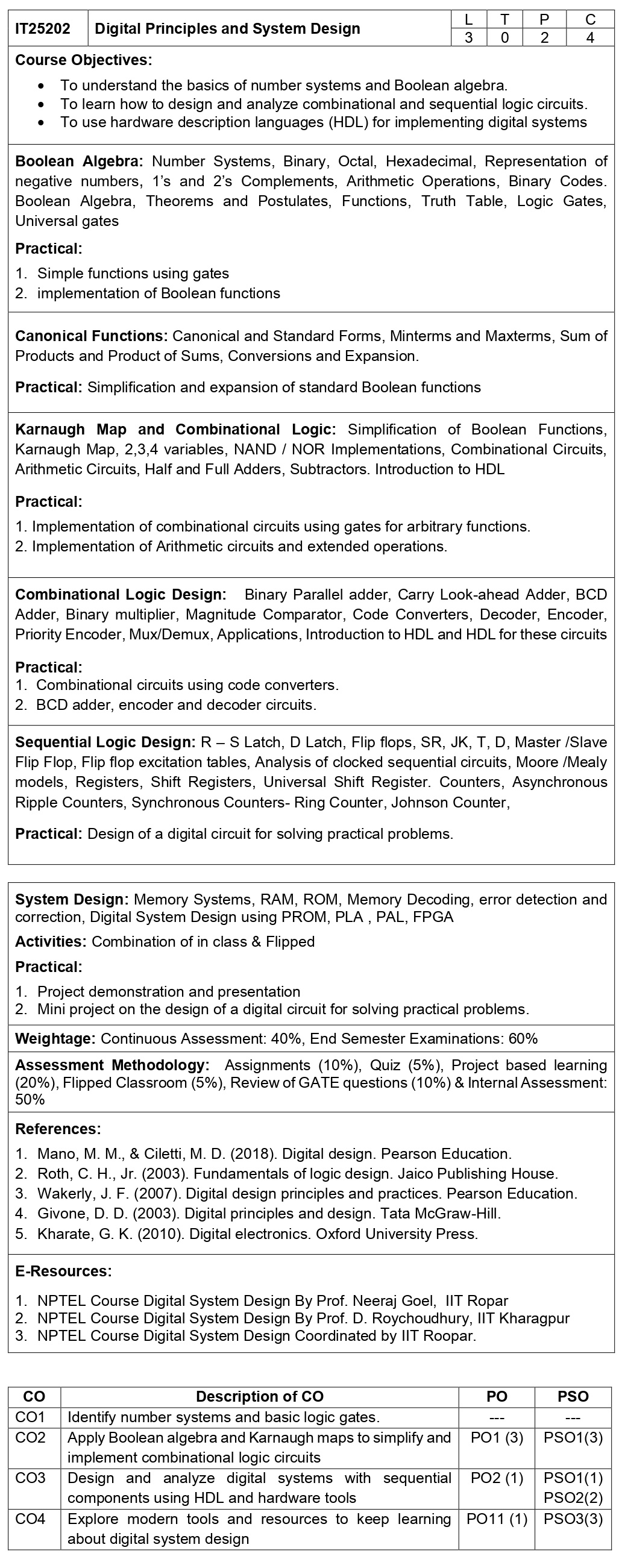
IT25202:
Digital
Principles and System Design
Course
Objectives:
•
To understand the basics of number systems and Boolean algebra.
•
To learn how to design and analyze combinational and sequential logic circuits.
•
To use hardware description languages (HDL) for implementing digital systems
Boolean
Algebra: Number Systems, Binary, Octal,
Hexadecimal, Representation of negative numbers, 1’s and 2’s Complements,
Arithmetic Operations, Binary Codes. Boolean Algebra, Theorems and Postulates,
Functions, Truth Table, Logic Gates, Universal gates
Practical:
1.
Simple functions using gates
2.
implementation of Boolean functions
Canonical
Functions: Canonical and Standard Forms, Minterms
and Maxterms, Sum of Products and Product of Sums, Conversions and Expansion.
Practical:
Simplification and expansion of standard Boolean functions
Karnaugh
Map and Combinational Logic: Simplification of
Boolean Functions, Karnaugh Map, 2,3,4 variables, NAND / NOR Implementations,
Combinational Circuits, Arithmetic Circuits, Half and Full Adders, Subtractors.
Introduction to HDL
Practical:
1.
Implementation of combinational circuits using gates for arbitrary functions.
2.
Implementation of Arithmetic circuits and extended operations.
Combinational
Logic Design:
Binary Parallel adder, Carry Look-ahead Adder, BCD Adder, Binary multiplier,
Magnitude Comparator, Code Converters, Decoder, Encoder, Priority Encoder,
Mux/Demux, Applications, Introduction to HDL and HDL for these circuits
Practical:
1.
Combinational circuits using code converters.
2.
BCD adder, encoder and decoder circuits.
Sequential
Logic Design: R – S Latch, D Latch, Flip flops, SR,
JK, T, D, Master /Slave Flip Flop, Flip flop excitation tables, Analysis of
clocked sequential circuits, Moore /Mealy models, Registers, Shift Registers,
Universal Shift Register. Counters, Asynchronous Ripple Counters, Synchronous
Counters- Ring Counter, Johnson Counter,
Practical:
Design of a digital circuit for solving practical problems.
System
Design: Memory Systems, RAM, ROM, Memory
Decoding, error detection and correction, Digital System Design using PROM, PLA
, PAL, FPGA
Activities:
Combination of in class & Flipped
Practical:
1.
Project demonstration and presentation
2.
Mini project on the design of a digital circuit for solving practical problems.
Weightage:
Continuous Assessment: 40%, End Semester Examinations: 60%
Assessment Methodology:
Assignments (10%), Quiz (5%), Project based learning (20%), Flipped Classroom
(5%), Review of GATE questions (10%) & Internal Assessment: 50%
References:
1.
Mano, M. M., & Ciletti, M. D. (2018). Digital design. Pearson Education.
2.
Roth, C. H., Jr. (2003). Fundamentals of logic design. Jaico Publishing House.
3.
Wakerly, J. F. (2007). Digital design principles and practices. Pearson
Education.
4.
Givone, D. D. (2003). Digital principles and design. Tata McGraw-Hill.
5.
Kharate, G. K. (2010). Digital electronics. Oxford University Press.