Digital Principles and Computer Organization - CS25C06
[ 2nd Semester - CSE,AIDS,CY Departments ]
Under Class: | 2nd Semester [CSE Dept Anna University 2025 Regulation] | | 2nd Semester [CSE(CY) Dept Anna University 2025 Regulation] | | 2nd Semester [AIDS Dept Anna University 2025 Regulation] |
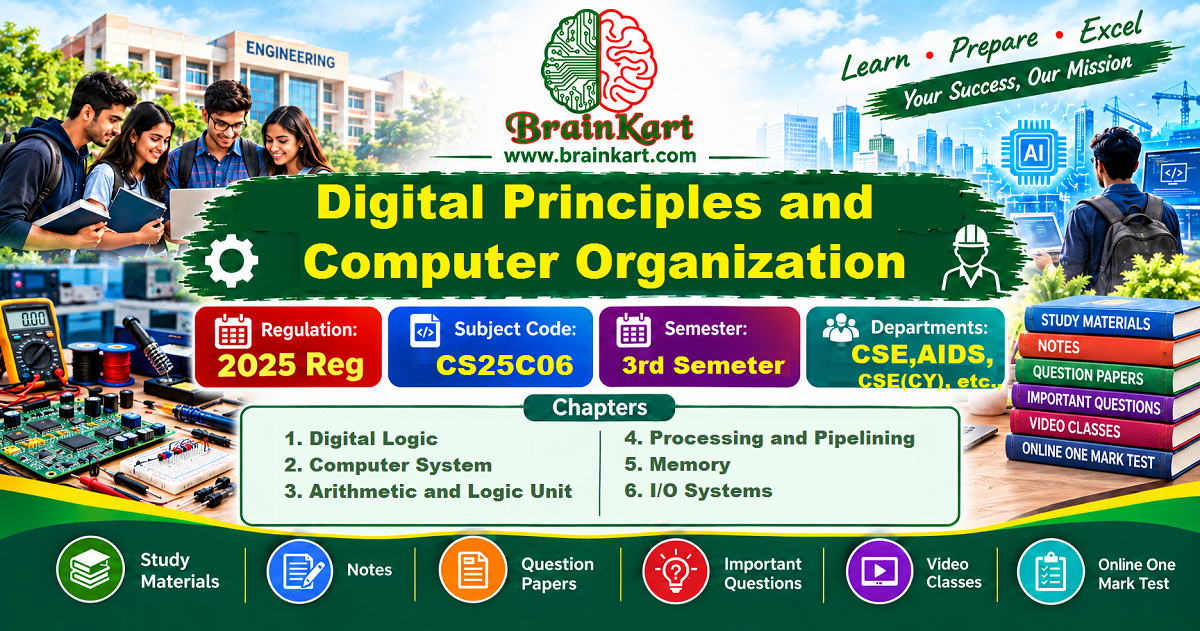
Digital Principles and Computer Organization - CS25C06 - Study Materials, Notes, Important Questions, Anna University Semester Question Paper PDF Download
Engineering - Digital Principles and Computer Organization - CS25C06 Subject (under Anna University 2nd Semester - CSE,AIDS,CY Departments Engineering Regulation 2025) - Study Materials, Written and lecture Notes, Important Questions, Semester Question Paper PDF Download
CS25C06:
Digital Principles and Computer Organization
Course
Objective:
•
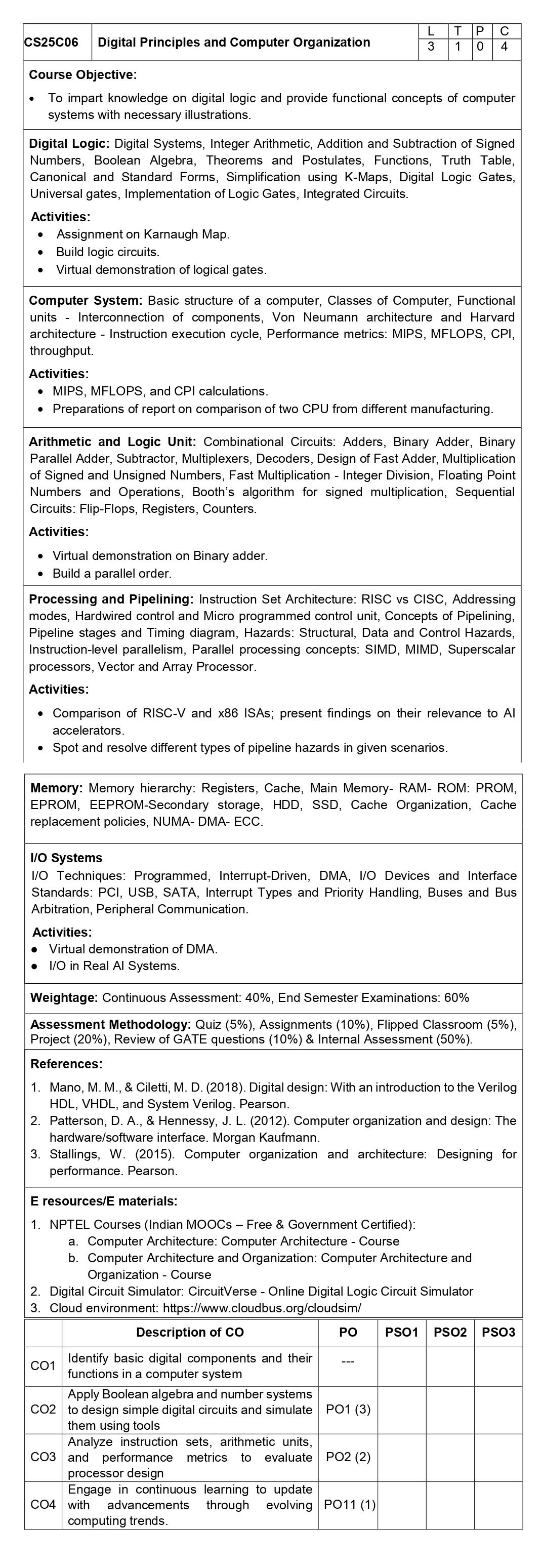
To impart knowledge on digital logic and provide functional concepts of
computer systems with necessary illustrations.
Digital
Logic: Digital Systems, Integer Arithmetic, Addition and
Subtraction of Signed Numbers, Boolean Algebra, Theorems and Postulates,
Functions, Truth Table, Canonical and Standard Forms, Simplification using
K-Maps, Digital Logic Gates, Universal gates, Implementation of Logic Gates,
Integrated Circuits.
Activities:
•Assignment
on Karnaugh Map.
•Build
logic circuits.
•Virtual
demonstration of logical gates.
Computer
System: Basic structure of a computer, Classes
of Computer, Functional units - Interconnection of components, Von Neumann
architecture and Harvard architecture - Instruction execution cycle,
Performance metrics: MIPS, MFLOPS, CPI, throughput.
Activities:
•
MIPS, MFLOPS, and CPI calculations.
•
Preparations of report on comparison of two CPU from different manufacturing.
Arithmetic
and Logic Unit: Combinational Circuits: Adders, Binary
Adder, Binary Parallel Adder, Subtractor, Multiplexers, Decoders, Design of
Fast Adder, Multiplication of Signed and Unsigned Numbers, Fast Multiplication
- Integer Division, Floating Point Numbers and Operations, Booth’s algorithm
for signed multiplication, Sequential Circuits: Flip-Flops, Registers,
Counters.
Activities:
•
Virtual demonstration on Binary adder.
•
Build a parallel order.
Processing
and Pipelining: Instruction Set Architecture: RISC vs
CISC, Addressing modes, Hardwired control and Micro programmed control unit,
Concepts of Pipelining, Pipeline stages and Timing diagram, Hazards:
Structural, Data and Control Hazards, Instruction-level parallelism, Parallel
processing concepts: SIMD, MIMD, Superscalar processors, Vector and Array
Processor.
Activities:
•
Comparison of RISC-V and x86 ISAs; present findings on their relevance to AI
accelerators.
•
Spot and resolve different types of pipeline hazards in given scenarios.
Memory:
Memory hierarchy: Registers, Cache, Main Memory- RAM- ROM: PROM, EPROM,
EEPROM-Secondary storage, HDD, SSD, Cache Organization, Cache replacement
policies, NUMA- DMA- ECC.
I/O
Systems
I/O
Techniques: Programmed, Interrupt-Driven, DMA, I/O Devices and Interface
Standards: PCI, USB, SATA, Interrupt Types and Priority Handling, Buses and Bus
Arbitration, Peripheral Communication.
Activities:
●
Virtual demonstration of DMA.
●
I/O in Real AI Systems.
Weightage:
Continuous Assessment: 40%, End Semester Examinations: 60%
Assessment Methodology: Quiz (5%), Assignments (10%), Flipped Classroom (5%), Project (20%), Review of GATE questions (10%) & Internal Assessment (50%).
References:
1.
Mano, M. M., & Ciletti, M. D. (2018). Digital design: With an introduction
to the Verilog HDL, VHDL, and System Verilog. Pearson.
2.
Patterson, D. A., & Hennessy, J. L. (2012). Computer organization and
design: The hardware/software interface. Morgan Kaufmann.
3.
Stallings, W. (2015). Computer organization and architecture: Designing for
performance. Pearson.
E resources/E
materials:
1.
NPTEL Courses (Indian MOOCs – Free & Government Certified):
a.
Computer Architecture: Computer Architecture - Course
b.
Computer Architecture and Organization: Computer Architecture and Organization
- Course
2.
Digital Circuit Simulator: CircuitVerse - Online Digital Logic Circuit
Simulator
3.
Cloud environment: https://www.cloudbus.org/cloudsim/