Digital Electronics - EE25301
[ 3rd Semester - EEE - Electrical and Electronics Engineering Department ]
Under Class: | 3rd Semester [EEE Dept Anna University 2025 Regulation] |
Digital Electronics - EE25301 - Study Materials, Notes, Important Questions, Anna University Semester Question Paper PDF Download
Engineering - Digital Electronics - EE25301 Subject (under Anna University 3rd Semester - EEE - Electrical and Electronics Engineering Department Regulation 2025) - Study Materials, Written and lecture Notes, Important Questions, Semester Question Paper PDF Download
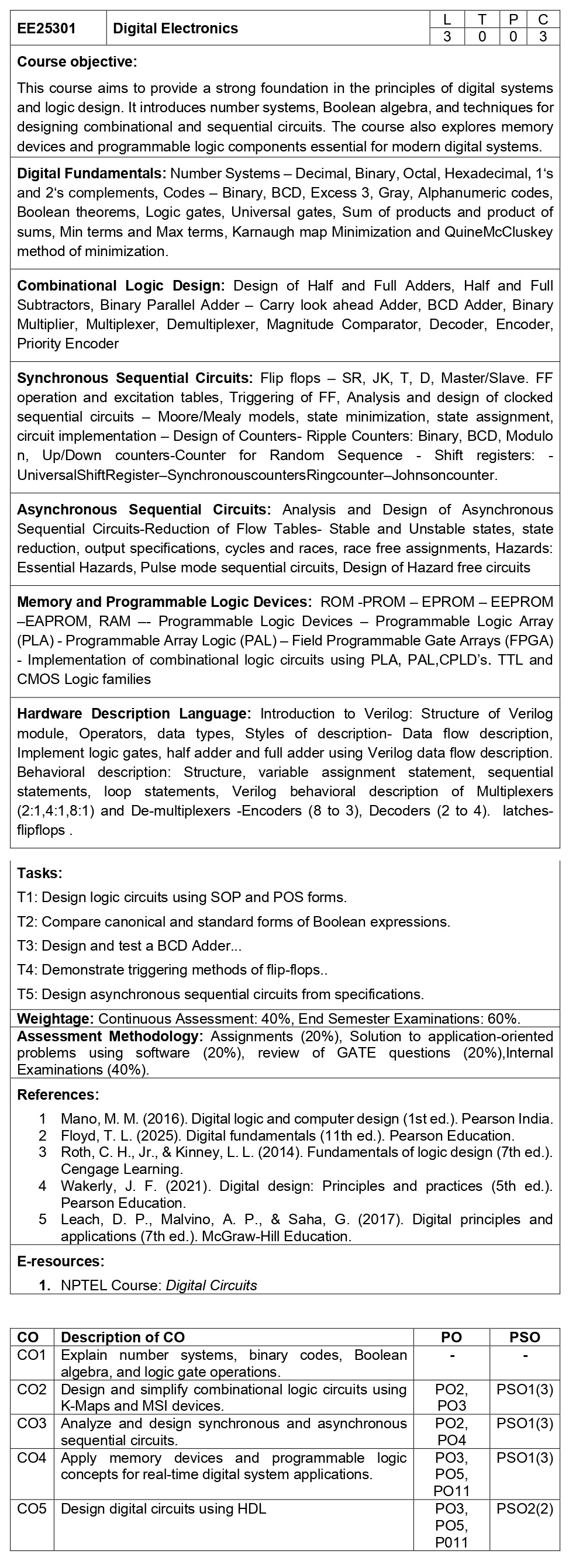
EE25301:
Digital Electronics
Course
objective:
This
course aims to provide a strong foundation in the principles of digital systems
and logic design. It introduces number systems, Boolean algebra, and techniques
for designing combinational and sequential circuits. The course also explores
memory devices and programmable logic components essential for modern digital
systems.
Digital
Fundamentals: Number Systems – Decimal, Binary,
Octal, Hexadecimal, 1‘s and 2‘s complements, Codes – Binary, BCD, Excess 3,
Gray, Alphanumeric codes, Boolean theorems, Logic gates, Universal gates, Sum
of products and product of sums, Min terms and Max terms, Karnaugh map
Minimization and QuineMcCluskey method of minimization.
Combinational
Logic Design: Design of Half and Full Adders, Half
and Full Subtractors, Binary Parallel Adder – Carry look ahead Adder, BCD
Adder, Binary Multiplier, Multiplexer, Demultiplexer, Magnitude Comparator,
Decoder, Encoder, Priority Encoder
Synchronous
Sequential Circuits: Flip flops – SR, JK, T, D,
Master/Slave. FF operation and excitation tables, Triggering of FF, Analysis
and design of clocked sequential circuits – Moore/Mealy models, state
minimization, state assignment, circuit implementation – Design of Counters-
Ripple Counters: Binary, BCD, Modulo n, Up/Down counters-Counter for Random
Sequence - Shift registers: -
UniversalShiftRegister–SynchronouscountersRingcounter–Johnsoncounter.
Asynchronous
Sequential Circuits: Analysis and Design of
Asynchronous Sequential Circuits-Reduction of Flow Tables- Stable and Unstable
states, state reduction, output specifications, cycles and races, race free
assignments, Hazards: Essential Hazards, Pulse mode sequential circuits, Design
of Hazard free circuits
Memory and Programmable Logic Devices: ROM -PROM – EPROM – EEPROM –EAPROM, RAM –- Programmable Logic Devices – Programmable Logic Array (PLA) - Programmable Array Logic (PAL) – Field Programmable Gate Arrays (FPGA) - Implementation of combinational logic circuits using PLA, PAL,CPLD’s. TTL and CMOS Logic families
Hardware
Description Language: Introduction to Verilog: Structure
of Verilog module, Operators, data types, Styles of description- Data flow
description, Implement logic gates, half adder and full adder using Verilog
data flow description. Behavioral description: Structure, variable assignment
statement, sequential statements, loop statements, Verilog behavioral
description of Multiplexers (2:1,4:1,8:1) and De-multiplexers -Encoders (8 to
3), Decoders (2 to 4). latches-flipflops .
Tasks:
T1:
Design logic circuits using SOP and POS forms.
T2:
Compare canonical and standard forms of Boolean expressions.
T3:
Design and test a BCD Adder...
T4:
Demonstrate triggering methods of flip-flops..
T5:
Design asynchronous sequential circuits from specifications.
Weightage:
Continuous Assessment: 40%, End Semester Examinations: 60%.
Assessment Methodology:
Assignments (20%), Solution to application-oriented
problems
using software(20%),review of GATE questions(20%),Internal Examinations (40%).
References:
1
Mano, M. M. (2016). Digital logic and computer design (1st ed.). Pearson India.
2
Floyd, T. L. (2025). Digital fundamentals (11th ed.). Pearson Education.
3
Roth, C. H., Jr., & Kinney, L. L. (2014). Fundamentals of logic design (7th
ed.). Cengage Learning.
4
Wakerly, J. F. (2021). Digital design: Principles and practices (5th ed.).
Pearson Education.
5
Leach, D. P., Malvino, A. P., & Saha, G. (2017). Digital principles and
applications (7th ed.). McGraw-Hill Education.