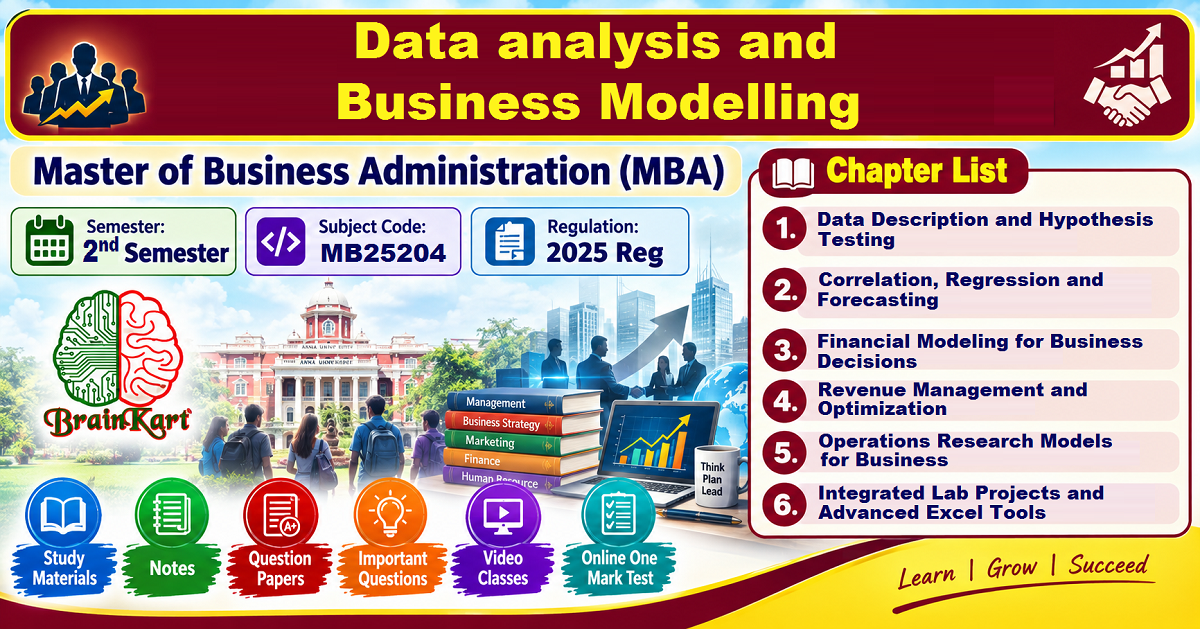
Data analysis and Business Modelling - MB25204
[ 2nd Semester - MBA - Master of Business Administration ]
Under Class: | 2nd Semester [MBA Dept Anna University 2025 Regulation] |
Data analysis and Business Modelling - MB25204 - Practical Manual, Experiments, Guide Study Materials PDF Download
Mba - Data analysis and Business Modelling - MB25204 Subject (under Anna University 2nd Semester - MBA - Master of Business Administration Regulation 2025) - Practical Manual, Experiments, Guide Study Materials PDF Download
MB25204:
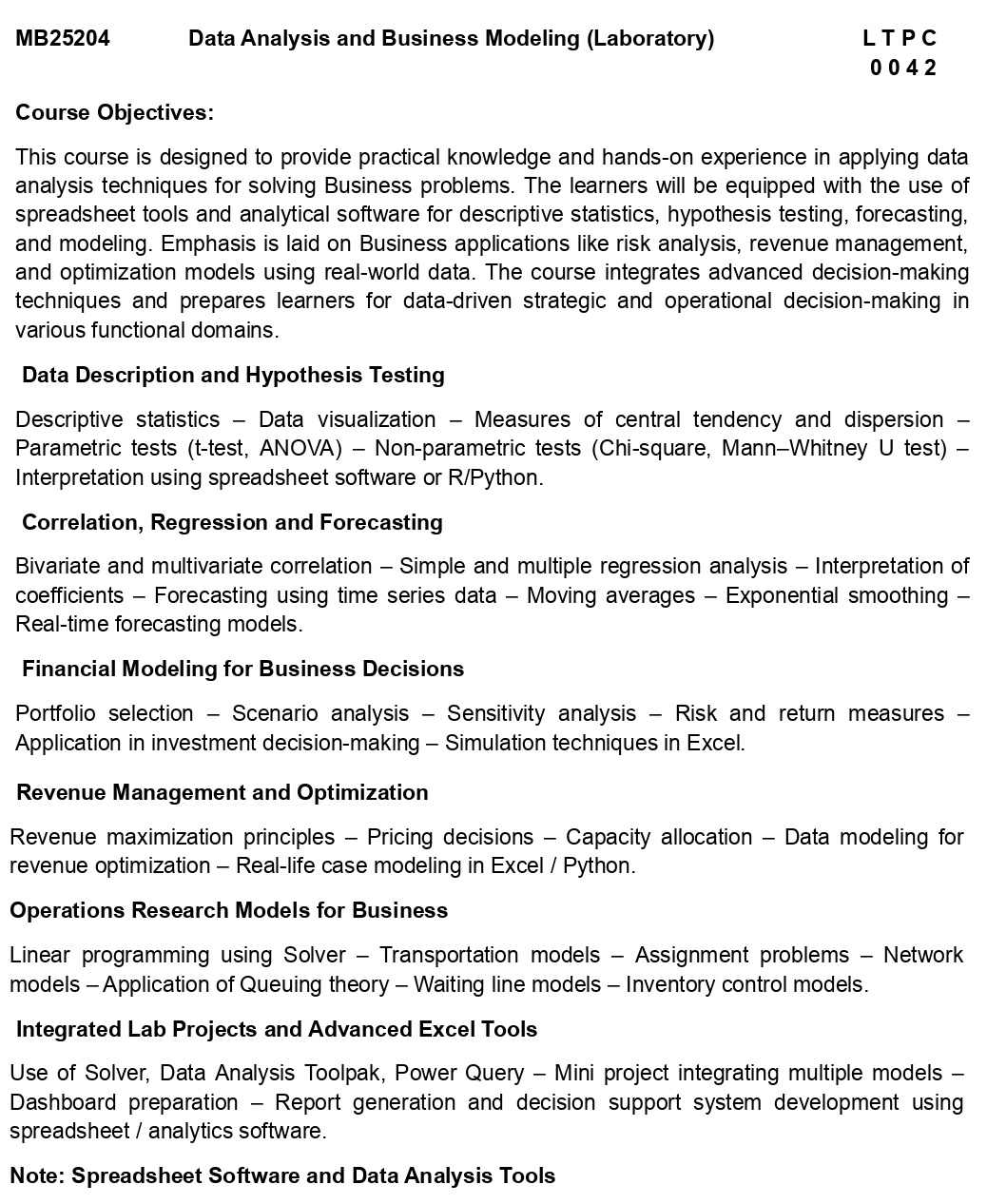
Data
Analysis and Business Modeling (Laboratory)
Course Objectives:
This
course is designed to provide practical knowledge and hands-on experience in
applying data analysis techniques for solving Business problems. The learners
will be equipped with the use of spreadsheet tools and analytical software for
descriptive statistics, hypothesis testing, forecasting, and modeling. Emphasis
is laid on Business applications like risk analysis, revenue management, and
optimization models using real-world data. The course integrates advanced
decision-making techniques and prepares learners for data-driven strategic and
operational decision-making in various functional domains.
Data
Description and Hypothesis Testing
Descriptive
statistics – Data visualization – Measures of central tendency and dispersion –
Parametric tests (t-test, ANOVA) – Non-parametric tests (Chi-square,
Mann–Whitney U test) – Interpretation using spreadsheet software or R/Python.
Correlation,
Regression and Forecasting
Bivariate
and multivariate correlation – Simple and multiple regression analysis –
Interpretation of coefficients – Forecasting using time series data – Moving
averages – Exponential smoothing – Real-time forecasting models.
Financial
Modeling for Business Decisions
Portfolio
selection – Scenario analysis – Sensitivity analysis – Risk and return measures
– Application in investment decision-making – Simulation techniques in Excel.
Revenue
Management and Optimization
Revenue
maximization principles – Pricing decisions – Capacity allocation – Data
modeling for revenue optimization – Real-life case modeling in Excel / Python.
Operations
Research Models for Business
Linear
programming using Solver – Transportation models – Assignment problems –
Network models – Application of Queuing theory – Waiting line models –
Inventory control models.
Integrated
Lab Projects and Advanced Excel Tools
Use
of Solver, Data Analysis Toolpak, Power Query – Mini project integrating
multiple models – Dashboard preparation – Report generation and decision
support system development using spreadsheet / analytics software.
Note: Spreadsheet Software and Data
Analysis Tools
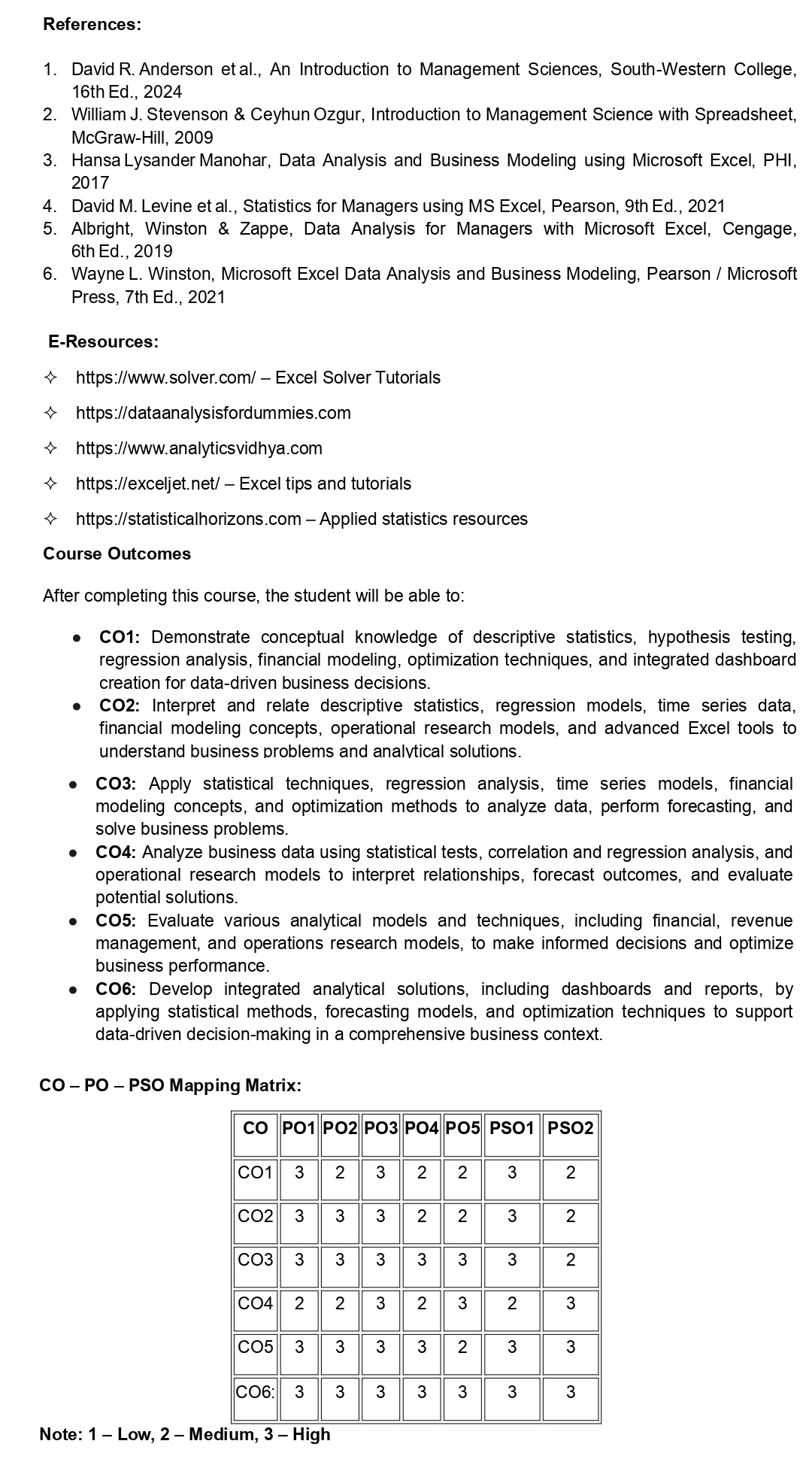
References:
1.
David R. Anderson et al., An Introduction to Management Sciences, South-Western
College, 16th Ed., 2024
2.
William J. Stevenson & Ceyhun Ozgur, Introduction to Management Science
with Spreadsheet, McGraw-Hill, 2009
3.
Hansa Lysander Manohar, Data Analysis and Business Modeling using Microsoft
Excel, PHI, 2017
4.
David M. Levine et al., Statistics for Managers using MS Excel, Pearson, 9th
Ed., 2021
5.
Albright, Winston & Zappe, Data Analysis for Managers with Microsoft Excel,
Cengage, 6th Ed., 2019
6.
Wayne L. Winston, Microsoft Excel Data Analysis and Business Modeling, Pearson
/ Microsoft Press, 7th Ed., 2021
Course
Outcomes
After completing this course, the student will be able to:
● CO1:
Demonstrate conceptual knowledge of descriptive statistics, hypothesis testing,
regression analysis, financial modeling, optimization techniques, and
integrated dashboard creation for data-driven business decisions.
●
CO2: Interpret and relate
descriptive statistics, regression models, time series data, financial modeling
concepts, operational research models, and advanced Excel tools to understand
business problems and analytical solutions.
● CO3:
Apply statistical techniques, regression analysis, time series models,
financial modeling concepts, and optimization methods to analyze data, perform
forecasting, and solve business problems.
● CO4:
Analyze business data using statistical tests, correlation and regression
analysis, and operational research models to interpret relationships, forecast
outcomes, and evaluate potential solutions.
● CO5:
Evaluate various analytical models and techniques, including financial, revenue
management, and operations research models, to make informed decisions and
optimize business performance.
●
CO6: Develop integrated analytical
solutions, including dashboards and reports, by applying statistical methods,
forecasting models, and optimization techniques to support data-driven
decision-making in a comprehensive business context.